Hay Shed
Three Bags FullThe Hay Shed is a familiar shelter at the center of the flock’s life on George Glenn’s pasture, but George’s death changes its meaning: the sheep retreat there together, and later scenes make it a place of warmth, memory, and watchfulness. Set beside the path through the fields and close to George’s caravan and vegetable garden, it belongs to a working landscape whose pastoral calm is repeatedly unsettled by violence, human ambition, and the sheep’s own discoveries.
Setting and Surroundings
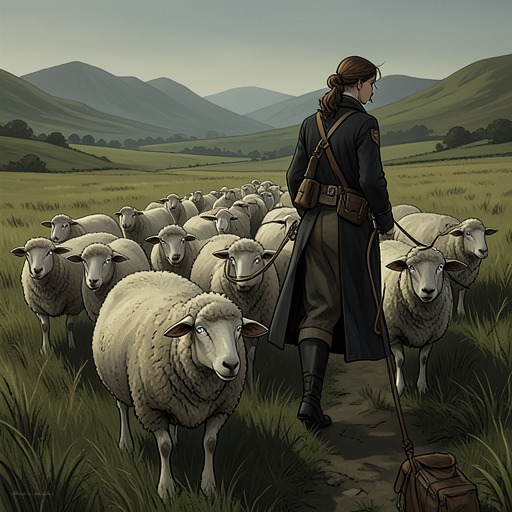
The Hay Shed stands in the green Irish pasture where George is found lying motionless, not far from the path through the fields. While the sheep hold a meeting near the cliff, a crow settles on George’s sweater and a rabbit sits nearby, making the shed’s proximity to the death scene part of an otherwise ordinary landscape. The narrative places the flock’s immediate response between two points: the body beside the shed and the meeting at the cliff edge.
George’s caravan stands behind the Hay Shed, with his fenced vegetable garden behind the caravan. The garden contains lettuces, peas, radishes, cress, tomatoes, endives, buttercups, and chives. After George’s death, the sheep take advantage of his absence: Lane pushes back the garden bolt, and several of the flock graze the beds bare. Their raid ends in silence and shame. The nearby shed, caravan, and garden thus form a small domestic and agricultural center within the pasture, where George’s rules had once organized the sheep’s access to food and space.
Shelter After George’s Death
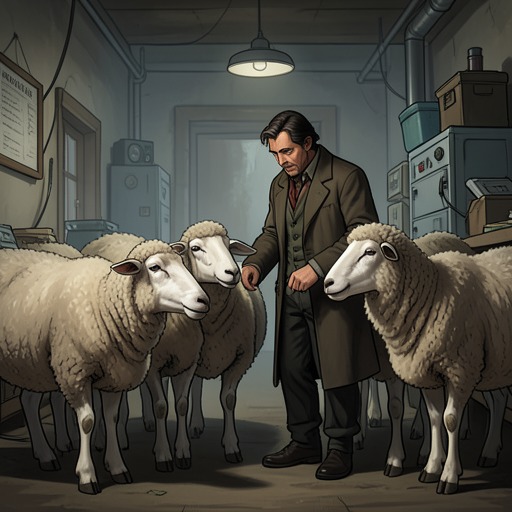
Soon after finding George, the sheep decide to enter the Hay Shed together. His death has made the interior seem gloomy and sinister, but staying together offers a refuge from the exposed pasture and the shock of what has happened. Miss Maple remains outside in the rain for a while, letting it wash the mud from her and eventually remove the last small bloodstain. When she joins the others, they have gathered around Othello, questioning him about his composure near the human who came down the path to examine the body.
The shed also shelters the flock when the weather makes the pasture difficult. On a windless day of thick gray mist, with visibility reduced to no more than two sheep’s lengths, the sheep remain inside for a long time because it is warm and comfortable. With George and Tess no longer driving them out into the early morning, they have become choosier about when to leave. The scene gives the shed a practical role, but also marks a change in the flock’s habits: without their shepherd and sheepdog, the sheep decide for themselves when the outside world is bearable.
Memory and the Life Around the Shed
The Hay Shed belongs to a broader landscape of shared routines rather than standing apart from them. George spends much of his time in the meadow, working in the vegetable garden or making repairs while the sheep graze. He arrives early, when they are still asleep together, and Tess has to drive them apart. Later, the sheep gather by the steps of the caravan, where George reads aloud. His books range from fairy tales and a book about sheep diseases to a detective story he abandons halfway through; most often, he reads romance stories and vents his anger at the red-haired women in them, especially his wife. The shed’s nearby position links it to this remembered pattern of work, feeding, and reading, though the reading itself takes place at the caravan.
After George dies, the Hay Shed becomes one of the places where the flock gathers to make sense of the altered pasture. It is not simply an enclosure against bad weather: entering it together gives the sheep a shared response to grief and uncertainty. Their later willingness to stay inside during the fog also contrasts with the earlier routine in which George and Tess determined the start of the day.
Exposure and Significance
The shed’s doorway also faces the vulnerability of the pasture to human intrusion. During a nighttime disturbance, white faces appear at its door as men in stocking masks approach. Maude has been uneasy about the scents in the air; she cannot smell the men from where she is, but detects a human smell descending from above and realizes that someone is lying on the dolmen’s capstone. The episode extends the shed’s role from shelter to a point within a watched and threatened landscape: danger is near, but its source is not confined to the ground around the flock.
Around the Hay Shed, the novel’s green, abundant pasture is never wholly secure or idyllic. George’s garden is protected by a fence and his watchfulness; after his death, the sheep consume it. Elsewhere on the same land, people discuss the value of George’s property and allege that his caravan was connected to nighttime boats and drug smuggling. Later, Gabriel uses George’s scythe to cut grass for his sheep, turning a familiar agricultural implement into an image of destructive power. These events do not all take place inside the shed, but they make its setting legible as a contested working landscape: a home for the flock, a place shaped by human labor and ownership, and ground on which the animals confront the consequences of both.