Heather’s marked circular chain pendant
Three Bags FullHeather’s marked circular chain pendant turns a small, baffling human object into a test of how the flock interprets evidence. Heather first treats its unbroken circular shape as a story with no ending; Miss Maple instead sees a possible link to George’s death and argues that the flock can follow human attachments to Things to find the murderer. The pendant’s importance lies not in any proven identification of its owner, but in the change it prompts: what Heather hid out of fascination becomes evidence Maple intends to keep.
Discovery and Concealment
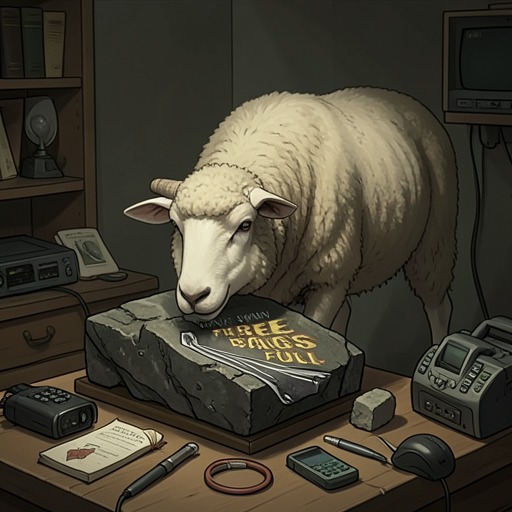
Heather found the pendant in the meadow soon after George’s death. Its shape caught her attention: it resembled a chain, but was shorter than Tess’s chain and formed a circle with no visible end. Heather wondered whether it might be not merely a Thing but a story, and the two signs on it strengthened that impression. She could look at its circular form for hours, imagining an endlessness that the other sheep did not share.
Rather than leave the object exposed, Heather rolled a stone over it to keep it safe. Later, while Sir Ritchfield was counting the sheep, she picked it up in her mouth and hid it beneath the dolmen. Her actions remained secret until she confessed. By then she was sorry and said she never wanted to see the object again. The episode separates her private fascination from any deliberate attempt to interfere with the flock’s investigation: the evidence establishes concealment and regret, not knowledge of the pendant’s owner or connection to the killing.
The Night Expedition
The flock decided to retrieve the object and dispose of it, returning it, in their understanding, to the world of Things, far from sheep. The assignment was unpopular. Several sheep made excuses, and the others were afraid to visit the dolmen at night after the wolf’s ghost had been seen there. The party that finally set out included Sir Ritchfield, Othello, Miss Maple, Maude, Zora, and Mopple the Whale. Mopple tried to evade the trip by pretending to be night-blind, even colliding with a post inside the barn, but his reputation as the memory sheep meant that he had to go.
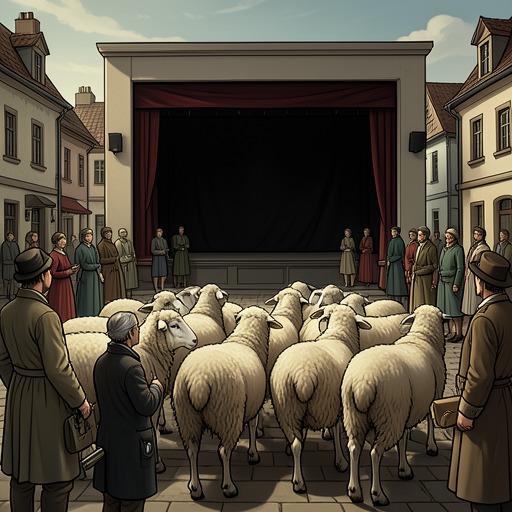
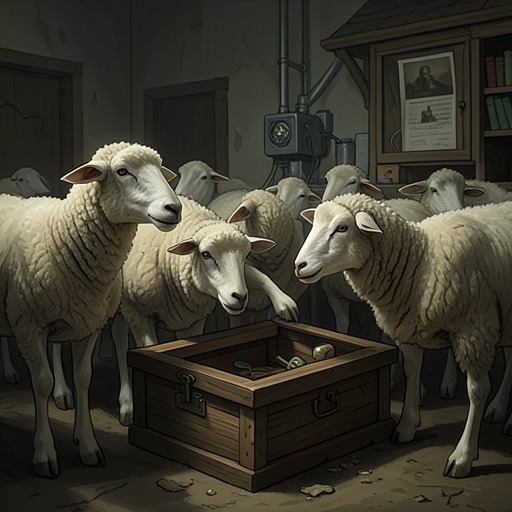
On a mild, warm, moonlit night, Sir Ritchfield led the party from the shepherd’s caravan toward the dolmen. The distance was visible from the caravan to the cliffs, although the tangy night smells dulled the sheep’s sense of smell. Maude waited outside, ready to detect any wolf ghosts, while the others bent beneath the dolmen’s capstone. Othello scraped away earth with his hooves. At first the sheep could not see what he had uncovered: their own shadows fell across the prehistoric tomb. They caught the smell of a sweaty hand and metal, with an additional sharp, nostril-tickling scent they could not identify. When Miss Maple persuaded Mopple to step back, a broad band of moonlight reached the pendant.
The object proved more ordinary than the sheep had expected. In the dust lay a thin chain with a piece of metal attached, its apparent endlessness explained by the fact that it formed a circle. The flock stared at it scornfully rather than finding the beauty or mystery some had anticipated. Sir Ritchfield, recovering his composure after losing his train of thought earlier, described the two marks: one seemed to him like an upward-pointing bird’s beak crossed by a line, the other like a stomach on two legs. He interpreted the second as a sign for one of the Two Legs and concluded that it was a bad sign. That is his reading of the marks, not a confirmed explanation of what they mean.
From Strange Thing to Evidence
The flock initially wanted to get rid of the pendant. Mopple would have been willing to touch it, but objected to burying it in case he later found himself grazing above it. Miss Maple broke with the group’s disposal plan: she said they should keep the object because it might be a clue. It had appeared after George’s death and might have been dropped by the murderer. Her suggestion does not establish that the pendant belonged to the killer; it changes the flock’s treatment of it from unwanted Thing to possible evidence.
Maple’s reasoning rests on her observation that human beings are attached to Things and that Things attach themselves to human beings. If the flock watches such objects closely, she argues, it may find the murderer. The pendant therefore matters as a possible point of contact between an unknown person and the meadow, rather than as proof in itself. Its human smell, metal, and marks make it legible to the sheep in fragments, while its ownership and purpose remain unresolved in these scenes.
Maple’s Use of the Pendant
After the encounter at the dolmen, the flock sees Miss Maple going toward the hay barn with the pendant in her mouth. When Cloud asks what she is doing, Maple explains that it is time to think about what to do once they have found the murderer. She enters the barn and emerges without the object, her eyes shining. The evidence shows that she has taken it into the barn and is pleased with what she is doing there, but does not specify where she puts it or what further use she makes of it.
The object’s trajectory—from meadow, beneath a stone, into Heather’s mouth, under the dolmen, and finally into Maple’s keeping—gives physical form to the flock’s changing method of inquiry. Heather reads the circle as an endless story; Sir Ritchfield reads its markings as ominous signs; Maple reads its presence after George’s death as a possible trace left by a human being. None of those interpretations conclusively identifies its owner. Its decisive narrative role is instead to make the sheep reconsider whether Things are only foreign objects to be rejected, or material traces that might lead them toward the truth.