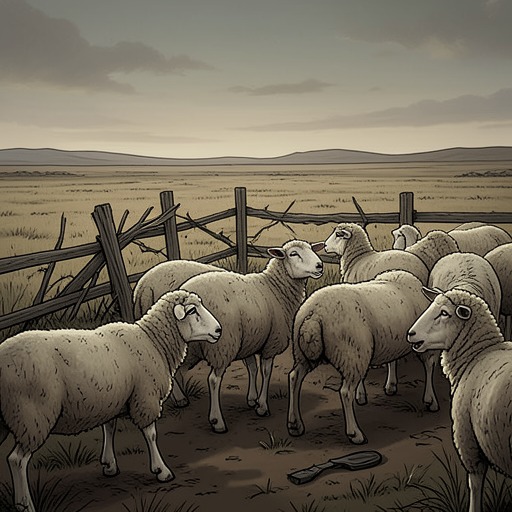
Herd yourselves; do not let yourselves be driven
Three Bags FullHerd yourselves; do not let yourselves be driven is Melmoth’s practical rule for resisting fear and control. He teaches the flock that being herded is not simply an unavoidable instinct: they can learn to direct themselves. The lesson culminates in a later choice with real consequences, when the sheep rally around Rebecca rather than passively accepting Gabriel as their shepherd.
Learning to Pay Attention
The lesson grows out of Melmoth’s training in attention. The sheep learn faster than they understand, and watching closely leaves them less time to feel afraid. But concentration is not an effortless cure: during a mock attack, Mopple the Whale is so intent on paying attention that he forgets to swerve and is run down; Heather chokes while grazing after swallowing the wrong way. These mishaps make the training physical and imperfect, not an abstract instruction to be brave.
The Practice of Self-Herding
As evening comes on, Melmoth teaches the flock not to let themselves be herded. Lane objects that being driven happens automatically, as though it were in their legs. Melmoth counters that others can herd them because they have not learned to herd themselves. His instruction is not to abandon the flock, but to take responsibility for its movement rather than yield that responsibility to a dog or another external force. The sheep practice until twilight. Melmoth takes the role of sheepdog, circling them in frantic mock attacks, feints, and sudden withdrawals; their task is to stand still. Some run away by instinct, while others exhaust themselves holding their ground. The exercise turns the rule into a repeated bodily choice: not every apparent threat has to dictate the flock’s response, although resisting that impulse takes effort.
From Training to Choice
The rule gains a public and practical echo when the lawyer reads George Glenn’s will. George leaves his fortune to the sheep so they can go to Europe as promised, but the animals need an authorized representative to accompany them as shepherd. The will sets out that representative’s rights and duties, including a requirement to read stories to the sheep for at least half an hour each day. The lawyer is to administer the money and check that the conditions are met, so the journey depends on both legal oversight and the flock’s choice of who will lead it. The people of Glennkill look toward Gabriel, who stands beside the lawyer, and none challenges him. The sheep compare the silence to the way no one disputes a lead ram once he has taken something on. Then Rebecca volunteers. Her choice changes the question from who appears to have assumed authority to who is willing to undertake the role, and the sheep are relieved: they would not have wanted to go to Europe with Gabriel.
What the Rule Makes Possible
Gabriel’s soft Gaelic murmuring still has charm, but it does not determine the flock’s decision. Othello steps forward with the sheep close behind, looks briefly at Gabriel, then turns and trots to Rebecca. One by one, the sheep cluster around her, and Maude calls her name. Their response makes the earlier lesson legible in a new setting: the flock does not merely endure someone else’s direction but acts together to indicate whom it will follow. The rule is therefore not a rejection of shepherds or collective life. The will requires a shepherd, and the sheep choose one; what matters is that their allegiance is expressed through their own action rather than imposed by the person already standing beside the lawyer. Melmoth’s drill, in which the sheep learn to hold their ground under pressure, and their gathering around Rebecca show two forms of the same principle: a flock can remain a flock while exercising judgment about when to resist and whom to follow.