Josh Baxter
Three Bags FullJosh Baxter is the landlord of the Mad Boar and a slender, initially unfamiliar figure in the sheep’s investigation of George’s death. He matters not because the evidence establishes him as the killer, but because he appears at the discovery of George’s body, later helps direct an attempt to open George’s caravan, and knows that someone else may be searching for the same hidden object. Each appearance adds information without resolving what he knows or whom he trusts.
Identity and First Appearance
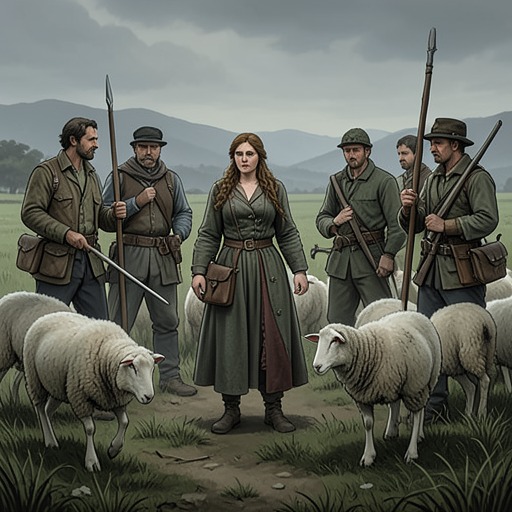
When a group of humans runs along the path from the village, the sheep notice that its leader is a very thin man they do not recognize. Their attention to him reflects the importance they attach to whoever leads a human group. The scene gives them no name or explanation for his arrival; he is first registered as a stranger among people moving toward the meadow.
Othello later supplies the identification. The thin man who came with three others and found George is Josh Baxter, the pub landlord. Josh was with Lilly, Ham, and Gabriel, and was the first human to examine George’s body. That role places him at the beginning of the human response to the death, but the evidence does not describe what he did at the scene beyond being the first to examine the body. His significance begins in this gap between a definite presence and an incomplete account.
Witness and Uncertain Clue
Josh is also among the four people whom Sir Ritchfield saw leaving with Gabriel, Lilly, and the butcher. Sir Ritchfield observed one of the four lag behind and bend over, perhaps to pick something up, put something down, or tear up a tuft of grass. He sneezed five times, however, and afterward could no longer remember which person had bent down or what they had held. The sighting therefore supplies a possible clue but does not identify Josh as the person who stopped. Treating him as the culprit would turn an explicitly forgotten detail into a certainty the account withholds.
The uncertainty is important to the way Josh functions in the mystery. He is visible in a group whose movements invite suspicion, while the one potentially revealing gesture remains detached from any individual. The sheep must weigh what they have actually seen against what they can only guess. Josh’s presence makes him relevant to their inquiry; it does not settle the meaning of the group’s departure or the identity of the person who bent down.
The Attempt to Open the Caravan
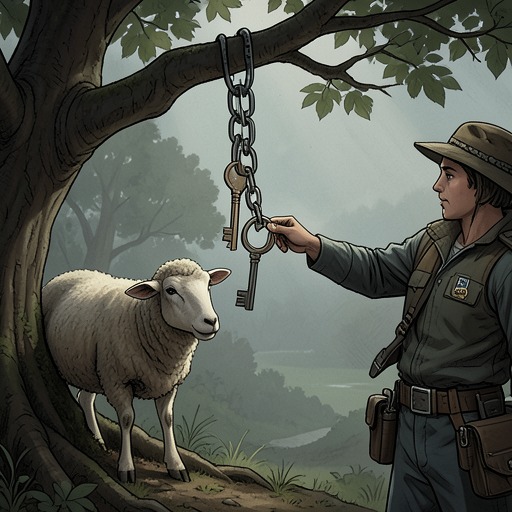
Later, the sheep hear Tom O’Malley, Harry the Sinner, and a third man approach George’s caravan at night. Tom frames their purpose as doing what must be done for Glennkill, but Josh dismisses that appeal and presses the group to stop talking and try the van. Keys rattle for a long time; Harry reports that the key does not fit. The scene connects Josh to an effort to enter the caravan and search for its contents, while showing that the attempt fails.
The sheep recognize Josh when he arrives by bicycle to meet Gabriel at the caravan. They recall him as the tall, thin man who had pressed his nose against its windows the previous night. His arrival brings their attention back to the failed entry, but he does not initially explain the keys to them. Instead, he speaks privately with Gabriel, whose calm attention seems to make him more willing to talk. The exchange reveals a more deliberate role than simply accompanying Tom and Harry.
What Josh Admits to Gabriel
Josh tells Gabriel that Tom and Harry would have gone to the caravan regardless. In his account, they wanted to find the grass, avoid a scandal, and preserve the tourist trade, but he insists that this was not the whole matter. He says he went along because he would rather be present than absent. The explanation makes his participation both protective and self-interested: he accompanies the men, yet also wants to keep watch over what happens.
He then admits that he gave them a wrong key so that they would not bring tools, while ensuring that they could not get in. This is a concrete act of obstruction, not merely a suspicion inferred from his being nearby. It complicates his role: Josh helps the search party reach the caravan, but frustrates its attempt to open it. His stated reasoning does not establish what he hopes to find or prevent others from finding, and the distinction between managing the search and sharing its goal remains unresolved.
Josh adds that the group was not alone. He says there was another person around, a stranger he suspects belonged to the drug people, and warns that the stranger might find the object before they do. His phrasing indicates that he regards the search as a contest with an outside party, not just an effort to avert local embarrassment. Yet the stranger’s identity and the object’s nature remain unconfirmed in this exchange. Josh provides the sheep with a wider possibility, not a solution.
Role in the Mystery
Josh’s appearances form a chain of partial disclosures: he is first a nameless leader, then the landlord identified among those who found George, then a member of the group leaving the scene, and finally the man who deliberately sabotaged a nighttime attempt to open the caravan. His knowledge grows clearer when he speaks to Gabriel, but never complete. The evidence leaves his actions open to more than one reading: he takes part in the search, controls its access to the van, and fears that an unknown rival may reach the sought-after object first.
This mixture makes Josh a source of both evidence and further uncertainty for the sheep. The forgotten movement near the grass cannot be assigned to him, and his admission about the wrong key does not reveal the full purpose of the search. He is neither merely a bystander nor, on the supplied facts, an identified criminal. His narrative importance lies in how he connects George’s death to the caravan and to a broader, still-unexplained competition over what it contains.