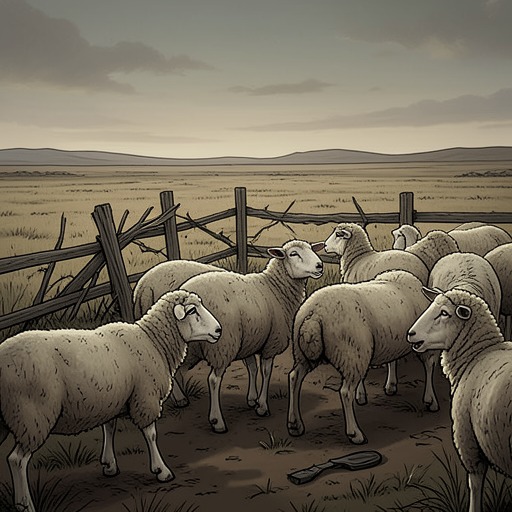
Justice!
Three Bags Full“Justice!” is the flock’s recurring cry after George Glenn is found dead, and its significance changes as the sheep try to understand what justice can mean. First a declaration that George’s killing must not go unanswered, the word becomes a contested principle, a renewed collective commitment, and finally a purpose that drives the sheep toward public action. It does not solve the murder by itself; it gives the flock a way to insist that the truth must be known.
The cry begins
The word enters the investigation through Othello. When the sheep discover George lying beside the hay barn, a spade in his body, Miss Maple argues that they owe their shepherd an inquiry: he had searched for the culprit when a fierce dog took one of their lambs. Othello identifies the act as human violence and calls for justice. The others join him, and the decision that George’s sheep will investigate his murder takes shape as a chorus rather than as a command from a human authority.
That first agreement is emotional as well as practical. George had protected the flock, and his death leaves the sheep without a shepherd or sheepdog. The word answers their alarm by giving it a direction: find the person responsible. Yet the flock does not have a settled account of what justice requires. Its shared cry precedes its shared understanding.
Othello’s definition and its challenge
For Othello, justice is closely bound to freedom of movement and choice. He explains it as being able to go where one likes, graze where one wants, and fight to keep one’s own way from being stolen. This definition draws on his own history: after the clown’s dog dies, Othello is sold to a knacker and taken to dogfights. He regards the dog’s death as just, but his own sale and forced participation in violence as unjust. His conception is not abstract law; it grows from the contrast between a life freely chosen and one taken away.
Othello applies that principle to George, insisting that someone stole George’s way to Europe. The Winter Lamb immediately complicates the claim: what if George had tried to steal someone else’s way? Othello replies that George would never have done so, while the lamb suggests that deprivation can make people take what is not offered to them. Their exchange makes the flock’s slogan morally less simple. A demand for justice must consider not only who suffered, but also what each person did and what circumstances shaped the act.
The dispute also exposes how much the sheep do not know. Othello is certain that George’s path was taken from him, but certainty is not proof of what happened. His cry can express loyalty to George and a desire for fairness while still leaving the murder’s circumstances unresolved. The word names the flock’s purpose, not a completed judgment.
When the flock falls silent
The first chorus does not hold. Later, when the others turn away from the investigation, Othello calls for justice beneath the crows’ tree. Only Miss Maple answers him. The rest resume grazing, defiantly presenting ordinary, untroubled sheep life as an alternative to the difficult work of inquiry. Othello continues to repeat the word quietly to himself. The contrast shows that the slogan can survive as an individual conviction even when the group no longer acts on it.
The cry returns with force when the will promises the flock a journey to Europe. The sheep rejoice at the prospect, and Othello is delighted that he can use the flock-leading skills George taught him. But the celebration falters when he realizes that the will has not revealed who murdered George. Heather argues that the killer will remain behind and is no longer dangerous; Mopple the Whale says the murder should still come to light. Zora makes the connection explicit: George was their shepherd, and they should discover the truth before leaving. The flock answers together again. This time, justice is not only a response to the loss of George; it is a duty the sheep choose to carry with them, even when another future is opening before them.
From accusation to disclosure
The word changes again when the flock confronts the possibility that Beth is responsible for George’s death. After Miss Maple concludes that Beth has not taken George’s soul, the Winter Lamb breaks the silence with a cry for justice, and Othello and the other sheep join him. But the next question is what justice should mean in this case. Cloud suggests that Beth should die because George is dead. Miss Maple rejects the idea that the flock can achieve justice by frightening Beth with a performance of sheep illness. Instead, she argues that the truth must get out of the sheep’s heads and become known to humans.
That shift matters. The flock’s earlier response focused on identifying a culprit; now its aim is to make the hidden account public. The obstacle is not simply that humans have failed to understand the sheep. Miss Maple recognizes that they will not pay attention to them unless something draws their attention. Justice therefore becomes a problem of communication as well as morality: the sheep must find a way to make their knowledge visible to a human audience.
A public purpose
The sheep carry that purpose onto a platform before an expectant audience. Miss Maple reminds them to do what they have discussed and to remember what Melmoth taught them. The flock has come there to make justice get out at last. A bang and a slamming door disrupt the hall, and the people turn in surprise. The scene presents the sheep’s public action as the culmination of the repeated cry, not as proof that the audience has already understood the truth or that the murder has been formally resolved.
Across these recurrences, “Justice!” works as a refrain that binds the flock through disagreement and hesitation. It begins in outrage at the spade in George’s body, acquires a definition through Othello’s concern for freedom, is tested by the Winter Lamb’s questions about responsibility, and returns when the promise of Europe threatens to eclipse the unresolved murder. By the time the sheep take the platform, the word has become a demand for disclosure: George’s death must not remain a story known only to the flock.