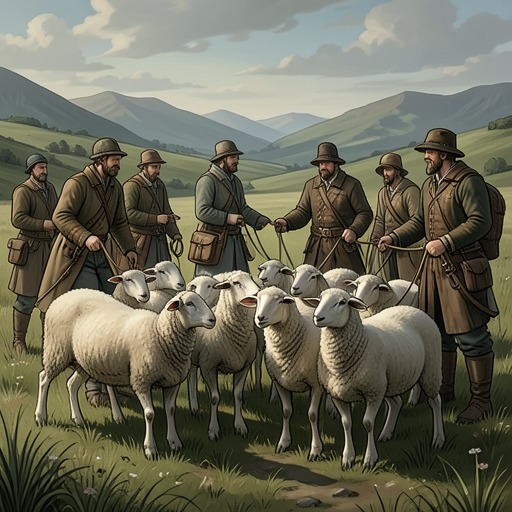
Lane
Three Bags FullLane is a quick-moving, pragmatic member of George Glenn’s flock whose attentiveness makes her useful both in daily life and in moments of uncertainty. She notices what happens around the meadow, recalls the mysterious visitors who came to George’s caravan at night, and acts when another sheep needs help. Her role is not that of a solitary detective or a leader, but of an observant participant whose speed and practical judgment help the flock respond to events.
Identity and Place in the Flock
Lane is explicitly described as the fastest sheep in the flock, and another sheep considers her more pragmatic than any of the others. These qualities are complementary: she can move quickly when action is needed, but she is also inclined to weigh what is possible rather than follow fear or speculation. When the flock is gathered near the cliff after George’s death, she is one of its members confronting the absence of the shepherd and the question of what to do next.
Her attention is not limited to danger or investigation. Lane asks what a Last Will and Testament is, a question that exposes how unfamiliar human legal arrangements are to the sheep. Later, during the legal proceedings over George’s estate and the flock’s future, she interjects a practical need: calcium tablets. The contrast is characteristic of her place in the story. Human beings discuss money, representation, and travel to Europe; Lane’s contribution brings the conversation back to the bodily requirements of sheep.
Observation and the Mystery Around George
Before George’s death, Lane had watched strange humans visit him at night. She slept lightly enough to hear car tires leave the paved road and turn onto the path through the fields. Sometimes she hid in the shadow of the dolmen to observe. In her account, the cars’ lights cut through the darkness or glowed in the mist, and dark-coated figures approached George’s caravan cautiously, taking care not to step on sheep droppings before knocking at its wooden door. The visitors were therefore not simply a rumor to her: Lane had repeatedly seen the nighttime pattern, though she did not know what the visitors wanted.
After George is found dead, that remembered traffic gives the flock another possible line of inquiry. Lane’s observations connect the peaceful-looking pasture to a concealed human world of cars, secret meetings, and possible motives. She also hears a human discuss George’s poverty, his refusal to sell, the valuable view, and the danger that Glennkill might become associated with the drug trade. Lane does not solve the murder from this information. Indeed, she voices the flock’s discouragement about finding the murderer. Her importance lies in helping make the surrounding circumstances visible while acknowledging the limits of what the sheep can infer.
The investigation also brings Lane into contact with frightening stories about supernatural or animal threats. When the possibility arises that the wolf’s apparition might actually have been one of the Devil’s hounds, she shudders and considers the implication: even humans fear such hounds. Her response shows a mind willing to test one explanation against another, but not immune to fear. Practical judgment does not make her fearless; it gives her a way to act despite uncertainty.
Initiative, Speed, and Cooperation
Lane’s pragmatism is especially clear when Miss Maple decides to go into the village to listen to a conversation between Beth and a red-haired woman. Miss Maple refuses to make the attempt alone and summons a small group of the flock’s bravest members: Zora, Othello, Lane, Cloud, and Mopple the Whale. Lane is included because she is regarded as sensible, and the plan depends on the sheep cooperating rather than on one animal acting as a hero. Her participation belongs to a collective investigation, not to a claim that she can understand the human conversation in advance.
Elsewhere, when Sir Ritchfield’s memory is failing, the flock devises an elaborate shared effort to make a memory large enough to fill the gap. Lane is among the sheep involved in this plan. The episode reflects the flock’s tendency to answer an individual’s difficulty through coordinated action: different sheep are drawn in, including Zora and Mopple the Whale, while Othello firmly refuses to take part. Lane’s presence fits her broader function as a dependable member of the group, one whose practical temperament can support a plan without becoming its center.
Her speed becomes a more direct service when she is told to run and find Melmoth. Later, Lane stands atop the cliffs, her eyes shining with admiration as she looks dreamily into the night. The scene places the fastest sheep in a moment of stillness: quickness is part of her identity, but the narrative does not reduce her to a messenger or a useful pair of legs. She can also pause and look outward, among the sheep gathered in the landscape that shapes their lives.
The Pasture, Its Goods, and Its Restrictions
Lane takes part in the flock’s first response to George’s death by helping open the vegetable garden behind the hay barn. The garden had been fenced off even though it stood in the meadow, and George’s watchfulness had prevented the sheep from eating its produce. After he is gone, Lane pushes back the bolt with her muzzle. Maude eats the buttercups, Cloud takes the peas, and Heather the tomatoes; within minutes the carefully planted beds are gone. Lane’s action is both a small practical accomplishment and a sharp change in ownership as the sheep experience it: the fence had been no real obstacle, but George’s presence had made the garden forbidden.
The episode gives the pastoral setting an edge. The meadow contains grass and cultivated food, but access to that abundance has been controlled. The sheep’s sudden harvest is not a planned act of farming; it is an immediate response to a boundary whose human enforcer has disappeared. Later, Gabriel uses a scythe to cut grass for his flock, beginning to graze on the side of the hill facing away from the sea. Against that image of deliberate cutting and provision, Lane’s garden episode belongs to the flock’s less controlled, opportunistic use of what grows around them.
The Flock’s Future
At the reading of George’s will, the sheep learn that the estate includes a substantial sum of money and that they will need an authorized representative to accompany them to Europe as their shepherd. The lawyer says that the representative’s rights and duties are set out in the will and that a third party will check the conditions. His smooth disappointment when he asks whether there is no one else underscores the human procedure’s uncertainty about who will represent the animals. The flock’s choice supplies an answer: Othello steps forward, looks at Gabriel, then trots to Rebecca, and the sheep gather around her one by one.
Lane’s mention of calcium tablets punctures the abstraction of the proceedings without undoing their stakes. The will concerns the sheep’s care, money, and destination, but their future still depends on concrete needs and on whom they will follow. Lane is part of the flock that makes its choice; the evidence does not assign her a separate ending or a private resolution. Her significance instead emerges cumulatively, through what she notices, the errands she undertakes, the boundary she opens, and the grounded observations she brings into a story whose apparent pastoral calm repeatedly gives way to questions of violence, property, and survival.