Melmoth’s solitary wandering
Three Bags FullMelmoth’s solitary wandering is not simply a journey between pastures but the lasting condition of a sheep who has passed through many flocks without feeling part of them. The book sets his wide-ranging life against the security of belonging: he teaches Othello how to observe and endure, yet leaves him behind at the circus, and later refuses George’s attempt to lead him home. His travels continue, but the distance between wandering and return remains unresolved.
A life among flocks, but apart
Melmoth’s history reaches back to a rainy night at the circus. Othello, still behind bars, watched the old ram gallop past the rows of tents while a cruel clown lay in the mud calling for a light. The encounter became a lasting point of reference for Othello, who knew he must find Melmoth again. By the time their paths crossed in Glennkill, years had passed. Othello had searched for him, but Melmoth had also found Othello, and their reunion was not the uncomplicated homecoming Othello might have imagined.
Before that separation, Melmoth had been Othello’s teacher. He taught him patience and how to observe fire, water, and a snail’s slimy trail; he also showed him how to watch his thoughts and drive rage and fear away. His voice, Othello remembered, had accompanied him and saved his life more than once. These lessons made Melmoth’s absence consequential: Othello had carried his mentor with him, but had also been left alone with the clown. The teaching and the abandonment belong to the same relationship, without the narrative supplying an explanation that would cancel either fact.
Melmoth’s own account of his travels stretches from hills and dales to salty beaches, shimmering rivers, and mist-covered mountains where wild goats graze in Wicklow. He passes through flock after flock, which he imagines as countless and distinct, like snowflakes, and continues all the way to the North Sea, where the world seems to end. The scale of this route gives his life a breadth that the settled flock’s pasture cannot contain. Yet movement does not amount to companionship: he describes following life as it winds onward, while Othello later understands that Melmoth has been alone in his heart even when surrounded by other sheep.
The rule against return
The force of Melmoth’s wandering becomes clearest when George tries to call him back. George uses the friendly voice with which he would tempt a sheep with a piece of mangel-wurzel, but Melmoth can scent that no piece is there. He still wants to go with George, back to the flock. Desire, however, does not decide the matter. Melmoth remembers the butcher’s rule: once a sheep is out, it is out for good. He concludes that he must remain alone.
George comes closer and takes Melmoth by his young horns in the familiar, friendly manner he had used before. This time Melmoth resists with a force he has never shown in any earlier struggle. The episode turns the idea of return into a physical conflict: George’s familiar gesture offers a route back to human care and the flock, while Melmoth’s resistance enacts the rule he believes has closed that route. The evidence does not make the rule a choice he freely welcomes; it shows him wanting to return and believing that return is forbidden.
Othello’s changed understanding
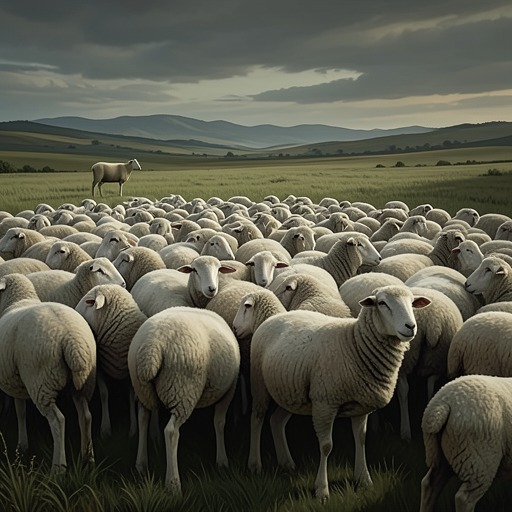
When Melmoth reappears among the sheep, Othello hides from him rather than running to greet him. He cannot decide what to do with the reunion. Melmoth knows he is there, yet leaves him alone, and Othello fears that this means he is only one sheep among countless others in a faceless flock. That possibility hurts more than the other explanations he considers. His response reveals the cost of their unresolved bond: the teacher Othello has sought is present, but neither recognition nor closeness is immediately assured.
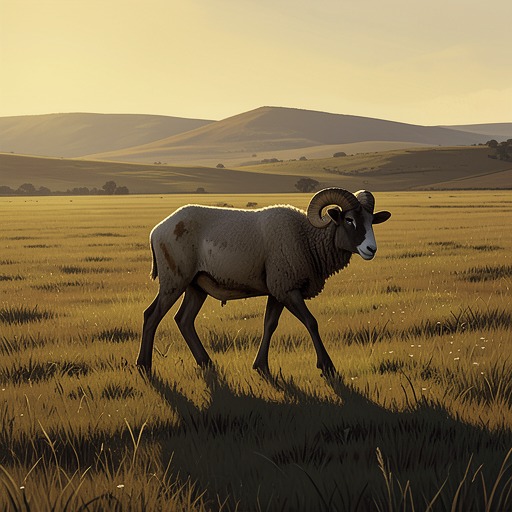
Later, as he prepares to face Melmoth, Othello revisits the maxim Melmoth taught him: sometimes being alone is an advantage. Othello now rejects it from experience. His own isolation was painful: he had been a single sheep among four dogs, two ferrets, and a white goose. He recognizes that sheep are not made to be alone and begins to feel pity for Melmoth, whose whole life has been marked by loneliness, even within a flock. The reunion also forces Othello to see the passage of time. Melmoth has grown old; the weight of the world shows in his long beard, and Othello can no longer imagine their possible duel as he once might have. The mentor is no longer the seemingly effortless figure of his youth, and Othello’s response has shifted from resentment toward pity.
Wandering as an unfinished story
Melmoth gives his travels the shape of a story, but insists that a story ends when it reaches its end, like a breath. Life, by contrast, continues across landscapes and through flocks. A lamb asks him to go on and tell about the North Sea, but Melmoth is no longer listening. The small interruption leaves his journey without a neat return or a final account of what happened there. His narrative distinguishes the ending of a tale from the continuation of life, a distinction that suits a wanderer whose travels have carried him forward without bringing him back to settled belonging.
The contrast with Othello gives Melmoth’s solitude its sharpest meaning. To the younger sheep, solitude first appeared as a piece of wisdom and then proved painful in practice; to Melmoth, it has become the condition under which he understands his life. His wandering joins instruction, separation, and resistance: he gives Othello tools for facing fear, leaves him behind, and later refuses the return he longs for because he believes the way back is closed. The book does not resolve that contradiction. Instead, it lets Melmoth remain both a traveler with an immense range and an old sheep whose passage through many flocks has not ended his loneliness.