Miss Maple
Three Bags FullMiss Maple is the most inquisitive and persistent sheep in George Glenn’s flock, and the murder of their shepherd gives those qualities a purpose. She turns panic into investigation, follows clues that the other sheep would rather leave alone, and eventually sees how Beth’s long wait and George’s plan to leave connect to the spade. Her importance lies not only in solving pieces of the mystery, but in insisting that the flock understand what happened and make the humans hear it.
Identity and Disposition
Miss Maple is described as the cleverest sheep in the flock, perhaps the cleverest in Glennkill and possibly in the whole world. Her intelligence is practical as well as analytical: she has an enquiring mind, does not give up, and sometimes feels responsible for what the flock should do. The annual Smartest Sheep in Glennkill contest does not attract her. Its winner is crowned with shamrock, then taken around neighboring pubs and repeatedly made to perform the trick that earned the title; the sheep may be plied with Guinness, while the shepherd is held responsible for pasture pranks. Maple’s refusal to compete is itself presented as evidence of her judgment: she understands that winning such a contest would bring obligations and indignities, not simply recognition.
That judgment distinguishes her from the flock’s more immediate appetites and fears. The sheep can be distracted by food, comfort, or the hope that danger will simply stay away. Maple notices what remains unexplained. Even when others have gathered to settle what makes a good shepherd, she keeps her attention on the question of how George died. Her intelligence is therefore not merely a ranking among sheep; it is the habit of returning to a problem after other minds have declared it finished.
The Death of George and the Start of the Investigation
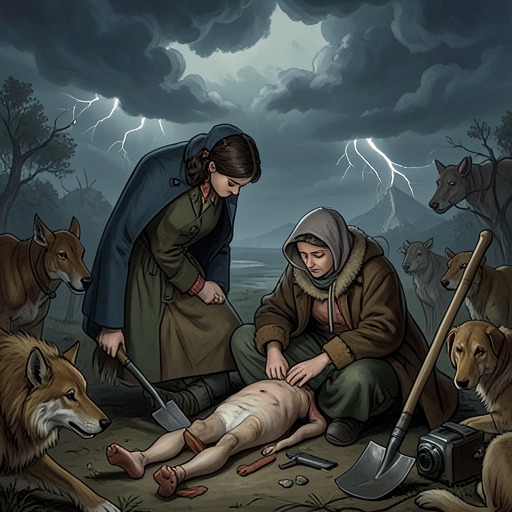
When the flock finds George lying in the grass beside the hay barn, with a spade driven into him, Maple quickly quells the first cries of alarm. She reasons that the sheep are in rich Irish pasture in midsummer and do not need to panic about hay, and that even a wolf would not use a spade to kill. The body, the tool, and the flock’s fear are all present at once, but Maple keeps them from turning fear into a premature explanation.
After the sheep decide to solve their shepherd’s murder, Maple approaches the body herself. In the summer heat, George has already begun to smell, and she is reluctant to examine him. She circles at a respectful distance while a crow flutters away, then moves closer to inspect the spade and sniff his clothes and face. Finally, she puts her nose into the wound and roots around; she returns to the others with blood on her muzzle. The procedure is disturbing to the flock, but Maple is willing to endure it because seeing and smelling the evidence matters more than staying comfortable.
An early clue is the missing garden spade. After the sheep raid the vegetable garden behind George’s shepherd’s caravan, Othello leads Maple to the place where George’s gardening spade usually leaned. It is gone. Later, when Maple considers whether one of the sheep could have had a part in George’s death, she refuses to exempt the flock from suspicion. She points out that the sheep know very little about Othello’s evenings with George behind the caravan, just as they do not know what Sir Ritchfield was doing in the place he described as containing dead people. Her inquiry turns inward as well as outward: loyalty does not make an unanswered question disappear.
Following Clues Without Forcing a Single Explanation
Maple’s investigation gathers questions from across the flock’s experience. She objects when the others want to stop thinking, recalling the missing Tess, The wolf’s apparition, God’s search in the meadow, the relationship between Lilly and Kate, Ham’s presence, the drugs associated with George, and the identity of the master hunter. The list shows the breadth of her attention, but it also shows the danger of treating every oddity as a clue to the same crime. She keeps asking what the flock has seen, even when the questions are unsettling or inconvenient.
Her view of the humans develops through observation. After Beth leaves, Maple reflects that Beth is not stupid, despite thinking too much about souls and too little about human beings. She also recognizes the intelligence of the red-haired stranger. The stranger’s observation that humans are herd animals gives Maple a way to interpret the villagers: they live together, come to see the spade together, and behave collectively, as a flock does. Maple is not simply translating human conduct into sheep terms; she is testing whether the pattern of gathering and belonging can help explain what humans conceal.
When the flock discusses George’s past, Maple uses the children’s fear of him to infer how reputation can travel between generations. She concludes that the children had learned their fear from older humans, like lambs learning from the flock, and that George had been dangerous to those adults because he knew a secret. At the same time, she keeps the inference provisional: Zora reminds her that the people who feared George had left him alone for years, and Maple does not dismiss the question of why they acted when they did. Her reasoning advances by distinguishing a plausible explanation from a proven one.
Reading the Human Conflict
Maple eventually understands that Gabriel is the master hunter. She reaches this conclusion from the humans’ behavior around George’s caravan and the hidden secret: Gabriel, Josh, Eddie, Harry the Sinner, Tom O’Malley, and others have all tried to get inside, while also fearing that someone else might do so. Maple infers that they want access not because they want the contents released, but because they want to find the evidence and destroy it. What appears to be a set of separate efforts becomes a pattern of people trying to control what can be discovered.
She is careful, however, not to make that pattern solve George’s murder by itself. When the small puzzles begin to fall into place, she can explain why Josh and the butcher were in the meadow in the mist, who left the Thing, and who the master hunter is. Yet she still cannot make those discoveries fit the larger question of the murder. She considers the possibility that this is a mistake of expectation: the clues may belong to different matters, and apparent connections may not be real connections. The detective’s task, in her view, is not to force every fact into one elegant design, but to recognize when the design is false.
Beth, the Spade, and the Motive
Maple’s final interpretation joins Beth’s repeated visits to George, her concern with his soul, and the spade. The flock had watched Beth come to the caravan steps and speak about George’s soul without understanding her purpose. Maple compares the patience of her approach to a predator’s circling of an injured lamb, while Othello insists that George was not weak and continued to defend himself. The distinction matters: Beth had waited, but George had resisted her access to him.
Maple reads the spade as carrying several meanings at once. It was associated with the vegetable garden, where George defended what was his; it also marked Beth’s inability to get at his soul. Then George was going away to Europe, taking his soul with him. Maple concludes that Beth had waited for years and acted when his departure threatened to make that waiting useless. The spade is therefore not an isolated weapon in her account: it links the garden, George’s resistance, Beth’s fixation, and the impending journey. Maple also interprets the decision to pin George to the meadow as an attempt to prevent his ghost from haunting the murderer. The attempted safeguard fails in the flock’s understanding; the murdered do haunt their murderers.
Justice and Narrative Role
Once Maple has recognized Beth’s motive, she turns from solving the crime to deciding what the flock must do with what it knows. She rejects the suggestion that the sheep should pretend to be ill again, as they had when driving Gabriel away. This time, a display of disease would not frighten Beth into doing the right thing. Maple insists that the truth must get out—not merely out of the caravan, but out of the flock’s own heads. For her, justice requires disclosure.
The problem is that humans do not understand the sheep. Maple acknowledges that difficulty, then observes that they do pay attention to the caravan. Her plan begins from that concrete limitation: the flock cannot assume that human listeners will understand their words, so it must find a way to make the truth visible where human attention already rests. Across the investigation, Maple’s role changes from the clever sheep who stops panic to a leader who asks the flock to accept uncertainty, examine its own suspicions, and act on a hard-won understanding. Her insistence on justice completes the movement of her inquiry: knowing the answer is not enough if the truth remains unheard.