Murder of George Glenn
Three Bags FullGeorge Glenn’s death becomes the starting point for his flock’s investigation and a test of what the sheep mean by justice. Found beside the hay barn with a spade wound, George is initially treated as the victim of a human crime; a hoofprint and later revelations complicate that account, linking the apparent murder to both village suspicions and a private history of estrangement.
Discovery and the Flock’s Decision
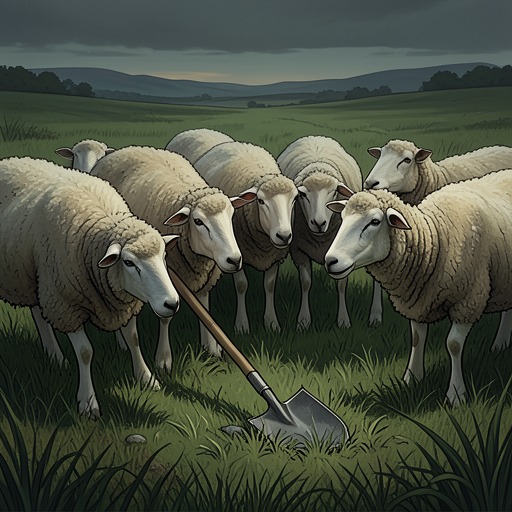
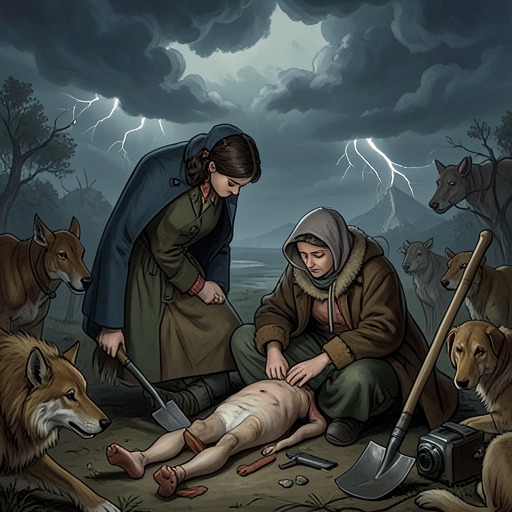
George lies in the grass near the path through the fields, close to the hay barn. A crow perches on his sweater while a rabbit sits nearby; at a distance, the sheep hold a meeting. They are proud that they have kept calm, though their first alarm is practical: without a shepherd, who will bring them hay? Miss Maple quiets them by pointing out that the rich pasture makes hay unnecessary in midsummer, and that a wolf would not use a spade. The tool in George’s body makes the death appear to be a human act.
Sir Ritchfield dismisses illness as an explanation, and Othello argues that the attacker must have been human, or an unusually large monkey. Maple turns that deduction into an obligation. George had sought out the culprit when a fierce dog took one of the lambs; as their shepherd, he deserved the same effort from them. The flock adopts Othello’s call for justice and resolves to solve the killing themselves.
Maple examines George while the others wait together at a distance. She circles before approaching, inspects the spade, and smells his clothes and face. She also notices details that do not fit easily into a simple account: his face seems peaceful, his clothes smell of smoke, and he holds flowers, although he is usually more interested in vegetables. Most importantly, she finds a single sheep’s hoofprint on his pale stomach, slightly above the wound. The mark becomes a concrete clue, but the evidence does not identify whose hoof made it or establish what happened.
Clues at the Pasture
The day after George’s death, the flock ventures out from the barn into a world without either shepherd or sheepdog. Mopple the Whale leads the hungry sheep toward the vegetable garden behind George’s caravan. George had fenced the garden off, but with him gone, Lane nudges back the bolt and the flock eats the lettuces, peas, radishes, cress, tomatoes, endives, buttercups, and chives. Their brief raid ends in silence and shame.
The garden episode also draws attention to a tool associated with George’s work there. The spade that usually leaned against the back of the caravan is absent. The discovery does not by itself solve the killing, but it gives the flock a specific absence to set beside the spade found with George and the hoofprint Maple has noticed. Ordinary pasture details become evidence because the sheep are trying to reconstruct a human event with the knowledge available to them.
Village Suspicions and Material Stakes
The death is also interpreted through the interests of the village. Harry argues that something hidden at George’s property must be drugs, and warns that discovery would ruin plans for a dolmen attraction, pony rides, a cultural centre, whiskey sales, and a seaside hotel. Tom backs a different part of the accusation: George had obstructed tourism, kept people away, and frightened them off, while boats supposedly brought goods to the beach at night for transport in his old vehicle the next day. These are villagers’ claims, not proof of George’s role or of a motive for his death.
Their accusations place the pasture inside a conflict over land and profit. To the sheep, the meadow is a place to graze and the garden is the food George had kept from them; to the villagers, the same property represents a potential business. The competing accounts deepen the mystery without confirming who killed George. They also show why the sheep’s investigation cannot be separated from the struggle over what his land is for.
Rebecca’s Story and the Retrospective Reframing
Later, Rebecca tells the sheep a story about a little girl with two fathers: one acknowledged and one secret. The girl and her secret father love one another, but after a quarrel they stop speaking. When he writes that he plans to travel to Europe and wants to see her first, she hides her happiness and keeps him waiting. He dies before they meet. Rebecca’s story gives the death an intimate context the flock’s early search for a culprit could not provide: George had a secret daughter, and their estrangement left a final meeting unrealized.
The story does not name a killer or explain the hoofprint, and it is not a formal resolution of the flock’s case. Instead, it changes the emotional shape of George’s death. The apparent crime remains entangled with unanswered questions, but the account of a father who waited for his daughter makes absence and delayed reconciliation central to how his end is understood. The flock begins with a demand for justice; Rebecca’s tale reveals a loss that cannot be reduced to identifying an assailant.