Othello
Three Bags FullOthello is the flock’s black, four-horned Hebridean ram, a newcomer with a mysterious past who becomes its strongest defender and most experienced guide. George rescued him from a dogfighting ring and taught him how to lead; after George’s death, Othello puts those lessons to use, helping the sheep confront human threats, protect George’s pasture, and choose their own representative for the journey to Europe. His movement from rescued outsider to lead ram gives the flock’s struggle for justice a physical as well as moral force.
Identity and Background
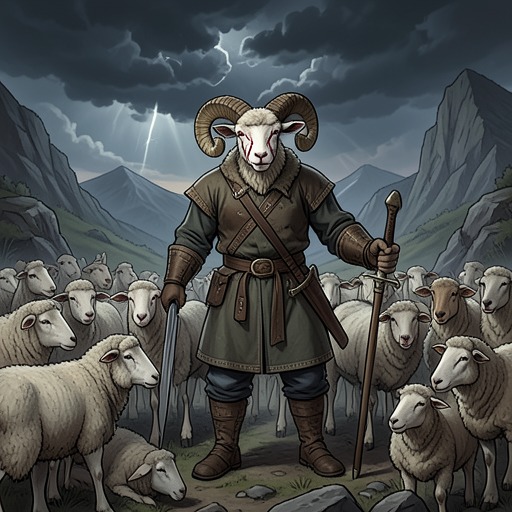
Othello’s appearance sets him apart before he does anything. He is the only black sheep in the flock, and his four sharply curved horns are so unusual that the other sheep react with awe and envy when he arrives as a full-grown ram. The flock has not seen him come; he simply appears one morning. George does not introduce him in the usual way. Instead, he sings, whistles, and dances, then applies stinging ointment to the long wound across Othello’s forehead. Othello stands still while George tends it, an early sign of the unusual trust between them.
That wound carries the history Othello does not initially explain. He had been fighting dogs; when George first saw him, Othello was exhausted, bleeding into his eyes, and struggling to remain standing beside a dead dog. The death did not reassure him: he expected another dog to come. A voice in his head warned him that closed eyes meant death, and George’s attentive gaze helped him stay upright until his strength returned. Othello then turned toward the door the dogs had entered through and lowered his horns. Soon George was driving him away in an old car, with Othello bleeding in the back seat, and promising to take him to Europe.
His past also shapes a blunt, hard-won idea of justice. Othello remembers that the clown’s dog did not survive, but that the clown sold Othello to a knacker, who took him to the dogfights. In his understanding, defeating an attacker does not make the system that exploits him fair. Justice means being able to go where one wishes, graze where one wishes, and fight when someone tries to take that freedom away. The principle is rooted in what happened to him, but it soon becomes a way to interpret what George’s death has done to the whole flock.
George’s Death and the Search for Justice
When the sheep find George lying dead beside the hay barn, a spade driven into his body, Othello is the first to take a sudden interest in the problem. Sir Ritchfield considers the spade a sufficient explanation of how George died, but Othello points out that a human—or, as he allows, a very large monkey—must have put it there. Miss Maple turns that observation into a decision: the flock owes George an effort to discover what kind of human killed him. Othello’s response helps move the gathering from shock toward investigation.
The missing garden spade offers an immediate physical clue. After George’s death, the sheep raid the vegetable garden behind his caravan, pushing the gate bolt aside and stripping the lettuce, peas, radishes, cress, tomatoes, endives, buttercups, and chives. Othello does not join the raid. He waits at the gate, then draws Miss Maple’s attention to the place behind the caravan where George’s gardening spade should have been. The garden that had been forbidden while George was alive thus becomes, through its destruction and Othello’s restraint, a reminder of both the shepherd’s absence and the absent tool.
Othello’s outsider status also makes him an object of suspicion. At a meeting with Beth, she suggests that the flock will not be able to live again until the black sheep has left. Othello gives her a hostile look. The moment puts his distinctiveness in sharp contrast with the villagers’ wish to make him responsible for the community’s unease: he is marked as different, but the story has already shown that his presence is bound to George’s rescue of him and his loyalty to the flock, not to the murder.
Courage, Leadership, and Protection
Othello’s courage is not presented as the absence of fear. When a gray wolfhound runs at the flock, the sheep scatter in panic. From her rocky ledge, Zora sees Othello confront the dog. He attacks first, running at it when the dog expects prey to flee. The dog swerves as Othello bears down, and Othello changes direction and charges again. The dog crouches with its teeth bared, but the encounter establishes that Othello can make a predator hesitate and that his speed and nerve can reverse the expected roles of hunter and hunted.
He later makes those qualities useful to the flock rather than simply displaying them in a fight. When Gabriel’s sheep threaten to graze George’s Place bare, Othello shows George’s sheep how to form a ring around the protected ground, standing shoulder to shoulder with their heads toward the newcomers. He takes the middle position so that he can help wherever the line is pressed. His instruction is practical: if the other sheep cannot get through, they cannot graze the place. The defense turns his individual strength into coordinated action and allows the flock to guard the pasture together.
Othello’s authority is visible again when the sheep must choose an authorized representative under George’s will. The will leaves George’s fortune to the sheep so that they can go to Europe, but the money must be administered and a representative must accompany them as their shepherd. That role carries duties set down in the will, including ensuring that stories are read aloud and that the sheep are not sold or slaughtered. When Gabriel murmurs in Gaelic, Othello steps forward, looks at him, then turns and walks to Rebecca. The flock follows, one sheep after another clustering around her. Othello does not merely lead the group away from Gabriel: his choice makes the flock’s preference legible to the humans deciding who will represent it.
Relationships and the Future George Promised
George is more than Othello’s rescuer. Behind the shepherd’s caravan, he trains Othello to lead a flock, keep his nerve while moving, and guide others forcefully but cautiously past or over obstacles. Othello remembers George telling him that Europe would be easy with him. When the will makes that journey possible, the memory gives the legal arrangement a personal history: the promised destination was also the future George had been preparing Othello to lead the sheep toward.
The flock’s choice of Rebecca gives Othello reason for confidence without erasing George’s absence. He is pleased that the sheep are going to Europe and believes Rebecca can serve them, even though she is not George. His sense of justice is therefore neither a simple victory nor a return to what the flock had before. The shepherd who rescued him will not lead the journey; instead, Othello must carry forward what George taught him with a new shepherdess and a flock that has made its own choice.
Rebecca’s first reading aloud also exposes a private grief connected to George. When her book proves too sad, she tells a story about a girl with a secret father, a quarrel, a long silence, and a letter saying that the father wanted to see her before traveling to Europe. The girl hides her joy and keeps him waiting until he dies. The sheep hear the story as Rebecca’s own, and its resemblance to George’s planned journey gives their future a painful family dimension. Othello’s part in the larger transition is not to explain that story, but to help secure the conditions under which Rebecca can lead the flock.
The Voice, the Performance, and Change
For much of Othello’s life, a voice in his head has helped him respond to danger. During the final public performance at the Smartest Sheep in Glennkill contest, the crowd’s attention revives the queasy feeling associated with his earlier appearance in a circus ring. He listens for the voice, trying each of his four horns in turn, but hears nothing. Its absence leaves him alone with the panic that is about to overtake him.
This time, Othello steadies himself without the voice. Zora nudges his hindquarters, reminding him to keep moving. He recalls that he has already defeated dogs, faced the priest the sheep call God, and become the flock’s lead ram. He steps firmly onto the platform. His action does not make the crowd or the past disappear; it shows that the courage once mediated by the voice has become something he can summon and enact for himself.
Othello’s role in the reenactment is death, embodied by the black ram. He watches the staged body of George with Beth, while Miss Maple directs the sheep through the sequence. Zora plays the dead shepherd; because the scene requires her body to be moved, she has to help with her strong legs, and during rehearsal the movement prompts cries that George is alive. In the final performance, George is dead when the flock reaches its grand finale, and Miss Maple stamps on Zora’s chest in place of the missing spade. Othello prowls around the body as death made visible. The performance converts his familiar image as a fierce, ominous ram into part of the flock’s effort to show what happened to George—and completes his change from a survivor rescued by one shepherd into a leader able to stand alone, act with others, and carry the flock toward a future George promised.