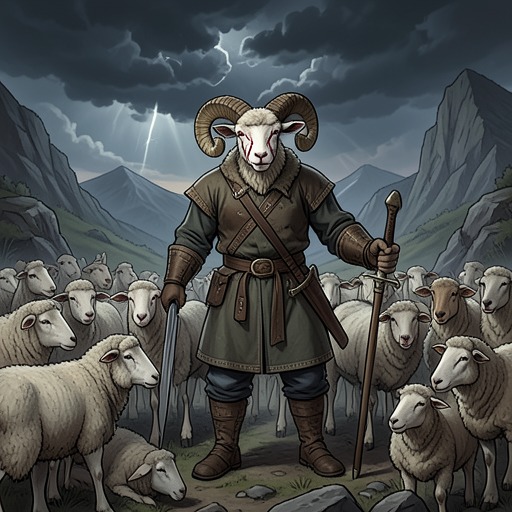
Othello drives off the wolfhound
Three Bags FullOthello drives off a gray wolfhound that turns a familiar threat—the dogs’ herding—into a hunt. As the human gathering near the dolmen draws the dogs farther across the meadow, the flock breaks apart in panic; Othello alone meets the wolfhound’s charge. Zora witnesses a reversal of the expected order: the sheep is faster, more composed, and finally more dangerous than the dog that seemed certain to prey on him.
The Dogs Advance
The danger grows as the human groups move closer to the dolmen. A couple of dogs had previously explored the meadow near their masters, sniffing about and being whistled back or ordered to lie down. Now three sheepdogs and another dog have formed a pack. The sheepdogs move low across the meadow, their dappled coats glinting as they head toward the hill. The flock recognizes the old discomfort of being driven apart and brought together again, but the gray wolfhound changes the meaning of the approach: it does not bark or hesitate, and its movement looks less like herding than hunting.
The flock’s alarm becomes panic. Sheep dash in every direction, carrying the startled sheepdogs with them. Mopple runs through the human crowd and knocks Harry the Sinner over, while Zora takes refuge on her rocky ledge. From there, she is the only sheep able to see clearly what happens on the hill near George’s Place. The flock’s confusion is not merely a reaction to an unfamiliar dog; it leaves Othello’s encounter with the wolfhound almost entirely unwitnessed.
Othello Turns on the Wolfhound
At the foot of the hill, Othello and the wolfhound are both rising from the ground. Othello attacks first, although, from Zora’s perspective, he should have fled. The wolfhound initially fails to recognize the black figure racing toward it as prey. When it does, it charges, but loses its nerve before the two collide, braking and swerving aside. Othello changes direction in a slight curve and gallops back toward it.
That repeated advance exposes the difference between the two opponents. Othello is faster, and the wolfhound seems to realize it; still, it crouches with its teeth bared, ready to leap at the ram from below. The encounter is not described as a prolonged struggle with a clear view of each blow. Zora sees the approach and the shifting balance, then closes her eyes, trying to turn her attention away from the danger. The next decisive sight is a dark body on the ground, its feet twitching as if still trying to run. For a moment she believes the wolfhound has brought Othello down. She then sees that the fallen animal is the wolfhound, while Othello is nowhere in sight.
The Wolfhound Is Carried Away
The wolfhound cannot get back to its feet. Its young master, one of the men who had laughed unpleasantly, approaches and prods it with his foot. A farmer then lifts the injured dog and carries it away. Blood on its belly alarms the people around the meadow. They cannot explain what has happened to an animal they regarded as strong, and cries of Satan and Goblin King pass through the crowd. The human gathering retreats in haste; George’s spade is left behind.
The outcome is strikingly different from the flock’s first interpretation of the attack. Sheep that had expected to be chased and driven apart have seen one of their own confront the dog rather than flee. Yet the flock does not gather around Othello or publicly acknowledge what he has done. Zora sees him again among the sheep as they slowly settle and begin grazing, but no one appears to take particular notice of him. His return confirms that he survived the encounter; the flock’s subdued response leaves the action without any explicit recognition or explanation from the other sheep.
Zora’s Witness and the Reversal of Predation
Zora’s position on the rocky ledge shapes how the scene is told. She can watch the attack from a distance, but she cannot bear to keep looking when the wolfhound crouches to spring. To steady herself, she recalls the birth of her first lamb, brown as earth, and the resolve she felt to defend him against the world. That memory does not explain Othello’s choice, but it sets the danger against a ewe’s intimate knowledge of vulnerability and protection. Her attention then returns to the hill, where the apparent victim is not the sheep but the dog.
The fight overturns the flock’s assumption that no sheep can stand against the force of dogs. The ordinary sheepdogs have approached as instruments of human control, driving animals that have been herded many times before; the wolfhound makes that familiar pressure suddenly lethal. Othello’s speed and repeated charges interrupt the expected chase, and the crowd’s retreat follows the reversal. The scene gives Zora evidence of Othello’s capacity for violence and leaves her thinking how little she knows about him. It also presents the pasture not as a quiet refuge from human activity, but as a contested place where animals can be hunted, driven, and, unexpectedly, fight back.