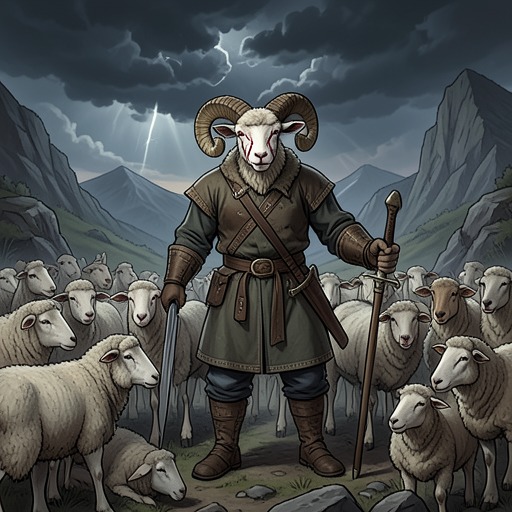
Othello’s rescue by George and escape from the dogfighting ring
Three Bags FullOthello’s rescue by George Glenn is a defining encounter in the ram’s life: George finds him bloodied after a fight with dogs and takes him away, beginning a bond rooted in attention and survival. Remembered at George’s funeral, the scene also gives the promise of Europe a lasting weight: George never makes the journey with Othello, but his will later provides for the flock to go there.
The Rescue Remembered
At George’s funeral, Othello recognizes who is inside the coffin by scent. While others attend to the ceremony, he remembers first seeing George through cigarette smoke, with blood running into his eyes and his legs trembling from exhaustion. The dog beside him is dead, but Othello expects another dog to come; survival has not yet meant safety. He wants to close his eyes, but an admonition that closed eyes mean death makes him force them open.
George meets his gaze with such interest that Othello can hold on until his legs stop trembling. The encounter is presented through Othello’s memory, not as a detached account of a rescue. Its decisive action is initially an act of looking: George’s attention gives the injured ram something to focus on when his body is failing.
From the Fighting Ground to the Car
Othello turns toward the doorway through which the dogs came and lowers his horns. The gesture makes clear that, even exhausted and wounded, he remains ready to face what may come through it. George then takes him away. Soon Othello is lying across the back seat of George’s old car, bleeding, while George sits at the wheel in the dark.
A separate recollection of Othello’s arrival in the flock fills in the visible aftermath: he appears one morning as a full-grown ram with four dangerously curved horns and a striking wound across his forehead. George tends the wound with the stinging ointment the sheep fear. He sings, whistles, dances, and is so excited that he takes off his woolly sweater. Othello, by contrast, stands perfectly still. The sheep do not see him arrive at the pasture, but George’s unusual joy and careful treatment make the rescue’s effects immediately apparent to them.
The Promise of Europe
In the car, George announces, “We’re going to Europe.” The promise gives their escape a destination, but Othello later recognizes that George was wrong: they never went. The distance between the declaration and its fulfillment is not erased by the rescue. Othello remembers the failed promise alongside the act that saved him, and his thought of justice carries both the rescue’s significance and its incompletion.
After George’s death, the promise returns in a concrete form. His will leaves the rest of his fortune to his sheep so they can go to Europe as he promised. The money is to be administered for them, and they must have an authorized representative to accompany them as shepherd. The document also sets out care conditions, including daily reading aloud, and requires an outside check on the representative’s duties. The flock’s journey is therefore no longer simply the plan George voiced in the car: it becomes a legal provision whose realization depends on choosing someone to represent them.
A Bond Seen Through Othello
The memory explains why Othello’s response to George’s death differs from that of the people at the funeral. He behaves solemnly among the gravestones, recognizes George in the coffin by scent, and remembers the first encounter that brought them together. His connection to George is conveyed through precise acts and sensations—the held gaze, the wound, the car, and the remembered promise—rather than through a stated account of affection.
The rescue also makes Othello’s later sense of justice personal. He was taken from a scene in which another dog could always replace the one who had died; George’s attention offered a way out, but the promised journey remained unfinished. When the flock’s future is subsequently secured through the will, the old promise gains a new possibility without changing the fact that George and Othello never traveled to Europe together.