Rebecca
Three Bags FullRebecca is the newcomer whose arrival redirects the sheep’s attention from the open road toward the human mystery surrounding George. She presents herself as someone who might help Glennkill’s tourist trade, but tells Beth that she has come for personal reasons and wants to learn about George’s life and death. The sheep first register her as a vivid presence in the landscape; in conversation, she becomes an investigator whose purpose is clear but whose private connection remains unstated.
Arrival and First Impression
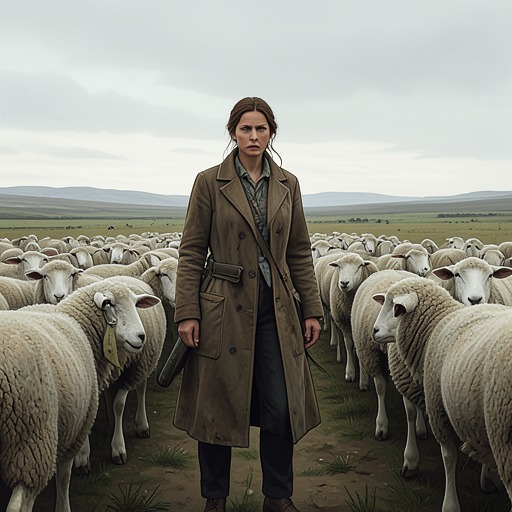
The sheep first see Rebecca approaching along the road with a suitcase she carries easily. A broad-brimmed straw hat shadows her face, while her red dress, stretching from shoulders to calves, stands out against the surrounding green. The flock reads her through scent as well as appearance: she brings a strong, earthy smell marked by sweat, and they imagine it as a scent to fall in love with. Their account makes her entrance bodily and immediate, filtered through the flock’s particular way of noticing people.
Rebecca puts her suitcase down in the middle of the road, looks at a map, and swears and laughs. The sheep take her pause not as fatigue but as thought. What sets her apart is what follows: she leaves the tarmac without the hesitation the flock expects from humans. To them, she moves like a sheep following its nose, choosing her own direction rather than letting the road lead her astray. Their comic comparison also gives the moment a practical significance: they anticipate that her arrival will unsettle the people of Glennkill.
A Newcomer in the Village
Rebecca’s striking first appearance does not define her entire presentation. When she enters the room where Beth is waiting, she wears blue trousers and a green shirt instead of the red dress. The sheep have been able to observe her outside the house, but when Beth answers her knock, both women disappear from view; the flock can hear only indistinct murmuring. Their partial access to the meeting preserves the scene’s tension: the sheep know a consequential conversation is happening, but cannot witness its beginning.
When Rebecca comes back into their sight, she gives her name and asks Beth to use it. Beth remains silent for a moment before identifying the real subject of Rebecca’s visit: George. That exchange shifts Rebecca from an intriguing stranger into someone deliberately seeking information about the dead shepherd. The book’s introductory account also describes her as a village newcomer with a secret and a scheme, placing her among the figures the sheep regard as possible suspects without yet explaining what her secret entails.
George and the Personal Inquiry
Rebecca tells Beth that she wants to find out as much as possible about George’s life and death. She says that boosting Glennkill’s tourist trade would be welcome too, presenting the commercial benefit as compatible with her other purpose rather than as its explanation. Her smile is described as ironic, although Beth does not notice it. The moment leaves a distance between what Rebecca says and what Beth understands, without disclosing the personal reason Rebecca withholds.
Rebecca is not there on behalf of the police. When Beth asks whether she is, Rebecca blushes and says that her reason is personal. The disclosure narrows the possibilities without resolving them: she has a definite interest in George, but the evidence presented here does not name their relationship or explain her motive. Her careful distinction between tourism, police work, and personal purpose establishes the unanswered question at the center of her introduction.
Questions and Narrative Role
Rebecca begins to pursue that purpose by asking Beth why George had been away so often recently and what he did when he was absent. Beth says she does not know. She recalls that he dressed well for these trips, in a suit and white shirt, looked ten years younger, and seemed like a gentleman. She believes he went to Dublin, to offices and banks, because he wanted to get away from Glennkill. Rebecca’s question brings these details into the conversation, but they remain Beth’s account, not a confirmed explanation of George’s absences.
As a character, Rebecca occupies two roles that do not neatly cancel each other: she is both a newcomer the sheep place among the possible suspects and a person actively asking questions about George’s death. Her directness is echoed by her first physical choice, leaving the road rather than following it. Yet she withholds the personal reason behind her inquiry, so the same independence that makes her an effective investigator also keeps her motives uncertain. The sheep’s sensory attention and limited view of the meeting reinforce that uncertainty: Rebecca can be watched, heard, and questioned, but her purpose is not yet fully known.