Rebecca Flock
Three Bags FullRebecca Flock enters the story as a name in George Glenn’s will and emerges as the person the sheep choose to represent their future. The revelation that she is George Glenn’s daughter gives a new shape to his private history; her willingness to take responsibility for the flock, and her investigation into the past, make that inheritance more than a legal transfer of land and money.
Identity and Inheritance
At the reading of the will, Rebecca Flock is identified as George Glenn’s daughter. The announcement startles the villagers, who immediately speculate about a concealed relationship and adultery. The will leaves her pastures in Glennkill, Golagh, and Tullykinree. In the same gathering, the lawyer announces that George Glenn’s remaining fortune is for his sheep, so that they can go to Europe as promised. Rebecca’s appearance thus links two inheritances: land left to her and a future intended for the flock.
The sheep’s provision is not simply financial. George Glenn’s will requires an authorized representative to accompany them, with the lawyer administering the money and checking the terms. The representative must arrange for stories to be read aloud to the sheep for at least half an hour each day; none may be sold or slaughtered, and a dense fleece is the primary breeding concern. The representative’s salary is reduced each time a sheep dies. These conditions make Rebecca’s possible role a continuing duty of care, not merely a route to a large payment.
Chosen as Shepherdess
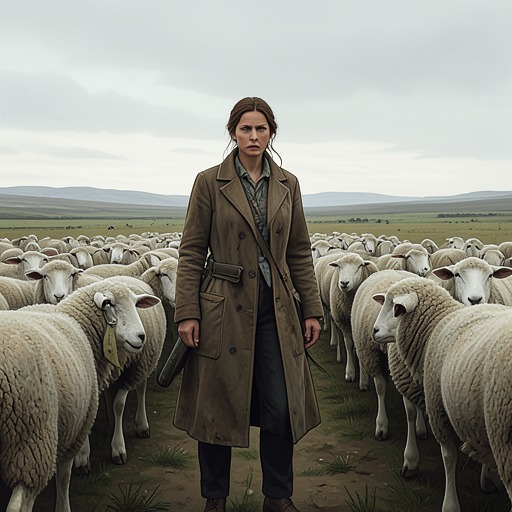
When the lawyer asks whether anyone wants the position, Rebecca Flock volunteers. She is pale but beaming, and stands beside Beth as the lawyer welcomes her offer. The villagers have hesitated despite the apparent financial attraction of the job, while Gabriel is present beside the lawyer. The flock, for its part, would not want to go to Europe with Gabriel. His murmured Gaelic does not change their decision: Othello steps away from him and trots to Rebecca, and the other sheep gather around her. Their choice makes her appointment more than a human decision about who should manage the estate. The sheep express a preference through their own movement, and the lawyer’s process recognizes it.
By evening, Rebecca Flock comes up from the village on foot with a small suitcase. She is to be the new shepherdess, George Glenn’s daughter, and she tells the sheep she will live in the caravan until their departure for Europe rather than remain in the village. The caravan door will not open. She tries the door, works at the windows, and probes the keyhole with a hairpin before sitting on the top step with her head in her hands. The posture recalls George Glenn sitting there alone. The resemblance unsettles the sheep, who recognize that she is sad; Melmoth responds by humming into the wind.
Investigating the Past
Rebecca Flock brings information from the newspaper files into her conversation with Beth. She has searched issues from seven years earlier and found the report of Wesley McCarthy’s murder in the stone quarry. The anonymous report to police produced no suspect and no arrest, and the story quickly disappeared from the headlines. Rebecca understands this as the lead Beth had been looking for and asks who Wesley McCarthy was. Beth reacts with recognition, clutching the glittering pendant around her neck, and explains that he was known as Weasel McCarthy. Rebecca’s research supplies a name and a history that Beth’s response confirms as personally charged, though this exchange does not itself resolve the murder.
Her search also connects her to George Glenn’s concealed past in another way. After a lamb’s crying draws her outside, Rebecca notices a key on a string on the caravan steps and puts it in her pocket. She follows the lamb beneath the dolmen, where the sheep have prepared the earth so that the hidden box is easier to find. Laughing, she uses the key to open it and kneels to take out a small packet. The discovery is not presented as the result of a planned investigation: the key catches her attention on a day when she has little inclination to wonder about anything, and the lamb’s cry leads her onward. Her encounter with the hidden cache nevertheless places her among the few people able to uncover what George Glenn left concealed.
Stories, Estrangement, and George Glenn
Rebecca Flock’s responsibility to read aloud becomes personal when she closes a book because its story is too sad. She then begins speaking without one, telling the sheep about a little girl with two fathers: one secret and one acknowledged. The girl and the secret father love each other, but quarrel; she tries to anger him, and they remain estranged. When a letter eventually says he plans to travel to Europe and wants to see her, she hides her joy and keeps him waiting. He waits until he dies. The story closely echoes the newly disclosed bond between Rebecca and George Glenn and their separation, giving form to what she has not otherwise explained to the sheep. Its account of delay and missed reconciliation makes the promised European journey carry an intimate family history as well as the flock’s future.
The scene also shows Rebecca adapting her care to the listeners. Rather than continue with a book she finds too sad, she pauses and invents a story in her reading-aloud voice. The sheep are tired, but the story reaches them; Mopple the Whale is the exception, distracted by the packet found beneath the dolmen. While Rebecca sits in the dark, humming, Mopple noses into the open packet and swallows its contents before she notices. She laughs at the discovery. The moment places her among the sheep not only as their appointed representative but as a reader and listener in their shared life, even as the hidden contents of George Glenn’s past remain entangled with the flock’s ordinary appetites.