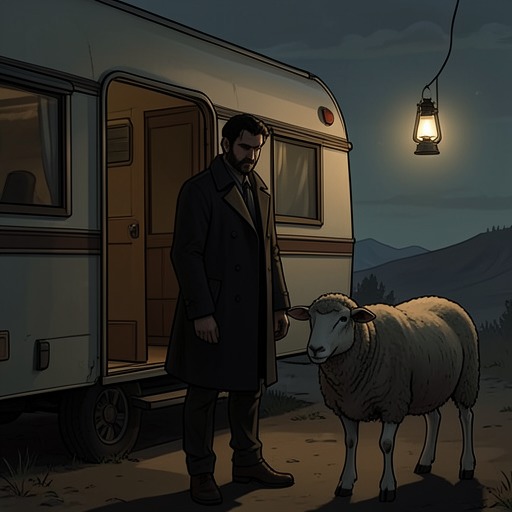
Rebecca discovers George’s hidden cache
Three Bags FullRebecca discovers George’s hidden cache when a crying lamb leads her beneath the dolmen, where the flock has prepared the ground for her to find it. A key, a box, and a skirt full of packets turn the flock’s old memories of George into evidence of a concealed human enterprise. The cache brings an unidentified man to George’s shepherd’s caravan, where its contents become a test of what Rebecca will do with the truth—and a reminder that the sheep have unknowingly carried part of that truth themselves.
The Key and the Hidden Box
Rebecca first notices the key on a string on the steps of the caravan. Its glint resembles spilled blood more than fire in the low sun, but she is preoccupied and pockets it without stopping to investigate. The lamb’s crying draws her onward, under the dolmen. The sheep watch as she reaches the hidden box; Othello has already scraped away earth to make it easier for her to find. The key fits, and Rebecca kneels to remove a small packet.
The sheep’s assistance is deliberate, but their knowledge is incomplete. They have brought Rebecca to the concealed object without understanding what it contains or what the humans’ interest in it means. She bites through the string and hears plastic crackle; dry material crumbles in her fingers. When she identifies it as grass, the smell and texture make the discovery legible to the flock in its own terms. Mopple the Whale recognizes immediately that it can be eaten. What Rebecca has found is not merely a box of human valuables: it is a cache whose contents the sheep can smell, touch, and, in one case, consume.
The Flock’s Earlier Part in the Secret
The discovery changes the meaning of a repeated memory. On earlier trips, George had taken the sheep to another pasture for a few weeks, announcing Operation Polyphemus. Each sheep carried a small packet tied beneath its belly and buried deep in its fleece. The packets smelled of nothing, and the flock had not known what they were carrying. Now the cache supplies the answer: the concealed packets contained the same kind of grass Rebecca has uncovered. Their innocent understanding of these journeys had left the human purpose hidden in plain sight.
Rebecca does not stop at the first packet. She gathers everything she can find beneath the dolmen, bunching her skirt into a makeshift red bag. Many small packets emerge, along with a larger, square package and a file of papers. She carries the heavy collection back to the caravan and remains out of sight for a while. When she reappears on the steps, a point of light glows before her lips and sweet, heavy smoke drifts across the meadow. The sheep grow sleepy; Rebecca, by contrast, becomes talkative. The contrast marks a shift from discovery to disclosure, although the flock can overhear only parts of what follows.
The Man and the Firm
The sheep move closer to the caravan, and Miss Maple and Othello graze beneath its only open window so they can listen. Inside, a man asks Rebecca why he should tell her something. She says nothing; the sheep hear her breathing fast and irregularly, then a heavy object hitting the floor. The man responds that she has found it. His restrained voice and the flock’s uneasy attention make the encounter feel less like an explanation than a negotiation whose stakes they cannot fully see.
The man explains that the goods included mainly grass, sometimes cigarettes, and other things depending on market demand. He also makes the file’s significance explicit: the information in it could deal a severe blow to his firm. Rebecca says she will do nothing with it, and he believes her. But belief does not end the matter. After a pause, he tells her that her assurance is not enough and apologizes. The exchange distinguishes Rebecca’s stated intention from the danger the file represents to the firm: even a promise not to use the information cannot make the documents safe to leave behind.
Collection and Consequence
Later, the man removes the packets from Rebecca’s skirt and counts them. He notes that one is missing because a sheep has eaten it, while treating the loss as an acceptable deduction from the delivery. The small discrepancy gives the flock an unexpectedly direct part in the scene: its instinctive response to the cache has altered the inventory, though the man regards the missing packet as a minor cost. He confirms that the file is present and takes the larger rectangular package as well. Rebecca suggests it is a videocassette; the man says he has never heard it mentioned, then pockets it. The cassette’s contents remain undisclosed, but its presence expands the cache beyond packets and papers, leaving another record in the man’s possession.
Before leaving, the man takes Rebecca’s hand carefully and kisses her fingertips without speaking. He returns to his car and drives away without saying goodbye. Only after the engine is beyond hearing do the sheep relax. Their unease gives way to a sense that order has returned, even improved: George Glenn’s daughter is sitting in the caravan, Gabriel and his voracious sheep have disappeared, and Europe lies ahead. The cache’s recovery therefore closes one immediate disturbance without making the flock’s knowledge complete. The sheep now understand the packets they once carried, but the file and videocassette have left with the man, and the human history they might reveal remains only partly accessible.