Sheep
Three Bags FullSheep, George Glenn’s flock, are not merely the pastoral background to the murder of their shepherd: they become its investigators, its witnesses, and eventually the heirs who must make a choice about their future. Their collective life is shaped by animal knowledge—scent, grazing, flock bonds, and the experience of being driven—while the plot repeatedly brings that knowledge into conflict with human explanations, property claims, and institutions. What first looks like a quiet Irish pasture becomes a place where the flock must judge who is dangerous, what a shepherd owes, and whether loyalty means staying together or deciding for themselves.
Identity and Flock Life
The flock is a community with internal differences rather than a uniform chorus. Miss Maple’s intelligence and authority help contain the first panic over George Glenn’s body; Sir Ritchfield is its oldest ram; Othello can lead under pressure; and Mopple the Whale’s hunger gives the group’s first day without a shepherd a distinct, practical direction. Their flock life also includes customary limits. George Glenn kept them out of his vegetable garden, and the ban had held not because the fence was difficult but because he watched over it.
That restraint ends in a vivid collective lapse. With George Glenn gone, Lane pushes the bolt with her muzzle, Maude eats buttercups, Cloud turns to the peas, and Heather to the tomatoes. Lettuces, peas, radishes, cress, tomatoes, endives, buttercups, and chives disappear from the carefully planted beds. The sheep then fall silent, recognize their own excess, and return to the meadow. Othello, who has not joined the raid, directs Miss Maple’s attention to the place where George Glenn’s gardening spade should be leaning. The emptied garden and the missing tool make appetite, guilt, and evidence converge in a single scene.
Investigation and the Flock’s Knowledge
The flock finds George Glenn lying beside the hay barn, a crow on his sweater and a spade protruding from his body. Its first anxious questions concern who will bring hay and whether a wolf is nearby. Miss Maple steadies the others by distinguishing a murder weapon from illness and by rejecting the notion that a wolf would use a spade. The flock then makes its own decision to solve the killing. When Heather asks what should happen after they find the culprit, Othello answers with justice, and the others adopt the purpose together.
Their investigation proceeds through the senses and comparisons available to them. Miss Maple approaches the corpse reluctantly in the summer heat, circles it, sniffs George Glenn’s clothes and face, and examines the wound closely enough to return with blood on her muzzle. Elsewhere, the flock reads people by smell as well as speech. They identify George Glenn’s daughter through the unmistakable family scent of sweat, skin, and hair, even as they puzzle over what human parentage means. Their way of knowing is not a decorative animal instinct: it gives them evidence that human observers may not have noticed.
They also try to understand human society by translating it into flock terms. Miss Maple argues that there is a wolf among them whom they cannot yet identify, and warns that the absence of a shepherd leaves them exposed. After noticing the unfamiliar sheep Gabriel has brought, the flock studies their short legs, long backs, sparse fleece, pale coloring, and nervous, lifeless smell. The animals’ appearance unsettles them before they understand their purpose. This uneasy observation becomes part of a broader recognition that not all sheep are kept for the same future.
Belonging, Threat, and the Pasture
The flock’s fear of being driven is both learned and freshly renewed. When people gather near the dolmen, three sheepdogs and another dog move into the meadow. The sheepdogs’ low approach recalls the familiar discomfort of being herded apart and brought together; the gray wolfhound changes that discomfort into the terror of being hunted. Later, with no shepherd to protect them, Miss Maple’s warning about an unidentified wolf makes the flock confront the possibility that danger can hide within what appears to be a community.
Their view of human belonging develops through the same analogy. When Sir Ritchfield cries out that George Glenn left the flock, Miss Maple applies the idea of leaving a herd to human life: George Glenn may never have belonged to the villagers, or may have been driven away from them. The flock later connects this question to Melmoth’s account of McCarthy. Miss Maple imagines George Glenn discovering that the group he lived among was the wrong flock—that its members were wolves rather than sheep. The pasture’s apparent division between safe insiders and threatening outsiders thus proves uncertain; the more decisive distinction is between those who protect a flock and those who harm it.
Human plans for the land sharpen that uncertainty. People speak of George Glenn’s resistance to tourists and development, suspect that he kept drugs in his caravan, and imagine a future of attractions, a cultural center, and a seaside hotel. Against that human contest over the pasture, the flock experiences the grass as food and habitat. When Gabriel uses George Glenn’s scythe to cut grass, the sheep see a human grazing without wanting to eat: the blade passes through the meadow and leaves flattened grass behind. Its hostile, sweeping action turns ordinary agricultural work into an image of destruction. The green landscape is therefore neither an untouched idyll nor simply a resource; it is a living place on which the flock’s survival depends and over which human plans compete.
Inheritance and Choosing a Shepherd
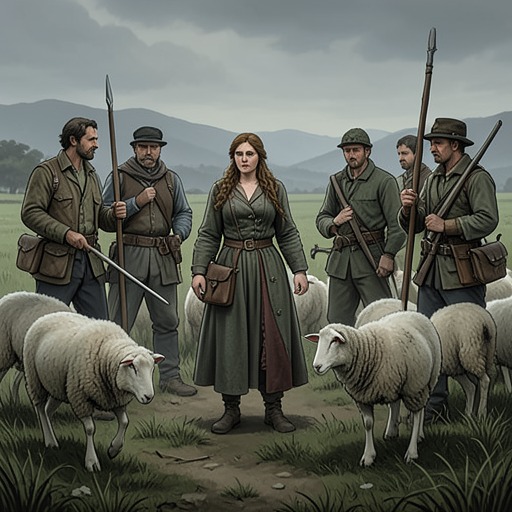
George Glenn’s will gives the flock an unexpected legal and material future. Led by Othello, the sheep approach the humans at the time of short shadows, hoping that the reading will disclose something about the murder or a clue. They listen as the lawyer explains that George Glenn’s remaining fortune is left to his sheep so that they can go to Europe as promised. The animals are to have an authorized representative as shepherd, and the will assigns that representative duties rather than leaving the bequest as money alone.
Those duties include reading stories aloud to the sheep for at least half an hour each day. The will also forbids selling or slaughtering them and makes dense fleece a priority in breeding. The lawyer is to administer the money and check that the conditions are met; the representative receives a salary that decreases each time a sheep dies. These provisions make the flock both beneficiaries and subjects of oversight. Their protection is written into a human legal document, but its practical force depends on who accepts the responsibility and how faithfully that person performs it.
The lawyer initially asks whether anyone wants the position. Gabriel stands beside him, and the human listeners appear to weigh the opportunity, but Rebecca volunteers. When the lawyer identifies the heirs as George Glenn’s flock—including a black four-horned Hebridean ram, a mountain Blackface, a merino, and the last Cladoir flock in Ireland—human surprise turns to hostility and Gabriel studies the animals critically. The flock does not leave its future to the human crowd’s judgment. Othello looks at Gabriel, turns, and walks to Rebecca; one by one, the sheep gather around her. Gabriel’s Gaelic murmuring cannot draw them back. Their movement is a decision made collectively and legibly, a choice the legal procedure alone could not make for them.
Narrative Significance and the Ending
The flock’s decision gives new weight to Othello’s earlier training. George Glenn had taught him behind the caravan how to lead, keep his nerve while moving, and guide others past or over obstacles. Othello now expects to put those lessons to use on the journey to Europe. He is glad the journey will happen, though not with George Glenn, and returns to the word justice before recognizing that something else has not been resolved: the secret did not get out. The prospect of travel brings hope without erasing the past.
Rebecca’s fulfillment of the reading requirement becomes another way for the flock to encounter human relationships. One night, after setting aside a sad book, she tells a story about a little girl with a secret father and an unsecret father. The secret father and daughter quarrel; she makes him angry even at a cost to herself, then keeps him waiting when he writes that he plans to travel to Europe and wants to see her. He waits until he dies. The story gives form to a painful relation without naming its participants, and the flock listens even when exhaustion overcomes the others. Mopple the Whale, meanwhile, seizes the moment to eat the grass Rebecca has found beneath the dolmen. The juxtaposition keeps the flock’s story rooted in bodily life even as it touches grief and reconciliation.
At the Smartest Sheep in Glennkill contest, the flock’s choice narrows to Miss Maple, Mopple the Whale, Zora, and Othello. Inside the crowded hall, smoke, noise, and human smells overwhelm the sheep’s usual means of orientation. Their fear eclipses the pride and anticipation that had surrounded the contest. They follow Othello down the narrow aisle, with Zora behind him, Miss Maple next, and Mopple at the rear holding the cloth they need as a stage prop. The scene recalls the flock’s repeated dependence on a lead animal, but the flock has also shown that it can deliberate, investigate, inherit, and choose. Its collective intelligence is practical and embodied: it arises from attention to one another and to the pasture, and it becomes most consequential when the sheep refuse to let human authority decide their future without them.