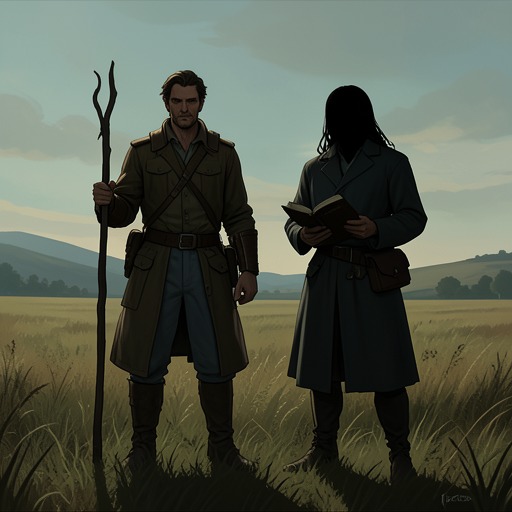
Sometimes being alone is an advantage
Three Bags Full“Sometimes being alone is an advantage” is both a practical maxim and a difficult lesson about belonging. George first offers it as a way to think strategically when outsiders must act without the protection of a group. Later, Melmoth and Othello repeat the thought under sharply different conditions: for one, separation is a rule that cannot be undone; for the other, it is a wound. At the end, Othello keeps Melmoth’s departure secret, leaving the phrase suspended between chosen solitude and painful isolation.
A maxim of tactical independence
George gives the expression its clearest practical meaning while he and Ham are confronting a body. Ham resists the idea that dealing with a corpse is simply part of a butcher’s work; George, no longer angry, asks whether he has ever herded sheep. His explanation turns from the work of herding to the conditions that make it possible: a flock stays together, and that predictability allows it to be driven. A single sheep, by contrast, is unpredictable. George concludes, “Sometimes being alone is an advantage.”
The remark is not a rejection of the flock so much as an observation about its vulnerability. A group’s cohesion makes it legible to anyone trying to control it; an individual outside it may be harder to direct. George applies that distinction to himself and Ham as well. If they are outsiders, he argues, they should use that position to find evidence, including by following up on Ham’s CCTV video and the newspapers sold in his shop. The maxim therefore joins an idea about sheep behavior to a concrete plan: separation can provide room to act when ordinary group expectations no longer apply.
Its confidence is deliberately conditional. George does not say that solitude is always better, or that a flock has no value. The word “sometimes” limits the claim, keeping it tied to circumstance. Being alone offers an advantage only when the situation rewards unpredictability and independent action. The later episodes test what happens when the same condition is not a temporary tactic but an enduring separation.
Melmoth and the cost of being out
For Melmoth, the expression follows a harsher declaration: once a sheep is out of the flock, there is no going back. The butcher has told him, “No going back. Once you’re out, you’re out for good.” Melmoth understands the rule as final; he is alone and must remain alone. The narrator then repeats George’s maxim. In this setting, its brisk practicality lands against a fact that makes solitude sound less like freedom than a sentence.
Othello’s response exposes that contradiction directly. Recalling his own escape from the cruel clown’s animal trailer, he remembers being alone among four dogs, two ferrets, and a white goose. He repeats, “Sometimes being alone is an advantage,” but angrily insists that it was not an advantage then: being alone had hurt. Sheep, he recognizes, are not made to live without one another. The concrete memory reverses the maxim’s emphasis. Unpredictability may help someone evade control, but it does not cancel fear, danger, or the need for companionship.
That recognition changes how Othello sees Melmoth. He feels pity for the old ram, who, in Othello’s understanding, has spent his life moving through loneliness and remained alone in his heart even within different flocks. Melmoth’s age makes the distance between them newly visible: Othello had once known him as controlled and powerful, but now sees the weight of age in him. The saying cannot close that distance. Instead, Othello’s memory gives it an opposite register, making the supposed advantage inseparable from the hurt that solitude can carry.
The maxim tested by a flock
When Othello asks Melmoth to lead the sheep to escape after Zora has discovered Gabriel’s flock is destined for slaughter, Melmoth looks over the waiting animals and asks whether Othello means all of them. He repeats, “Sometimes being alone is an advantage.” This time the expression is not offered to help outsiders gather evidence. It stands between a solitary figure and a group asking him to guide them.
Othello answers that the sheep will not go alone—not one of them. Melmoth’s reply is brief: then they will have to stay. The exchange makes the maxim’s limits stark. The flock’s refusal to separate is precisely what prevents the individual escape Melmoth appears to imagine; yet its togetherness also expresses the loyalty that Othello has learned to value. The scene does not establish that either solitude or unity is universally right. It shows that the same phrase can recommend independence to one listener and sound like a barrier to another.
A departure left unexplained
At the end, the sheep mistake a shaggy gray cloud for Melmoth transformed into a cloud sheep. Othello knows that Melmoth has instead climbed down the steep tunnel through the rock beneath the pine tree and gone away. As the others look upward with veneration and sadness, Othello considers explaining what happened, then decides not to. He believes they would understand less, not more.
The closing return of the expression therefore accompanies both departure and silence. Othello retains the truth of where Melmoth went, but not an explanation of what Melmoth understood or why he left. The more Othello has learned about him, the less he feels he understands him; he remains unsure whether Melmoth understood everyone perfectly or was simply crazy. In that uncertainty, solitude is neither reduced to a clever tactic nor presented as a condition with a single meaning. The recurring maxim gathers its force from these contrasts: independence can help someone act, enforced separation can hurt, and a solitary departure can remain beyond the flock’s comprehension.