The Fifth Night
Three Bags FullThe Fifth Night is the final and decisive night of Melmoth’s self-imposed absence from the flock: a remembered flight across the winter countryside that ends with the discovery of Weasel McCarthy’s concealed body. Told by Melmoth to the flock on a summer day, the episode turns an old wager into a delayed revelation. Its structure moves from playful anticipation, through five days of isolation and pursuit, to the recognition that the body in the ground links Melmoth’s wandering to George’s history.
Place in the Flock’s Story
The Fifth Night reaches the flock not as ordinary chronological narration but as Melmoth’s story, told aloud beneath the shade tree after Ritchfield challenges his recollection of George and the past. Melmoth summons the others to hear what happened when he went into the night, and his telling makes a private ordeal into shared knowledge. The summer setting of the account stands against the November cold of the events recalled: the flock sits among leaves and flies while Melmoth’s words carry them into darkness, over frozen ground and stone.
That contrast matters to the episode’s timing. The flock learns the story only after Melmoth has returned and after George’s death has made the past newly urgent. His account does not simply fill in an interval in his life; it reveals what his absence exposed. The present-day listeners receive the discovery at the same time that the remembered pursuit reaches its end, so the story’s suspense depends on the gap between what Melmoth endured and what the flock has yet to understand.
The Five-Day Absence
The wager begins as a contest between the twin rams. Melmoth says he will be gone for five days and five nights, a span Ritchfield finds baffling. Their exchange turns quickly into a playful song of five suns and five moons, five blackbirds and five nightingales. The two romp around the meadow, and neither expects anyone to hunt for Melmoth. The jaunty counting gives the departure the air of a game; the later story reveals how far its consequences exceed that expectation.
Melmoth’s account replaces the meadow’s rhythm with the hard repetition of flight. He runs over stick, stone, and bone while the butcher’s dogs howl behind him and the butcher follows. The repeated words help him concentrate on running rather than on the pursuers, but they cannot keep his breath steady indefinitely. The fifth night is therefore not merely the last unit in a count. It is the point at which the wager’s imagined freedom meets exhaustion, danger, and the landscape’s physical limits.
Winter Wandering and the Quarry
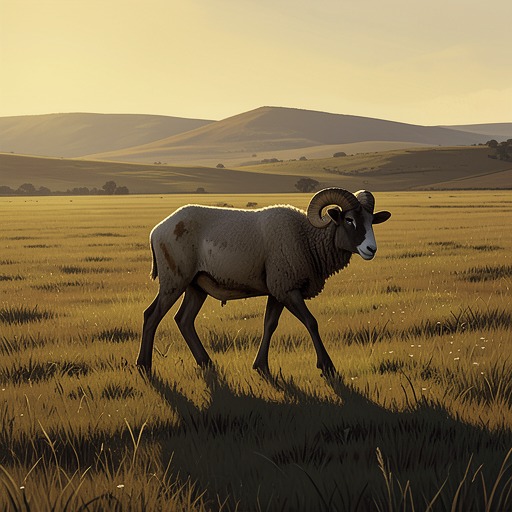
The first night had already made the journey difficult: Melmoth caught a cold while huddled in a prickly hawthorn hedge, inadequately sheltered from the icy November wind, and could not sleep. In daylight he roamed the gray-green moorland, cautiously nibbling coarse grass. From a hill he could see the blue strip of sea, but not a single white woolly dot. The brief euphoria of being alone gave way to panic; he galloped in zigzags through empty hills. His solitude shifts from chosen adventure to an absence that stretches all the way to the horizon.
On the fifth night, pursued into the old stone quarry, Melmoth reaches a mound of pebbles and uncovers a human leg bone. He clambers over the leg and hides in the shadows while the dogs pant nearby. The scene makes the quarry’s stones more than obstacles in his escape: beneath them lies a human body. The butcher’s light searches the rocky slope, finds Melmoth, and then goes dark. The pursuit and the discovery converge at a place where running can no longer keep the past out of sight.
The butcher and George then pull more of the body from the pebbles. As the legs, torso, and arms emerge at odd angles, the dead man’s identity becomes clear: it is Weasel McCarthy. Melmoth’s fifth night thus ends not in reunion or safe return, but at the threshold of a secret concealed in the ground. The discovery gives the remembered night a consequence beyond Melmoth’s survival: it supplies the flock with a buried fact about George’s world.
Recurring Measures of Time
The story’s five-night count sits within a book where night and day repeatedly organize knowledge and danger. In the present aftermath of George’s death, his body lies beside the hay barn while the flock meets near the cliff; the next morning, the sheep find themselves in a world without their shepherd or sheepdog. A separate nocturnal rhythm appears in the locals’ account of boats arriving by night and goods being taken to George’s caravan, followed by his departure in his old vehicle the next day. These repeated patterns do not establish that every night hides the same secret, but they make the night a recurring interval in which human activity can remain unseen by the sheep.
Other scenes return to the measure of a day through changes in what the land means. After George is gone, the sheep raid the fenced vegetable garden behind his caravan, then fall silent and look at one another in shame. Later, Gabriel uses George’s scythe to cut grass: to the sheep, the human act of grazing becomes destruction, the blades lying flat where the iron tool has passed. Such episodes set the remembered winter flight against the flock’s changing present, where familiar places and objects acquire new meanings as time passes and human control changes hands.
Rebecca’s later tale of a girl with two fathers offers another, more intimate measure of waiting. The girl delays seeing the secret father after a letter says he plans to travel to Europe and wants to see her; he waits himself to death. The tale does not recount Melmoth’s wandering, but it echoes the book’s attention to time lost through separation and to knowledge arriving too late. In The Fifth Night, the delay takes another form: what began as a five-day departure becomes a story withheld until its final night can disclose what lay beneath the stones.
Significance
The episode turns duration into evidence. Melmoth’s repeated counting first marks a playful promise, then measures exposure to cold, loneliness, and pursuit, and finally brings him to the quarry where Weasel McCarthy has been buried. The movement from song to breathless flight to the body’s identification changes the meaning of the five nights: they are no longer an amusing test between twins but the interval through which a hidden death becomes visible.
The story also gives the flock a way to learn what it could not have witnessed directly. Melmoth’s memory restores an earlier scene to the communal present, and the discovery at the end makes his tale consequential for the flock’s understanding of George. Its final revelation does not resolve every question surrounding the dead men. Instead, it establishes that the flock’s inquiry reaches into a past concealed beneath the familiar landscape, where a night of wandering became the route to a human secret.