The murder of Wesley McCarthy
Three Bags FullThe murder of Wesley McCarthy is an unresolved killing from seven years before Rebecca questions Beth, and its significance reaches beyond the discovery of a body in a stone quarry. The sparse account of the crime opens onto McCarthy’s land deals, a proposed slaughterhouse that threatened local livelihoods, and a guarded secret that the sheep connect to George and the Shepherd’s caravan. The book supplies no killer or definitive motive; instead, it shows how an apparently forgotten murder continues to shape what people fear will be revealed.
Discovery and the surviving record
Rebecca brings the case back into view after searching newspaper files from seven years earlier. She tells Beth that Wesley McCarthy was found murdered in the stone quarry, that an anonymous caller reported the body to the police, and that investigators made no arrest and identified no suspects. The story disappeared from the headlines almost at once. These details establish both the fact of the killing and the thinness of what the public record can explain: the caller’s identity, the circumstances of the murder, and the reason the investigation stalled remain unknown in the account.
Beth recognizes the name as Weasel McCarthy, the name by which he was known locally. Her reaction reconnects the newspaper report to a past the village had discussed but never resolved. She recalls that nobody knew where McCarthy came from or what he was doing in Glennkill. He had money, bought Whitepark, and lived there quietly for a time. At first he was popular; after his murder, people claimed that they had sensed something wrong about him from the beginning. That retrospective suspicion sits uneasily beside Beth’s description of his earlier welcome: the village’s judgment changed, but the evidence available to it did not thereby become clearer.
McCarthy’s money and local power
Beth describes McCarthy’s account of his wealth as a story that persuaded people at the Mad Boar. He presented himself as someone who had started as a small farmer and moved into investment abroad. Locals entrusted him with money, and the first investors even received some of it back. Beth’s derisive recollection suggests why the story initially worked, while the later outcome remains deliberately unspecified; the passage does not establish the precise terms of any fraud or explain how McCarthy acquired all his money.
His influence became visible in the land he bought. He acquired plots gradually, first beside the meadow and then across nearly all the land between it and the village. Beth says he paid well, at a time when local people had little money and few practical choices. They did not initially ask what he intended to do with the property; by the time they understood, it was too late. The killing is thus recalled alongside a broader change in ownership: McCarthy’s presence was not merely a private mystery but a force that altered who controlled the ground around Glennkill.
The slaughterhouse controversy
The plan for the land was to build the largest abattoir in Ireland. When Beth left for Africa, people were urgently discussing ways to stop it, including citizens’ action groups and petitions. When she returned, Whitepark was empty. She had not even heard that McCarthy had been murdered until Rebecca raised the case. The sequence gives the murder a striking place in Beth’s account: it had vanished from her knowledge along with the public campaign, while the intended development itself had also disappeared.
Beth explains why the proposal threatened more than a single business. She points to the smell and animal transports, and says a slaughterhouse would have damaged tourism, bed-and-breakfast businesses, and the Mad Boar. Farmers, too, might have lost a market for their meat. Yet she also identifies a contradiction in local opposition: people could complain about McCarthy forcing his way into the area and still buy meat wherever it was cheapest. Her account does not prove that the slaughterhouse plan caused the murder. It does show the conflicting economic interests around McCarthy’s land and why the aftermath cannot be reduced to a simple division between a united village and an outsider.
The murder’s continuing implications
The sheep construct a further link between McCarthy’s murder and George’s death. Miss Maple reasons that Gabriel was already the lead ram when McCarthy was murdered and believes that George and the butcher had made sure the sheep were safe. In her interpretation, Gabriel fears that what happened will come out, and expects the Shepherd’s caravan to be the source of disclosure. This is the sheep’s inference, not a solved account of either killing; the passage gives their suspicion force without confirming its full explanation.
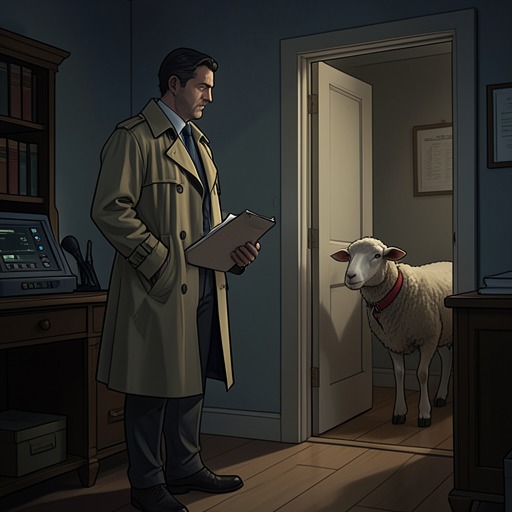
Later, Inspector Holmes receives a videocassette from a discreet man who says it will tell him all about McCarthy and could help his career. The man disappears before Holmes can question him. The cassette therefore revives the possibility of evidence without revealing its contents or resolving the case in the scene. Holmes’s unease extends beyond the Glenn investigation to his own life and his reluctance to return to the police station. Across these recollections, McCarthy’s murder remains a hinge between public silence and private knowledge: a body was found, a caller reported it, and the headlines moved on, but the past keeps returning through the sheep’s suspicions, Beth’s memories, and a tape left on a table.