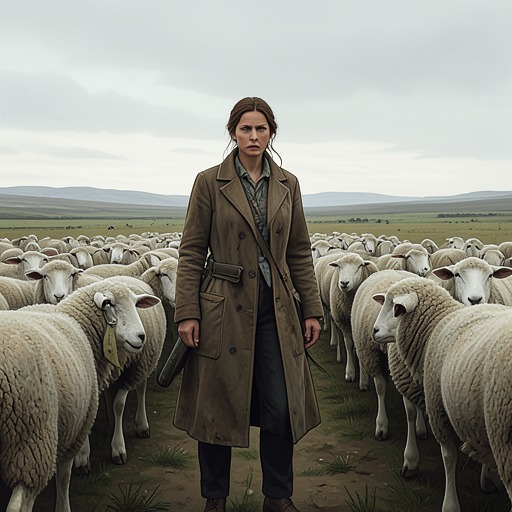
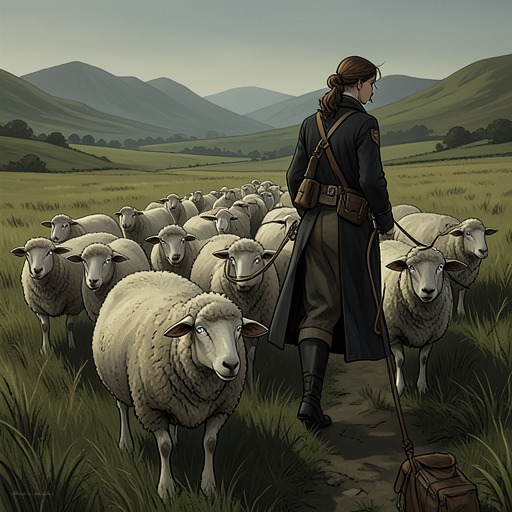
The sheep choose Rebecca as their shepherdess
Three Bags FullThe sheep’s choice of Rebecca as their shepherdess turns George Glenn’s unusual will into a decision made by the flock itself. The lawyer can manage the money and explain the conditions, but he cannot simply appoint the representative without determining what the sheep want. Gabriel volunteers first; Rebecca then steps forward, and the flock chooses her not by speaking in words the humans understand but by moving together to her side. The scene makes their preference legible within a human legal process while preserving the sheep as the agents of the decision.
The Will and the Choice to Be Made
George’s shepherd has been found dead in the grass near the hay barn, and the flock has already had to confront a pasture without its familiar keeper. At the later reading of the will, the lawyer reveals that George has left the rest of his fortune to his sheep so they can go to Europe, as he had promised them. The sum is beyond the sheep’s understanding, but the promise is plain enough: they are to travel, and the money is intended for them.
The inheritance does not settle who will accompany them. The lawyer explains that the sheep need an authorized representative to go with them as their shepherd, and that the will specifies this representative’s rights and duties. He will administer the money, while a third party will check that the stated conditions are followed. Among them are requirements that stories be read aloud to the sheep for at least half an hour each day, that no sheep be sold or slaughtered, and that dense fleece be the chief concern in breeding. The arrangement makes their welfare part of the legal instructions, even as it depends on a human representative to carry those instructions out.
The role has financial terms as well as obligations. The representative will receive a salary, reduced by a specified amount each time a sheep dies; after the whole flock has died, a final premium is payable and further payments end. Gabriel asks whether an epidemic would count, and the lawyer confirms the arrangement. His question brings the economic structure into sharp view: the sheep’s lives are not merely the reason for the appointment but also the measure by which the representative’s pay changes.
Gabriel Volunteers; Rebecca Steps Forward
Gabriel is the first to offer. His prompt claim meets no immediate challenge from the people of Glennkill. They look between him and the printed conditions, and their silence lets his offer stand for a moment. The flock’s response is different. The sheep understand that with Gabriel they would not have wanted to go to Europe, though the humans cannot initially tell what the animals prefer.
When the lawyer asks whether anyone else wants the position, Rebecca answers in a warm voice suited to reading aloud. She stands beside Beth, pale but beaming, as the lawyer acknowledges her offer. Her presence matters in practical terms as well as in the flock’s immediate relief: the daily storytelling clause is not an incidental detail of the will, and Rebecca’s voice is already associated with reading to the sheep.
The lawyer then makes clear that he is not to decide alone. George’s sheep are the heirs, so they must indicate which candidate they want. He positions Rebecca and Gabriel apart and asks the flock to choose between them. The procedure is imperfect: the sheep cannot answer in ordinary human speech, and their first cries do not seem to register with the lawyer. Maude bleats Rebecca’s name; Lane, Cordelia, and Mopple the Whale join her. The humans remain unsure what the sheep mean, and someone suggests leaving them with Gabriel because he knows how to handle sheep.
The Flock Makes Its Preference Visible
The decisive act is not a speech but a movement. Gabriel murmurs in Gaelic, a voice that once would have enchanted the flock and still carries charm. Othello steps forward, looks briefly at Gabriel, then turns and trots to Rebecca. The others follow, clustering around her one after another. The contrast is exact: Gabriel tries to draw them through familiar verbal appeal, while Othello’s deliberate movement gives the rest a visible course to follow.
The sheep then bleat Rebecca’s name together. The lawyer calls the choice unanimous and closes his briefcase. The vote has no human ballot, and the sheep’s speech is not translated word for word; instead, their collective movement makes their preference clear enough to be accepted. The legal representative’s authority is therefore not used to substitute his judgment for theirs. He sets up a way to ask, watches the answer take shape, and confirms it.
The result also distinguishes the sheep’s selection from a simple preference for any experienced keeper. Gabriel has presented himself as a candidate, and his voice retains its appeal, but the flock does not gather around him. Othello’s turn toward Rebecca supplies the pivotal gesture, and the rest follow. The scene grants the flock a form of political agency without pretending that communication between sheep and humans is effortless: first the lawyer fails to understand their cries, then their shared action resolves the ambiguity.
Europe, Care, and the Meaning of the Appointment
After the decision, the sheep return silently to their meadow, still not understanding everything about the will or the process. They do understand that they are going to Europe. Zora imagines the destination as a huge meadow full of apple trees, joining the legal promise to the flock’s own picture of what lies ahead. The appointment thus carries a practical consequence—the representative who will accompany them—and an imaginative one: the future becomes a place they can anticipate together.
Rebecca’s selection also acquires a personal resonance in the later scene around George’s shepherd’s caravan. After reading a sad book, she tells the sheep a story about a little girl with two fathers, one secret and one not, who becomes estranged from the secret father after a quarrel. When a letter says he wants to see her before travelling to Europe, she hides her joy and makes him wait; he dies while waiting. The story connects the journey George promised with a painful separation and a missed chance to meet again. It does not alter the flock’s vote, but it gives Rebecca’s role as the person who will accompany them an intimate emotional context.
The choice is therefore both an arrangement for the sheep’s care and a test of whether their wishes can count within a human institution. George’s will supplies money, safeguards, and a destination; the lawyer supplies a procedure; the flock supplies the decision. Rebecca’s appointment completes that sequence without reducing the sheep to passive beneficiaries. They are the ones who choose who will shepherd them toward the promised Europe.