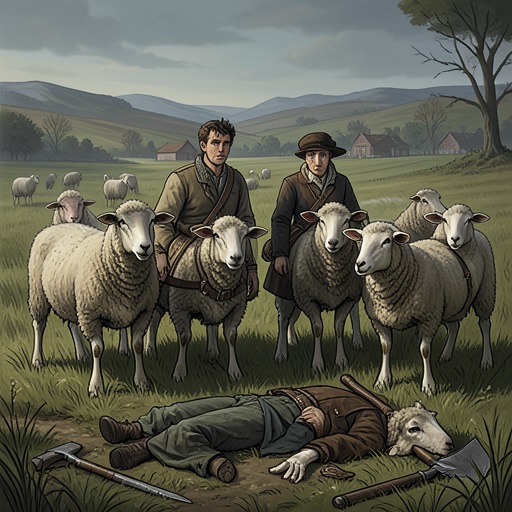
The wolf is on the inside
Three Bags FullThe wolf is on the inside is Fosco’s compact, unsettling answer when Zora asks about the wolf. The exchange turns an image of an external threat into one of inwardness, then follows the flock’s attempt to make sense of that reversal: Zora can imagine falling into an abyss, but not falling inside oneself. The phrase’s force lies partly in this unresolved gap between Fosco’s account and the sheep’s understanding.
The Exchange and Its Image
After a stretch of silence, Zora raises her head and asks, “What about the wolf?” Fosco replies, “The wolf is on the inside.” His answer does not explain what the wolf is or describe how it got there. Instead, it relocates the image: the wolf is not presented as something simply approaching from outside, but as something internal. The expression therefore offers a direction for thought without supplying a definite account of the wolf’s nature.
Zora tests this unfamiliar idea by comparing it to The Abyss. She asks whether the wolf is like an abyss within oneself, and Fosco agrees that it is like one. That agreement makes the comparison available to her, but it does not make the underlying experience intelligible. The image carries a sense of inward depth, while leaving unanswered what that depth contains and what it means for the wolf to be there.
Zora’s Test of the Metaphor
The most revealing part of the exchange is the distinction Zora draws between two kinds of falling. She can understand falling into an abyss: the image gives her a fall and a destination she can conceive. Falling inside oneself is different. Her hesitation exposes the limit of the comparison rather than resolving it; the word abyss helps her approach Fosco’s idea, but cannot make the inward movement comprehensible to her.
Zora consequently says that this is not something sheep can understand. Fosco agrees, repeating that it is not something sheep can understand. Their shared conclusion establishes a boundary in the conversation: they have found language for the image, but not a way to translate it into an experience the flock can grasp. The phrase is thus presented as an explanation that remains, even to its listeners, partly beyond explanation.
Limits and Narrative Effect
The scene gives no further definition of the wolf, so the phrase should not be mistaken for a fully explained doctrine. Its meaning remains concentrated in the contrast between outside and inside, and in Zora’s attempt to measure the unfamiliar against an abyss. The dialogue allows the metaphor to resonate without deciding exactly what the wolf represents.
The surrounding reactions sharpen that incompleteness. The flock has been silent while digesting what it heard from Fosco; in the hall, Beth has stopped talking, and the humans are agitated. After Zora and Fosco acknowledge what sheep cannot understand, Miss Maple remains baffled and ends the discussion by saying, “Well, it got out. Let’s go home.” Her words return the scene from a difficult inward image to the practical movement of the flock. The phrase remains unresolved, but the conversation has made its central distinction plain: the wolf is imagined not merely as an outside danger, but as something within, a possibility the sheep can approach through metaphor without claiming to comprehend.