Things
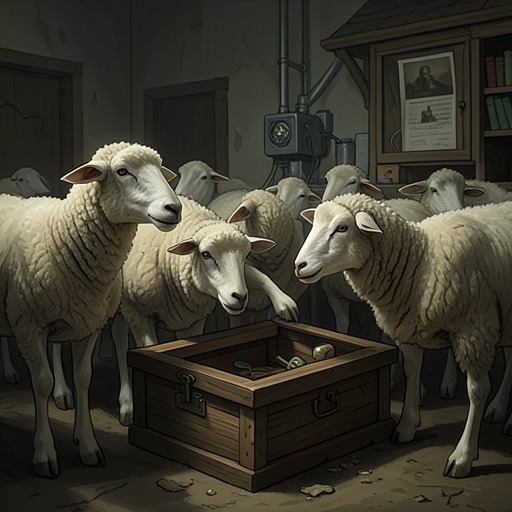
Three Bags FullThings are the human-made objects the flock struggles to interpret: useful or ordinary to people, but strange, sign-bearing presences to sheep. Heather’s discovery of a circular chain after George Glenn’s death sharpens that difference. What first enchants her becomes, in Miss Maple’s reading, a possible trace of the murderer. The concept therefore joins the book’s comic contrast between human and sheep perception to its central inquiry into how material objects can carry evidence and connect people to events.
A Sheep’s Category of Human Objects
The sheep do not approach human possessions as transparent tools. A Thing has to be examined for what it is, what its marks might mean, and why a human might be attached to it. When Miss Maple asks what kind of Thing Heather has found, Heather cannot settle on the human category of beauty. Instead, she describes the object through its apparent endlessness: it has no end. That answer reveals both her fascination and the limits of the flock’s vocabulary. The Thing’s striking feature is not its practical use but a quality that seems to challenge the sheep’s expectation that things have boundaries.
The flock’s replies expose how far apart their assumptions are. Sara insists that everything has an end; Zora considers the larger possibility that without endings there could be nothing else at all. Heather then revises her account: the object bears two signs like marks in books and might be a story rather than a Thing. Its resemblance to a chain, and the fact that one can look at it without finding an end, make it seem almost inexhaustible. The exchange gives the object a double character: it is physically small, yet its unfamiliar marks and circular form invite interpretation beyond its material size.
The human world appears more broadly as a world organized around Things. A later reflection contrasts silk, made from caterpillars whose bodies humans boil and strip, with wool taken from shorn sheep. People accept either material as clothing so long as it is white and warm, yet the passage imagines them as still naked before Things: exposed to, betrayed by, and implicated in the objects around them. This is not simply a catalogue of human possessions. It presents human dependence on material things as a condition that makes people vulnerable as well as powerful, and sets that dependence beside the sheep’s own experience of being shorn.
Heather’s Discovery and the Circle
Heather found the marked circular chain pendant in the meadow soon after George Glenn’s death. She let it hold her attention, then covered it with a stone to keep it safe. On the day she confessed, she had picked it up in her mouth and hidden it beneath the dolmen while Sir Ritchfield counted the flock. Ashamed of having concealed it and unwilling to see it again, she told the others what she had done. Her changing relationship to the object—from secret fascination to confession—makes it an immediate test of the flock’s ideas about Things: it can attract, trouble, and divide attention even before anyone understands its significance.
The sheep’s expedition to the dolmen begins as an effort to put the Thing where they believe it belongs: on the ground, away from sheep. Fear of the wolf’s ghost makes the night journey unsettling, and the party forms through a mixture of duty, curiosity, and reluctance. Sir Ritchfield leads; Miss Maple is plainly eager to inspect the object; Maude and Zora join for different reasons; and Mopple the Whale cannot escape the obligation because he is the memory sheep. At the tomb, Othello scrapes away earth with his hooves. A shaft of moonlight finally falls on what the sheep had been unable to see clearly in shadow.
The revelation is deliberately anticlimactic. The flock had half expected something beautiful, but the object proves to be a thin chain with a piece of metal, its endlessness no more mysterious than the circle it forms. Sir Ritchfield can identify two marks on it: one sharp and beak-like, the other resembling a stomach on two legs. He decides that the signs stand for one of the Two Legs and calls the object a bad sign. His confident interpretation does not solve the mystery; it shows how readily the sheep turn unfamiliar marks into a warning when the human system behind them is unavailable to them.
From Thing to Clue
The object’s meaning changes when Miss Maple refuses to discard it. While the others consider what should be done with it, she recognizes that its arrival after George Glenn’s death may matter. It could have been dropped by the murderer, she proposes, comparing the possibility to the way animals leave droppings. Mopple objects that the Thing does not smell like droppings, a response that brings the flock’s sensory habits into comic collision with Miss Maple’s reasoning. Her point is not that the chain resembles evidence in a sheep’s world, but that it may connect a human being to a place and an event.
Miss Maple extends that insight into a method: human beings are attached to Things, and Things attach themselves to human beings. If the flock watches such objects closely, she argues, it may find the murderer. The chain thus ceases to be merely Heather’s secret or an incomprehensible ornament. Its presence in the meadow becomes a possible relationship-marker, something that may have passed from a person into the landscape and can lead the investigators back toward that person. The episode establishes attention to material traces as part of the flock’s detective work, even though the chain’s precise significance is not resolved here.
Objects, Memory, and Human Vulnerability
The concept also carries a darker charge in the later image of a spade. The recollection of the object makes the remembering figure shake with laughter, while sadness creeps into a hind hoof. The passage sets that bodily response against a world overwhelmed by green growth, suggesting that a Thing can return through memory as more than a neutral tool. The spade is recalled alongside laughter and sadness, and the image gives material objects an emotional afterlife without explaining away the tension between those reactions.
Across these scenes, Things are at once material objects, puzzles, and points of contact between beings. The flock’s first impulse is to classify or banish what it cannot understand; Miss Maple instead asks what connection an object might disclose. Heather’s fascination demonstrates that a Thing can command attention without yielding its meaning, while the chain’s possible evidentiary value gives that attention practical stakes. The contrast does not make the sheep’s interpretation infallible or the human one complete. It makes the objects themselves the ground on which those different ways of knowing meet.