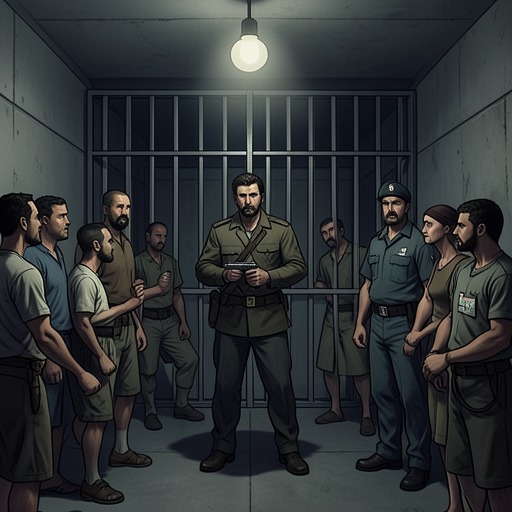
Concealed explosives for emergencies
Three SecondsThe concealed explosives are a portable, deliberately disguised reserve assembled from pentyl fuse, nitroglycerine, and a detonator. Piet Hoffmann treats them not as abstract contraband but as components to be measured, divided, and made to disappear: first among a car’s hidden stores, then inside books from Aspsås Library. Their power lies in the contrast between their compact, unremarkable packaging and the destructive force Hoffmann associates with them.
Composition and Acquisition
The explosives arrive through Lorentz as part of a larger transaction. Lorentz deducts fifty thousand kronor for the explosives, citing the short notice; the deal’s figures set that amount against a total of one million kronor for ten kilos, with nine hundred and fifty thousand paid in cash and the remainder supplied in explosives. The exchange links the material to the wider criminal economy without making it merely another commodity: Hoffmann has specified what he needs, and the components are supplied to his requirements.
The package contains pentyl fuse and nitroglycerine, with a detonator and fuse also included in the arrangement. Hoffmann presses for specifics. The fuse is not just cord, and the nitroglycerine is described as having a high detonation velocity and being packed in plastic pockets. The promised detonator and fuse complete the set of components. The materials’ small scale does not lessen their danger; Lorentz’s warning that they will produce a major explosion makes their potential consequence plain.
At home, Hoffmann opens the packages in the kitchen after moving through the garden in darkness. He does not ordinarily check deliveries from Lorentz, trusting their source, but handles this consignment directly. The fuse resembles a thin, coiled cord, about eighteen metres long. Hoffmann unwinds it, feels it, cuts it in half, and puts the two nine-metre lengths back. The nitroglycerine is divided among twenty-four flat plastic pockets, together holding four centilitres. In making the materials easier to separate and place, he also makes their quantities and individual components manageable.
A Reserve Hidden in Ordinary Things
The kitchen inspection is methodical, but it takes place in a recognizably domestic setting. The packages lie on the table where the family will eat breakfast in a few hours. Hoffmann avoids switching on lights until he is inside, partly to avoid waking Zofia and partly to avoid being seen by a family member getting up during the night. His attention moves between the hazardous parcels and the anticipated ordinary morning, a contrast that gives the explosives a place inside family life even as he works to keep them out of sight.
After dismantling a miniature revolver, Hoffmann places its pieces in a plastic bag and carries them with the eighteen metres of fuse and four centilitres of nitroglycerine. He hides these materials, along with nine hundred and fifty thousand kronor, in a brown bag behind the car’s spare tyre. The spare tyre is more than a hiding place: it makes a concealed cache out of the car’s ordinary equipment. The fuse and nitroglycerine are portable, but the text gives no account of their being used there. Their immediate role is to remain available and hidden.
Concealment Inside the Prison Library
Later, in Aspsås prison, Hoffmann turns concealment into a more elaborate operation. He has six seldom-requested books from Aspsås Library, marked for storage, as well as a plastic sleeve of nitroglycerine and pentyl fuse already cut into two nine-metre lengths. Their low circulation makes the books suitable hiding places; their ordinary status helps disguise the dangerous material inside them.
Hoffmann chooses Nineteenth Century Stockholm, the largest book, measuring twenty-two centimetres by fifteen. He cuts open the front and back of its library cover, removes the porous filling, and replaces it with the explosive and fuse. He then glues the cover back together, tidies the edges, and leafs through all six books to check that the joins are secure and the rectangular cuts cannot be seen. The work depends on the book retaining its appearance as a book: a visible cavity would defeat the concealment, while a properly repaired cover returns the dangerous contents to apparent normality.
Other components are hidden separately. In The Marionettes, Hoffmann cuts a rectangular cavity and places a detonator and a small receiver inside. The explosives are therefore part of a concealed collection that includes devices with different functions, distributed across modified library books rather than left together in a single conspicuous package. When one of Hoffmann’s sons comes to the desk and asks what he is doing, the scene brings the practical risk of concealment into the same room as the children, without showing that they understand what the books contain.
Function and Significance
The explosives’ defining feature is the way their material presence changes with context. A length of cord and a set of small transparent pockets can pass, at a glance, as harmless objects; in Hoffmann’s handling, they become measured components of a dangerous reserve. The books intensify that transformation. Their titles and library covers present ordinary reading matter, while cuts, removed filling, and carefully restored edges convert them into containers.
The reserve is prepared rather than detonated in these scenes. The narrative establishes its composition, movement, and concealment in detail, but does not show Hoffmann setting it off. That distinction matters: the explosives signify a capacity for violence and a means held in readiness, not an explosion already carried out. From Lorentz’s delivery to the hidden car cache and the reworked prison books, Hoffmann’s repeated task is to keep the dangerous object available while making it difficult to recognize. The suspense lies in the gap between what the objects appear to be and what they can do.