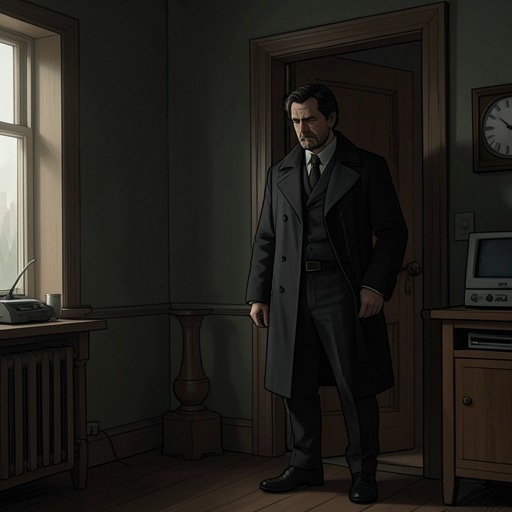
Emotional dissociation as survival
Three SecondsEmotional dissociation as survival describes Piet Hoffmann’s suppression of thought, longing, and feeling as a practical defense against mortal danger. The novel presents it not as an abstract condition but as a state he adopts inside Aspsås prison: when the operation reaches its most dangerous moment, emotional control becomes part of how he stays alive.
Adoption under prison conditions
Before entering Aspsås prison, Hoffmann has studied it from a distance, mapping its buildings from the church tower and learning about Block G’s staff and prisoners with Erik Wilson’s help. Yet his first passage through the prison gates makes the difference between preparation and confinement concrete. After registration and processing, he is given prison clothes and left in a sterile waiting room. Ten days later, he has spent most of each day alone in a small cell, with no visitors or ordinary sources of news and entertainment. The prison governs space, contact, and time; Hoffmann’s emotional shutdown takes shape within that controlled environment.
His transfer to voluntary isolation changes the form of confinement without ending it. A riot squad escorts him from Block G to the unit in Block C, where prisoners can move around shared areas but do not encounter people from other units. The apparently familiar layout—a wardens’ room, TV corner, showers, kitchen, and Ping-Pong table—exists inside a narrowed social world. Hoffmann has become accustomed to having another person nearby; isolation makes him confront how strongly solitude intensifies his longing. The contrast clarifies what the shutdown protects him from, as well as what it costs.
What the shutdown suppresses
Hoffmann’s emotional state is described through what he cannot allow himself to dwell on. He feels no fear or anxiety and keeps thoughts and longings at bay, including thoughts of Zofia, Hugo, and Rasmus. The separation is not presented as indifference to his family: their importance is precisely why he must exclude reminders of ordinary life while operating under threat. He traces the start of this state to his passage through the prison gate, making the boundary of the institution a turning point in his inner life.
The same discipline sustains him while he hides during the hostage crisis. In a confined pipe, with the prison’s electricity and ventilation shut off amid smoke and fire, he endures thirst, hunger, pain, darkness, and rising heat. As his strength and patience wear down, he reduces his horizon to a few minutes at a time. This is not a return to emotional engagement but a narrowing of attention to immediate endurance: the method helps him continue, even as he comes close to giving up.
Brief failure and recovery
The shutdown is not complete or effortless. As Hoffmann waits for the shot that is meant to kill him, he has arranged the scene so that the apparent death will support his escape: he stands in profile by a window, with an earpiece, a concealed body and explosives, and an ignition fuse. When he hears the order to fire through the receiver, he is supposed to remain in position, but his legs move before he intends them to. Twice, his control fails.
The narration marks the return of control as brief and consequential. Hoffmann loses the detached state for two seconds as the shot is about to be fired; on the third attempt, he suppresses thought, feeling, and longing again. He stands firm when the shot comes. The scene connects emotional numbness not only to prolonged imprisonment but to a precise survival task: maintaining the appearance of a victim long enough for the staged death to work.
Function and limits
Across these episodes, dissociation is a tool with a cost, not a permanent absence of attachment or fear. It helps Hoffmann tolerate isolation, physical deprivation, and the prospect of being shot by concentrating his attention and excluding emotional demands. Yet the remembered longing for company and the two-second lapse show that the state can weaken under pressure. Its decisive function is temporary control: it allows him to perform the role required by his escape plan, then reassert itself at the moment when wavering could expose him.