Ewert Grens
Three SecondsEwert Grens is a lifelong homicide investigator whose work brings him to the collision point between an unsolved murder and the police’s concealed use of criminal informants. His pursuit of the truth is also personal: the investigation unfolds alongside signs of a private life he has tried to put away, and culminates in a decision he believes may have cost a man his life.
Identity and Background
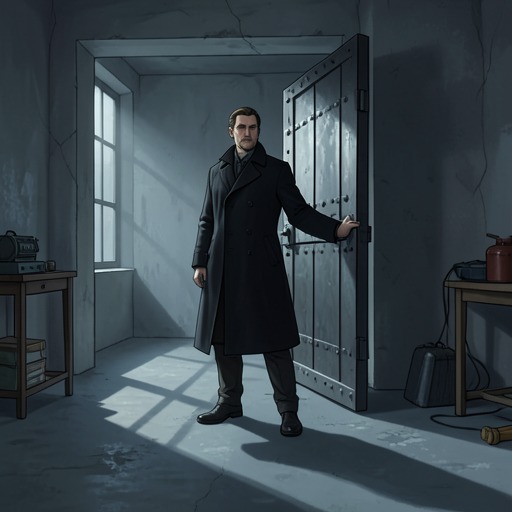
Grens has investigated murders for as long as the victim in the Västmannagatan 79 case had been alive. He approaches each death as singular, carrying its own sequence and consequences; certainty about the physical evidence does not mean certainty about the human story. In the homicide unit, his work is set against the long, dark corridors familiar to his colleague Sven Sundkvist, who has spent his adult working life with the City Police. Sven’s quiet habit of sitting with Grens without pressing him for explanations gives their professional partnership a personal steadiness.
The investigation also runs beside Grens’s unresolved loss. On the drive to Västmannagatan, his colleague Mariana Hermansson finds four old Siw Andersson mix cassettes in the car. Grens hides them under the seat, afraid both of having them near him and of forgetting to take them away. He intends to keep those last remnants of another life sealed in a taped cardboard box. Elsewhere, passing the cemetery near Haga, he hesitates before continuing along the E4, imagining that he might return and drive slowly past people tending graves. His grief is not explained away; it appears in these acts of avoidance and delay.
The Västmannagatan 79 Investigation
The case at Västmannagatan 79 presents Grens with an apparent chain of evidence that does not quite hold together. The victim is identified as an informant for the Danish police; investigators find traces of amphetamine and evidence connected to drug couriers, establish the direction of the gunfire, and learn that another Swedish-speaking person was in the flat. That person raised the alarm, and Grens has listened to the recording so repeatedly that the voice has become part of his own sense of the case. Yet the assembled facts leave him with a persistent feeling that something is missing.
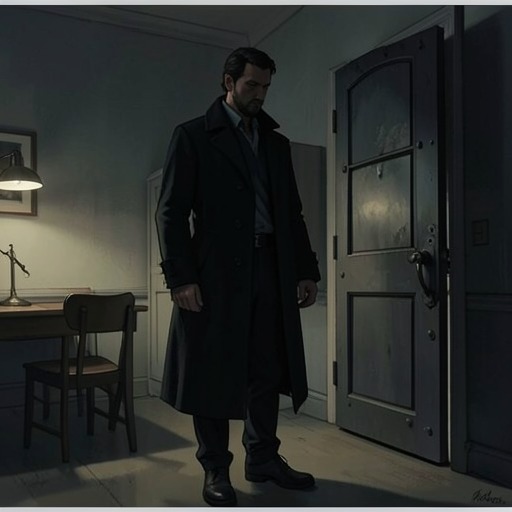
Grens’s suspicion survives even as the investigation appears to have its basic answers. A body, a location, physical traces, and a witness voice offer the outline of an explanation, but not a satisfying account of what happened. He returns to the case while it is stalled, taking a thin file to the office where the investigation continues after the rest of the unit has gone quiet. His attention is not simply on collecting more evidence; he is testing whether the official story can accommodate what the evidence already says.
A possible lead emerges through the Radom 9mm pistol. For the first time since the preliminary investigation began, Grens has a name and a possible connection to an execution. The lead does not resolve the case, but it changes its shape: the murder may link the local scene to a wider chain of violence. Grens holds onto the discovery after the conversation has ended, a coffee-stained sheet and crumbs in his hand, as though the tentative connection might otherwise disappear.
Command at Aspsås
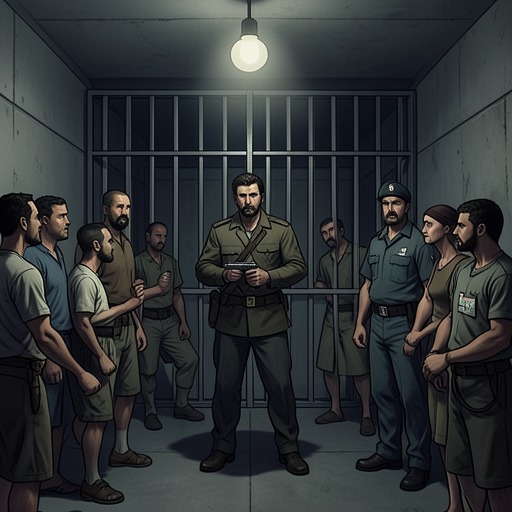
When the crisis at Aspsås Prison turns into a siege, Grens moves from investigating the case to bearing direct responsibility for lives inside the prison. A room with a small wooden altar becomes the command post: drawings of the prison cover the surfaces, and empty or half-finished coffee cups mark the long hours of discussion. Grens moves among Edvardson, Sven Sundkvist, and Mariana Hermansson after taking command. He is resolute and focused on finding a solution, but the decision ahead is his alone.
The stakes are not abstract to him. Looking toward Hoffmann behind reinforced glass, Grens understands that the authorities’ response is shaped by the elderly prison warden held inside: the threat to that guard is what makes the situation urgent. The contrast forces Grens to confront how the value assigned to a hostage can determine the effort made to save him. As the crisis narrows toward a decision, Grens leaves the crowded command post and stands alone in a church tower, uncertain whether he has the courage to decide that another person should live or die—and to carry the consequences afterward.
Grens orders a lethal shot at Hoffmann, crossing a boundary he has never crossed before. Three days later, he recognizes that the decision he had dreaded throughout his working life was not merely an operational choice: he had fired a lethal shot at another person. The act gives the siege a lasting personal cost, even before he learns that the man he ordered shot had worked for the city police.
The Informant System and the Final Reversal
The investigation eventually turns back on Grens’s own lethal order. He finds confirmation in the records that the man he had ordered shot had worked for the city police. The discovery reframes the siege: Hoffmann was not simply the suspected criminal at the center of the crisis, but a covert police informant whose role had been concealed from the investigators making decisions about him.
Grens follows that revelation into a larger body of records. Looking back exactly one year, he finds 302 secret intelligence reports, several concerning cases he recognizes. They describe informants whose work to expose one crime had generated or obscured another, while investigations collapsed despite relevant knowledge already held within the police. The reports disclose a second, hidden track beside ordinary case files: information gathered for police management that did not reach the official investigations Grens and his colleagues conducted.
The implications extend beyond Hoffmann’s case. The police service had used criminals as covert human intelligence sources for years while denying and concealing the practice. Crimes committed in connection with informant work had been marginalized so that other crimes could be investigated, and preliminary investigations and trials had proceeded without correct information. What Grens uncovers is not a single error but a concealed operating system that compromised the truth available to investigators and courts.
The truth also unsettles his certainty about the shot. After nearly three hours at his desk, facing the unfillable gap in the bookshelf, Grens recognizes that he has found something decisive; the realization is that Hoffmann is alive. The man he believed he had ordered to his death survived, so the act Grens had carried as a final decision did not produce the outcome he feared. The discovery does not erase his responsibility: it changes what that responsibility means, while exposing how little he had been allowed to know when he made the choice.