Government Offices of Sweden
Three SecondsThe Government Offices of Sweden matter to the novel less as an abstract seat of administration than as a place where a covert arrangement leaves a trace. At Rosenbad, a meeting brings together a state secretary from the Ministry of Justice, the informant known as Paula, Paula’s handler, the country’s most senior police officer, and Göransson, the police manager linking the investigation to its concealed intelligence operation. Visitor records, security footage, and a recording allow Ewert Grens to reconstruct who entered the building and connect the meeting to Piet Hoffmann. The offices thus become both the setting for official secrecy and the site where that secrecy becomes vulnerable to evidence.
The Government Offices as a setting
The relevant scenes identify Rosenbad as the location of a state secretary’s office and place the meeting inside the Government Offices. The building is not merely a backdrop: its sign-in book and surveillance system make arrivals legible, while the meeting held within it remains hidden from the detective investigating the Västmannagatan 79 case. The contrast is central. The institution’s ordinary procedures preserve a record of access, but those records do not explain the purpose of the gathering; Grens has to assemble its meaning from separate sources.
The novel does not establish that the Government Offices as a whole directed the police operation or shared the participants’ knowledge. It depicts particular officials and police figures meeting there. That distinction matters: the evidence implicates a small group operating across institutional roles, rather than proving collective knowledge throughout the government administration. The building’s significance comes from the convergence it hosts and from the documentary trail its security arrangements inadvertently preserve.
The May 10 meeting
A recording Grens examines is identified as coming from the Government Offices on Tuesday, May 10. Its voice is the one he recognizes as Hoffmann’s. In reconstructing the gathering, Grens draws a table and five circles: one for a likely state secretary from the Ministry of Justice, one for the person calling himself Paula, one for Paula’s handler, one for the country’s most senior police officer, and one for Göransson. The arrangement brings together government and police authority with the undercover source at the center of the operation.
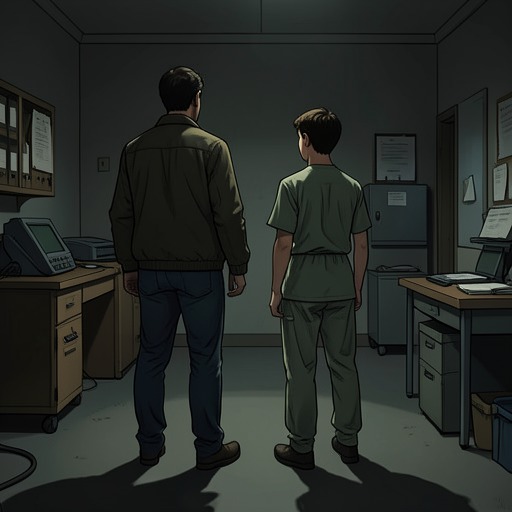
The visitor book provides a separate route into the same meeting. On May 10, the state secretary had four visitors, who arrived separately within twenty-five minutes: the national police commissioner, Göransson, Erik Wilson, and, at 15:36, Piet Hoffmann. The security footage fills in the sequence. At the entrance, each visitor signs in without looking up at the camera. On the second floor, the commissioner and Göransson enter the state secretary’s office within minutes of one another; Wilson arrives twenty minutes later, and Hoffmann follows about seven minutes after Wilson. The book and footage together turn a list of names and times into a reconstruction of a coordinated encounter.
Surveillance, records, and discovery
The Government Offices’ cameras occupy two identified positions: one above the glass security desk and another in the second-floor corridor, opposite the state secretary’s office. Footage from the cameras shows five people entering a room within a short period. In one still, a man stands with his arms out while another searches him. Grens explains that the man being searched has a criminal record and was then working as an informant for the city police; the person searching him is a chief superintendent. He looks toward Göransson as he makes the point, tying the image to the police hierarchy implicated in the meeting.
Grens’s investigation also exposes a gap in the building’s own record-keeping. He looks directly into a corridor camera, echoing the informant’s earlier look into the lens. At roughly the same time, a security employee opens a control-room door and discovers that two numbered security tapes are missing from a metal shelf. The narrative does not identify who removed them or establish that their disappearance was ordered by the meeting’s participants. Instead, the missing tapes sharpen the contrast between the footage Grens has obtained and the evidence that is no longer available.
The audio and visual evidence reach Grens through different routes. He hears Hoffmann’s voice on a disk marked with the date and the Government Offices location. He also obtains camera footage showing the visitors and their movements through the building. When he presents the material, he distinguishes a police laptop from his own CD player, which Lars Ågestam had given him years earlier and which he had only recently begun using to listen to recordings. The distinction underscores how the investigation depends on evidence assembled outside a single official channel.
Institutional consequence and narrative role
The meeting changes the meaning of Grens’s stalled murder investigation. Göransson is not simply a senior officer above him: he is Grens’s immediate manager and Erik Wilson’s manager, responsible for both their workloads, and the meeting helps explain why the Västmannagatan 79 case has produced no answers. The information that had appeared to be an unexplained investigative failure now points toward concealed knowledge about Hoffmann’s informant role. The offices provide the setting in which those separate strands become connected, but the visitor log and recordings—not an official disclosure—enable Grens to make that connection.
The episode also places Rosenbad’s meeting beside the pressure exerted on prison administration. At Aspsås, the chief warden is told by a director general that Grens must not be allowed to question Hoffmann, and is given no explanation for the restriction. The evidence does not identify that caller as one of the five people at Rosenbad. Read together, however, the scenes show the consequences of the hidden operation reaching beyond the government building: a detective’s access to a prisoner is restricted while records from the May 10 gathering point back toward the officials and police figures who knew about the informant.
As a narrative location, the Government Offices are therefore a threshold between public authority and concealed action. Their cameras and sign-in book make the participants’ passage visible; the meeting’s purpose remains obscured until Grens combines those traces with a voice recording and his knowledge of the investigation. Rosenbad does not resolve the case by itself. It supplies the coordinates—people, times, room, image, and voice—that expose how the official account and the hidden operation diverge.