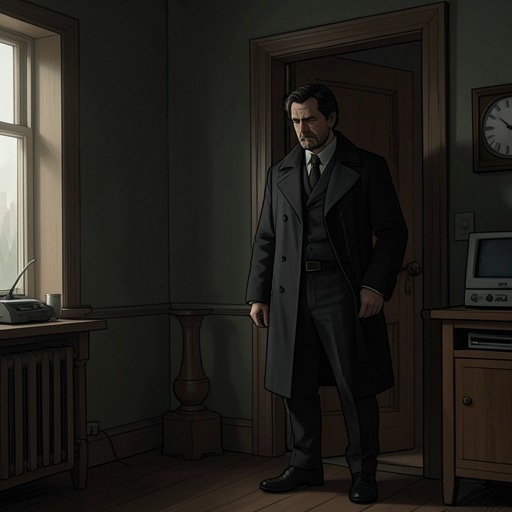
Hoffmann escapes from Aspsås prison
Three SecondsHoffmann escapes from Aspsås Prison by turning the institution’s own routines and architecture into a route out. After an explosion provides cover, he hides in a ventilation shaft, waits for a shift change, and walks through the prison in a guard’s uniform. His exit depends not on force but on timing, observation, and exploiting the unfamiliarity of temporary staff; the passage through the gate is the culmination of a prison identity he has carefully constructed and performed.
From staged inmate to threatened prisoner
Hoffmann’s escape follows his arrival at Aspsås, where he had never before been inside the prison walls. Though he had studied its buildings from the church tower and learned about Block G’s prisoners and staff while on remand, intake made the prison’s control of bodies and movement immediate. He was searched, issued clothes, and placed in a sterile waiting room. Ten days later, he had spent twenty-three hours a day alone in a small cell, without visitors or access to newspapers, television, or radio. The isolation and its strict limits on time and contact formed the setting in which he had to make a life inside the prison.
Once placed in a unit, he studied how its social order worked as closely as its physical layout. Before the other prisoners returned, he sat in the television corner where everyone would see him. He took a seat and marked cards already associated with someone else, making his arrival visible rather than waiting to be accepted. Two of the prisoners he particularly needed to reach were Stefan Lygas and Karol Tomasz Penderecki, members of Wojtek who had been serving long sentences at Aspsås. They were his helpers in removing competitors and taking control of the prison drug market, but would become executioners if his identity as Paula were exposed.
That criminal standing was supported by information as well as performance. Lygas and Penderecki had prepared the other prisoners for Hoffmann’s arrival and obtained copies of police, criminal-intelligence, prison, and court records through Lygas’s lawyer. At supper, two older prisoners demanded to see his papers. Hoffmann let them ask their questions while Lygas and Penderecki held back, turning the confrontation into a test of status and respect. He had already taken a first step in the prison’s drug economy: with forty-two grams of manufactured amphetamine at thirty percent strength, he had brought down three principal dealers. Reports had reached Warsaw, where the next stage of the operation was being marked.
Isolation, exposure, and the blast
The balance that Hoffmann had established did not last. When he believed he was about to be exposed, he used the prison’s voluntary-isolation procedure as a way to escape the immediate reach of other prisoners. Ten members of the prison riot squad, equipped with helmets, shields, and sedatives, entered Block G. Six remained to discourage further violence, while four escorted him to the voluntary-isolation unit in Block C. The move changed his immediate surroundings but did not make him safe: the unit’s residents were a closed circle, and the threat of exposure remained.
Hoffmann later understood that one of four people had betrayed him—the same person he had regarded as protection and a possible means of escape. During the hostage crisis, the explosion left him on the floor, temporarily unconscious and with severely impaired hearing. Smoke filled the workshop, and he waited until it had spread through the opening where a window had been. In the confusion, police were on the roof responding to the hostage drama, while the smoke obscured much of the building. The blast did not simply mark the crisis’s climax; it created the cover he needed to disappear from the place where officers believed he had been.
The route through the prison
Hoffmann took the older guard’s uniform and threw the clothes out through the window before jumping onto a roof a few metres below. He moved across it toward a metal structure that concealed a ventilation shaft. Climbing down inside, he kept his arms and legs against the walls until the passage narrowed and his grip became difficult; then he let himself fall the remaining distance to the bottom. The shaft was about sixty centimetres in diameter and led back into the building. He crawled along it until he was above a substation with a door opening onto a lower prison passage.
There he concealed himself with the uniform clothes beneath his head and planned to remain for at least three days. He did not intend to sleep or dream; his immediate purpose was to wait without drawing attention. When he eventually prepared to move, the watch showed five minutes to eight. He allowed another fifteen minutes to pass, avoiding the guards finishing their shifts because they had seen his face. The dark substation’s fifty-seven coloured lights surrounded the wait, while the loss of much of his hearing made it harder to judge movement beyond the door.
He chose the incoming night shift because those officers had started work after lock-up and had not met the prisoners. Three wardens were about twenty metres down the passage joining Block G to central security. The older one carried the keys; the two younger staff members were newly qualified and in only their first days at work. Hoffmann approached them as if he belonged with them. When they reached a locked security door, he joined their passage through it, presenting himself as another member of the group rather than as an escaped prisoner.
Passing the gate
The deception depended on the temporary wardens’ inexperience. At the end of May, Aspsås relied on a large influx of summer staff who received a brief introduction and a two-day course before beginning work. Hoffmann learned that the three walking with him were on their third day and due to have their first day carrying keys the next day. Their shared unfamiliarity made his disguise plausible: he was now simply one of four wardens moving toward central security and the main gate.
At the reception area, he faced three possible doors. The route past central security led through the glass control room, where monitors and numbered switches governed the locked doors. Two guards were inside. One was a bearded man at the front; the thinner man behind him, around fifty and apparently senior, was someone Hoffmann recognized. The explosion had damaged Hoffmann’s hearing and balance, but he kept his posture controlled as he entered the final stretch. The recognition mattered: Lennart Oscarsson remained immediately behind him. Hoffmann turned and nodded toward a guard who was gesturing irritably, and he and Oscarsson met eyes. No alarm followed, and no one moved to stop him.
At the metal detector and the door opened from within the glass control room, the disguise held. The clean-shaven man with cropped hair left through the gate wearing a warden’s uniform. He had passed among staff whose faces and experience offered him a narrow opening, while the prison’s own doors, shift patterns, and divided responsibilities supplied the route. The escape ends with Hoffmann outside the prison wall, apparently just another temporary employee going home. The contrast with his arrival in leg irons is decisive: the institution that first controlled every movement has become a system he can cross by reading its routines better than the people enforcing them.