Hoffmann's explosive decoy
Three SecondsHoffmann's explosive decoy was a staged death device built around a body concealed beneath a rug and a precisely timed explosion. It allowed a sniper's shot to appear to kill him while the blast and smoke hid his escape from the prison workshop. The arrangement depended on the apparent body, the shot, and the explosion reading as one event; later, Ewert Grens pieced together how its separate parts had made that deception possible.
Construction and Timing
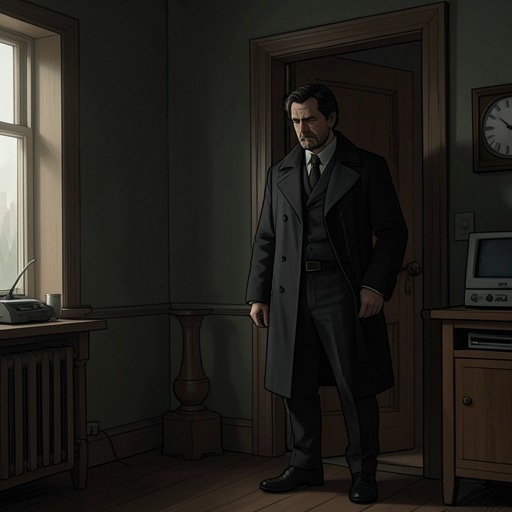
The plan was arranged around the moment a sniper fired from the church tower at a workshop window. Before the shot, Hoffmann stood by the window and adjusted his earpiece, with the body beneath the rug and a barrel of diesel and gas nearby. He positioned himself in profile so that the sniper would aim at his head, helping make the apparent death seem consistent with the shot. The decoy therefore relied not on the explosion alone but on the scene being read in a particular way: the shot would seem to strike Hoffmann, and the blast would erase the evidence needed to question that account.
The timing left almost no margin. The bullet had a three-second flight from the church tower to the workshop window, a distance of 1,503 meters. Hoffmann waited for the shot, then moved forward as the bullet hit the window and lit a fuse attached to the concealed body. He had two seconds to reach a concrete pillar before the fuse reached its detonator. The sequence made the sniper's shot a cue for the explosion, joining an external act of violence to a mechanism already prepared inside the workshop.
The rug had a practical role in the device's design. In the later investigation, the sniper-and-observer transcript drew Grens's attention to the rug and to what had been attached to it. His review established that the rug was tied with a pentyl fuse and could direct the blast pressure downward, helping protect someone standing nearby. The concealed charge included nitroglycerine, packed around the body in small plastic bags, as the principal prison officer Jacobson later described in an interview. In the scene itself, Hoffmann took cover behind the pillar; the explosion followed as the final length of fuse disappeared.
Detonation and Escape
The blast damaged the workshop, collapsing two walls and blowing the shattered window into the prison yard. The concrete pillar and the rug over the concealed body dampened the pressure reaching Hoffmann; he was unconscious only briefly and survived. As the explosion’s heat reached the nearby diesel barrel, black smoke filled the room. Hoffmann waited for the smoke to pour through the opening where the window had been, spreading a dark screen across much of the workshop building. Under that cover, he threw the older guard’s uniform clothes out through the window and jumped after them onto a roof a few metres below. The decoy’s effect therefore depended on more than the staged shot and explosion: the smoke concealed the transition from apparent death to escape.
Grens’s Reconstruction
After the escape, Ewert Grens spent two days moving frame by frame through Aspsås prison’s security-camera tapes, comparing the images with forensic and autopsy reports and interviews conducted by Sven Sundkvist and Mariana Hermansson. The critical clues were not simply the explosion’s aftermath but details embedded in testimony and recorded conversation: a transcript of the sniper and observer before the shot, and prison officer Jacobson’s account of what Hoffmann had placed over the hostage. Grens’s reconstruction turned those scattered records into an explanation of how the apparent killing had been staged.
Grens laughed aloud in his office, then left police headquarters and drove to Aspsås. There, he requested prison-camera footage beginning at 2:26 p.m. on May 27 and sat down with fresh coffee to watch what had happened after the shot from the church tower. The explosive decoy thus persisted beyond its moment of detonation: its apparent success shaped the official investigation, while the same surviving records gave Grens a route back through the scene.
The Body as Evidence
The decoy’s final function was to prevent the concealed body from being identified after the explosion. Jacobson’s account, later corroborated by Grens’s investigation, established that the body had been covered with plastic bags containing enough nitroglycerine to make identification impossible. This made the body more than a hidden component of the device: it could stand in for Hoffmann within the scene of the apparent killing, while the blast removed the means of checking that assumption. The deception depended not only on what the shot and explosion appeared to show, but also on the absence of evidence that might disprove it.