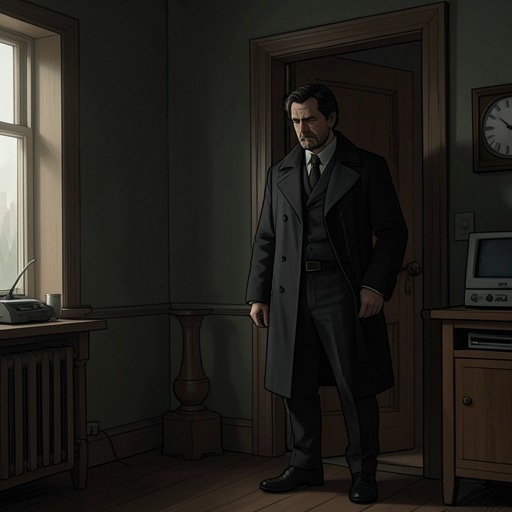
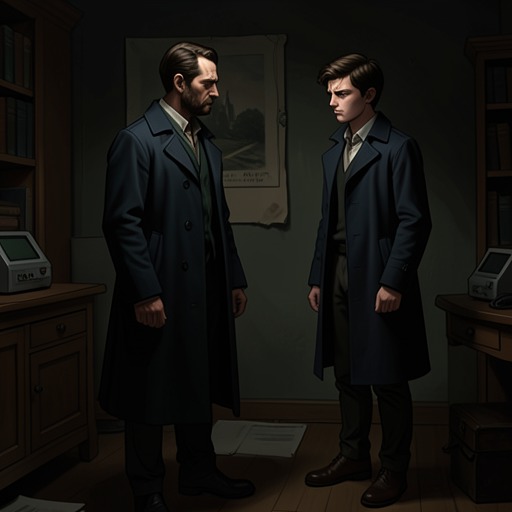
Hoffmann’s vow not to involve his family in undercover work
Three SecondsHoffmann’s vow not to involve his family in undercover work is a personal boundary he sets at the beginning of his career as a police informant: whatever risks the role demands, he will not make the people he loves bear them. Its force lies in the difference between a promise made to himself and the repeated secrecy on which his work depends. When he breaks that boundary by leaving his sons alone in a car while he goes inside, he does not treat the lapse as a minor practical compromise. He sees it as a betrayal of the principle that had allowed him to respect himself.
The Rule and Its First Near-Breach
From the time he was recruited, Hoffmann had promised himself that he would never put anyone he loved in danger. He frames the rule as part of his identity, not as an instruction imposed by his handlers: protecting his family is the condition he sets on his participation in undercover work. The absolute terms matter. This is not merely a wish to keep his cases private; it is a commitment not to make Zofia or the boys participants in the danger and deception surrounding him.
The boundary had come close to being crossed before. A few years earlier, Zofia had invited two unexpected visitors in for coffee, unaware that they were senior figures from the organization checking on Hoffmann as his status rose. He later explained that they were clients, and she believed him. The episode leaves the family outside the truth, but only because Hoffmann supplies a convincing false account. His vow therefore operates in an uneasy space: he intends to shield his family from the operation, yet maintaining that separation already requires lying to them.
The Breach at the Car
The more direct violation occurs when Rasmus and Hugo are with Hoffmann in the car. Both boys are feverish; after Calpol takes effect, they lie on the back seat, with Hugo partly on top of Rasmus. Hoffmann feels something he identifies as possibly shame and apologizes inwardly for their being there. He knows they should not have been brought into the situation, even temporarily.
Before leaving, he leans over the back seat and kisses their cooler foreheads. He tells them he must go away for a very short while and asks them to sit still. Then he locks the car door and goes inside. The sequence makes the breach concrete: the promise is not broken through an abstract change of policy but through the immediate decision to leave his children on their own while he attends to something connected to the concealed world around him. Erik Wilson, already watching from a second-floor window as Hoffmann crosses the communal gardens in his Paula role, is nearby in the operation’s choreography; the boys, by contrast, have no knowledge of that role or the surrounding circumstances.
The moment is limited in duration, but the narrative gives it lasting moral weight. Hoffmann calls it the only time and promises himself it will never happen again. That assurance does not undo the act. It shows instead that he understands the rule as still binding precisely when he has violated it.
Self-Deception and the Cost of the Broken Promise
Later, Hoffmann judges the breach through the harsher standard he has applied to other people. He had despised those who lied to themselves, including men he encountered in prison. Now he recognizes that he has crossed his own stated line: he had insisted that he would never use his family for lies or force Zofia and the boys to become entangled in them, and he has done so himself. His conclusion is not that circumstances have excused him. He says, in effect, that he has only himself to blame and acknowledges that he has lied to himself.
That judgment reaches beyond the single decision to leave the boys in the car. The rule had helped preserve a picture of himself as someone who could inhabit a false identity without allowing it to consume his private moral life. Once he uses the family he meant to protect as part of the practical conditions of his work, that distinction collapses. He feels that there is nothing left in himself that he can like. The vow’s failure thus becomes a crisis of self-recognition: the damage is not only the risk imposed on his family, but the discovery that his own conduct has begun to resemble the conduct he condemned.
A Private Boundary in a Compromised System
The vow also stands against the wider institutional environment of the novel. The Swedish Police Service uses criminals as covert human intelligence sources while denying and concealing the relationship; information is altered to create credible criminal backgrounds, and crimes may be marginalized so that other crimes can be investigated. The novel’s closing account describes exposed informants as outlaws whom the authorities deny having used, leaving the infiltrated organization to respond to the exposure. These practices establish a system in which deception and danger are not exceptional side effects but recurring conditions of covert policing.
Hoffmann’s promise does not reform that system or guarantee that secrecy will keep his family safe. It is a personal restraint within an operation that repeatedly depends on false identities and hidden knowledge. The earlier story about Zofia serving coffee to senior officials shows how readily the family home can come within reach of the work, even when she believes the visitors are clients. The later scene with the boys makes that proximity harder to disguise: he has not told them what is happening, but they are physically present and left alone while he continues the operation.
The vow therefore functions both as a protection he tries to provide and as a standard by which he exposes his own failure. Its absolute wording cannot coexist easily with an undercover life built on concealment, but the text does not present that contradiction as permission to abandon it. Instead, Hoffmann’s shame marks the difference between recognizing the demands of the role and accepting that those demands erase his responsibility to the people he loves.