Isolation and extraction protocol after undercover identity exposure
Three SecondsThe Isolation and extraction protocol after undercover identity exposure is the survival procedure Erik Wilson gives Piet Hoffmann for the moment his cover is about to fail inside prison. Escape is not treated as a realistic immediate option: Hoffmann is to request voluntary isolation, contact his handlers after reaching protection, and wait for the papers needed to remove him. The protocol gives him a narrow route through a closed institution, but its application also exposes the limits of protection when an informant’s identity and the channels around him may already be compromised.
Purpose and trigger
Wilson presents the procedure as a contingency for exposure, not as a general prison routine. The premise is starkly practical: a prisoner cannot get far on his own, while a request for isolation can move him away from the unit where the danger has arisen. The trigger is the imminent disclosure of Hoffmann’s undercover identity, when remaining among the other prisoners could make him vulnerable to a death sentence carried out inside the prison.
The advice is framed around survival rather than escape in the moment. Hoffmann is to invoke the prison’s available protective mechanism first; only once that protection is in place is he to contact the people outside. The order matters: the protocol does not ask him to risk reaching a handler while still exposed in the ordinary unit. It makes isolation the necessary first step between a failed cover and an attempted extraction.
The promised sequence
Wilson describes a three-part process. Hoffmann must ask to be put in isolation, make contact after he has secured that protection, and then wait for a week while the necessary papers are arranged for someone to come and get him out. The interval makes clear that extraction is not instantaneous. The procedure depends on Hoffmann enduring a period of confinement while an external administrative process is completed.
This timetable gives the contingency both a promise and a limit. Wilson offers a defined expectation—one week for the papers and the arrival of a rescuer—but the immediate responsibility remains with Hoffmann: he must recognize the danger, request the correct form of protection, and survive until help can be organized. The procedure therefore relies on a sequence of decisions and institutional actions rather than a single rescue at the moment his cover is threatened.
From contingency to isolation at Aspsås
The plan is discussed before Hoffmann enters Aspsås Prison. His arrest and admission are staged around the fabricated profile of a documented, dangerous criminal, and the authorities transport him into the high-security institution under that identity. His arrival is the first time he has actually been inside the prison, despite having studied its buildings from the church tower and learning about its staff and prisoners with Wilson’s help. This preparatory knowledge supports his undercover role, but it does not remove the danger the isolation procedure is designed to address.
The account distinguishes the protocol from the confinement that accompanies his initial prison placement. After ten days, Hoffmann has spent twenty-three hours a day in a small cell, without visitors or ordinary media. He then receives a guided introduction to the unit’s routines before settling into his cell. That initial separation is part of his entry into prison; the later move to voluntary isolation is a specific response to exposure. Treating them as the same measure would obscure the protocol’s purpose: the later transfer is triggered by a new threat and is meant to protect him from other prisoners.
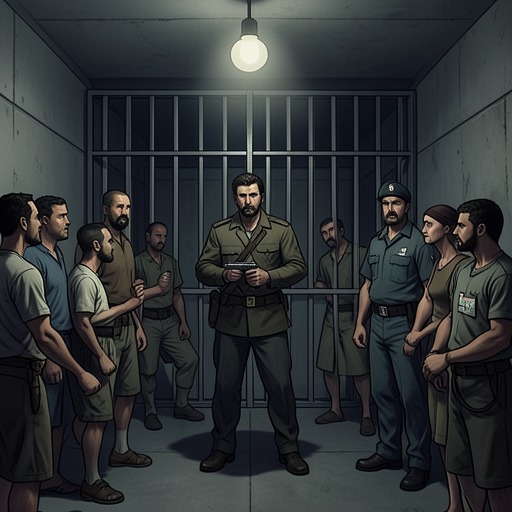
When the danger arises, ten members of the prison riot squad enter Block G wearing protective equipment and carrying sedatives. Six remain to deter further violence, while four escort Hoffmann through the prison to the voluntary-isolation unit in Block C. The movement enacts the procedure’s central logic: remove the threatened prisoner from the unit where the danger has developed and place him in a controlled, separate environment. The transfer is carried out by a coordinated staff response, not by Hoffmann escaping on his own.
What isolation can—and cannot—secure
The voluntary-isolation unit resembles an ordinary prison unit in its basic facilities, including cells, a staff room, a television corner, showers, a kitchen, and a table-tennis area. Its defining protection is separation: prisoners there can move around without encountering inmates from other units. The arrangement changes Hoffmann’s immediate exposure by restricting who can reach him, while leaving him inside the prison and under prison control. It is a protective relocation, not freedom.
Nor does separation settle the question of who betrayed him. In isolation, Hoffmann hears someone calling for Paula, the identity under which he has infiltrated Wojtek. He concludes that one of the people he had regarded as protection and a route to escape has exposed him. The scene sharpens the protocol’s vulnerability: moving him to a different unit can reduce contact with the original threat, but it cannot undo the disclosure or establish that the people connected to his operation remain trustworthy. The promised external extraction is consequently more than a matter of moving between prison blocks; it depends on a covert relationship that may itself have been compromised.
The routine of prison also gives the procedure a human cost. In his ordinary unit Hoffmann measures safety in small, repeatable precautions: before sleep he checks the pillow, the chair at the threshold, and the sock between the door and its frame, calculating how little time he would have to react if someone attacked when guards could not see or hear. Such details are not the isolation protocol itself, but they show the environment in which he must use it. The rule offers an official route to protection within a place where his daily survival otherwise depends on vigilance and on the prison’s rhythms.
Secrecy and institutional dependence
Hoffmann’s admission depends on an invented criminal identity supported by police records, intelligence material, prison records, and a recent judgment. The files help make him credible to both the authorities and the prisoners whose trust he needs to establish. That constructed background is operationally adjacent to the isolation rule: the same undercover arrangement that enables him to enter prison also creates the exposure risk from which he may later need to be removed.
The book places such arrangements within a wider system of concealed informant work. It describes police use of criminals as covert human intelligence sources as a cooperation that is denied and hidden, and records that crimes have been marginalized while investigations and trials proceeded without complete information. Ewert Grens’s review of 302 secret intelligence reports reveals how information about informant operations could remain separate from official investigations. This context does not establish that the extraction procedure itself is never followed; it does show that Hoffmann’s safety depends on institutions whose covert practices also obscure what they know and what they have done.
The protocol is therefore both a practical safeguard and a measure of the operation’s fragility. It names an actionable response to exposure—request isolation, make contact once protected, and wait for removal papers—then leaves the informant to endure the time between protection and extraction. At Aspsås, the separation can change who is able to approach Hoffmann, but the suspected betrayal demonstrates that no transfer can restore the secrecy on which the operation originally depended.