John Edvardson
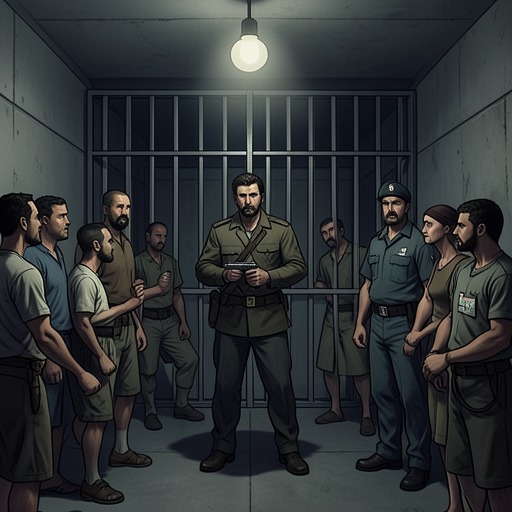
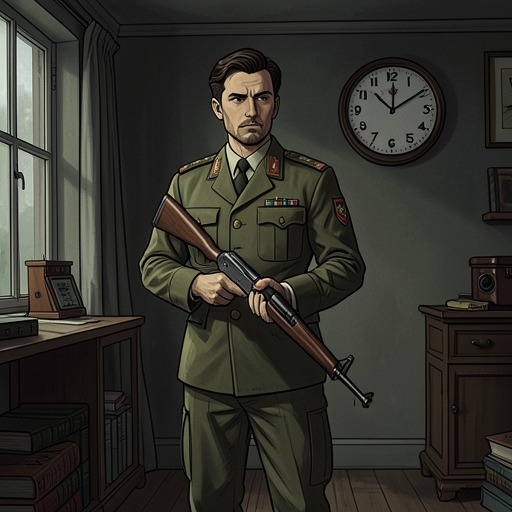
Three SecondsJohn Edvardson, head of the National Task Force, directs the police response to the hostage crisis at Aspsås prison. His defining choice is to resist a rapid assault on the workshop: because he believes a forced entry could prompt the hostage taker to kill, he places the marksmen outside the prison and organizes a cordon and listening operation. The scenes present him as a tactical commander working under severe time pressure, where restraint and preparation must coexist with the readiness to intervene.
Identity and Function
Edvardson enters the crisis as the senior figure leading the National Task Force. When the force reaches Aspsås prison, Lennart Oscarsson and Sergeant Rydén are at the main gate. Rydén greets Edvardson, who has arrived in the passenger seat of the first of two large black vehicles. The task-force troops have travelled from headquarters at Sorentorp and Solna; nine men in matching protective equipment are deployed from the vehicles while they are still moving. The coordinated arrival, with helmets, protective visors, balaclavas, and body armor, establishes the scale and specialized nature of the response.
Edvardson’s authority is practical and immediate. He moves toward the prison building after being directed to the upper floor, where the hostage taker and hostages have been seen. The officers with him include members carrying submachine guns and two carrying long-range sniper rifles. His role is not simply to bring force to the scene: he must determine where it can be used without making the danger to the hostages worse.
Tactical Judgment at the Prison
Edvardson’s assessment turns on the difference between being able to enter and being able to enter safely. The task force could break down a door or come through a skylight, and a rapid assault could give officers control of the situation within seconds. But the hostage taker has threatened to kill, and Edvardson believes that a direct storm would drive him to carry out that threat rather than surrender. In his assessment, the hostages’ immediate safety limits the usefulness of the force’s speed and equipment.
He therefore rejects an approach through the prison interior for the marksmen. The hostage taker has been seen at an upper-floor window, but the snipers cannot reach a suitable position from inside. Edvardson decides to position them outside the prison instead. This is a consequential adjustment: rather than treating the inaccessible window as a reason to force entry, he changes the marksmen’s position and keeps the possibility of an assault separate from the immediate plan. The decision does not resolve the crisis; it preserves the hostages’ safety as the condition governing what the police do next.
Containment and Coordination
Twenty minutes after coming down from the church tower, Edvardson is in the churchyard with the marksmen. They have seen the hostage taker and the hostages twice, but the officers still refrain from forcing entry while the hostages remain alive and unharmed. The churchyard is cordoned off by Uppsala Police. Patrol cars from Arlanda and Stockholm are positioned around the prison wall, alongside officers from the local district, Uppsala, Arlanda, and Stockholm. With twelve more members of the National Task Force expected, Edvardson is coordinating a wider police presence around the prison rather than a single unit acting alone.
When those additional twelve task-force members arrive, Edvardson assigns them across three positions. Four are to remain outside the workshop entrance in Block B and set up microphones; five are to climb the building and install further listening equipment on the roof; three are to reinforce the officers already in the stairwell. The distribution gives the police several ways to observe and prepare while maintaining a presence close to the workshop. It also shows that the operation is not limited to the conspicuous armed perimeter: gathering information about events inside is part of the tactical response.
The Standoff and Its Limits
The hostage taker’s behavior complicates the usual assumptions behind a police siege. Wardens have reported that he is not under the influence and that his actions appear planned rather than impulsive. Edvardson’s approach accordingly treats the threat as deliberate: an assault that might overpower an impulsive suspect could instead trigger a considered act of violence. He seals off the churchyard and positions the task force, but does not mistake containment for control. The next move remains with the hostage taker.
When Ewert Grens reaches the second floor, eight task-force members are waiting outside the workshop, prepared to break down the door and take control within ten seconds. Grens judges that interval too long. Edvardson leans closer to answer him quietly, but the account does not disclose the substance of his reply. This moment places Edvardson’s command within a tense exchange between operational readiness and the urgency perceived by another senior officer. The armed team is prepared to act, yet no order to enter is reported in this scene.
Narrative Significance
Edvardson’s part in the crisis is defined by choices made under incomplete access to the events inside the workshop. He can deploy armed officers, establish a cordon, and arrange surveillance, but he cannot safely treat a fast entry as an uncomplicated solution. His decision to use positions outside the prison and to place microphones and listening equipment around the workshop makes the standoff a contest of observation and timing as well as force.
The account does not provide Edvardson’s personal history or disclose the eventual result of his commands. It presents him through the responsibilities of the emergency: arriving with a specialized unit, weighing the likely consequence of an assault, organizing police across the churchyard and prison building, and keeping an armed response ready while the hostages remain at risk. His significance lies in that command problem, where the capacity to act is never identical to the wisdom of acting immediately.