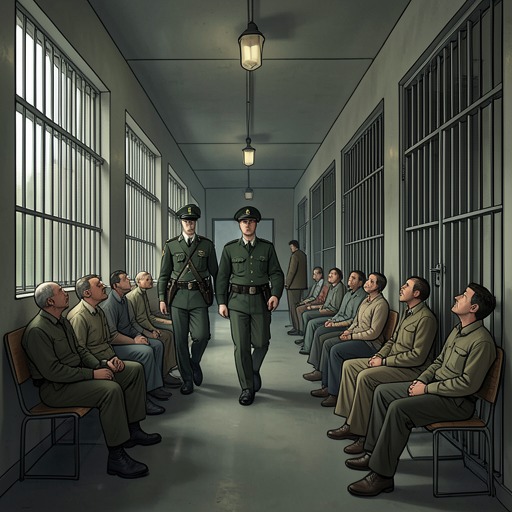
Kronoberg Remand Prison
Three SecondsKronoberg Remand Prison is the first institutional stop in Piet Hoffmann’s planned passage into Aspsås Prison. Its underground garage serves as a threshold between the staged arrest and the next phase of his undercover operation: Hoffmann is brought there in custody, Erik Wilson waits nearby, and, after ten days, guards transport him onward under heightened security.
Role in Hoffmann’s transfer
Before his arrest, Hoffmann anticipates being taken by police van to Kronoberg Remand Prison and issued loose prison clothes. The remand prison is therefore part of the operation’s planned route, not its destination. After his arrest in a pool hall, he is brought into police custody; ten days later, he is to be moved from Kronoberg to Aspsås Prison.
That transfer begins below street level. A small elevator descends to a metal cage in the garage beneath Kronobergsparken, where the prisoner is escorted to a transport bus. The sequence makes the prison a controlled passage point: Hoffmann moves from police custody through the remand facility’s garage and into a guarded vehicle bound for the high-security prison where he is meant to establish his new identity.
The garage and Wilson’s vigil
Erik Wilson waits in his car opposite the entrance to the Kronoberg garage as police vans pass and vehicles continue to enter and leave. After the vans drive away and their sirens are switched off, he shows his identification at the barrier and drives into the police garage beneath Kronobergsparken. He parks in a steel cage in front of the elevator leading up to the remand prison, giving him a view of the steady traffic below the building.
Wilson waits for half an hour, lowers both windows so he can hear what is happening, and listens as a car stops and people get out. His vigil is tense and uneasy; when the large bay doors begin to slide aside, the garage becomes the point at which he may see the transfer unfold. The scene places Wilson close to Hoffmann’s custody without making him part of the escort itself.
A dangerous identity in official custody
By the time of the transfer, the Kronoberg wardens have read documents describing Hoffmann as one of Sweden’s most dangerous criminals. They have also heard that, after his arrest ten days earlier, he spat at a colleague in the parking area and threatened him. The account shapes how the guards expect him to behave: they watch both the prisoner and one another, anticipating trouble during the short walk from the elevator to the bus.
The transport is correspondingly more guarded than usual. Four wardens accompany Hoffmann, two more than the ordinary complement; he wears handcuffs and leg irons, while the guards decide against adding a waist restraint. Their precautions show how the dossier and the story about his conduct have fixed his status in custody before he reaches Aspsås. The prison’s role in the operation is thus not only logistical: it is also where an imposed criminal identity governs how the authorities handle him.
Departure for Aspsås
The bus carrying Hoffmann leaves the Kronoberg garage for Aspsås Prison. The distinction between the two institutions matters: Kronoberg is his remand-stage holding and transfer point, while Aspsås is the high-security prison where the undercover operation is to continue. Once the bus passes through Aspsås’s gates, Hoffmann enters a prison he has previously studied from the church tower but has never physically entered.
Kronoberg Remand Prison consequently marks a narrow but decisive interval in Hoffmann’s journey. Its elevator, garage cage, and transport bus make custody visible as a sequence of controlled thresholds, while Wilson’s wait nearby reveals the covert partnership running alongside the official process. Hoffmann leaves Kronoberg under guard and under the weight of a dangerous-prisoner file, on his way to assume the prison identity his operation requires.