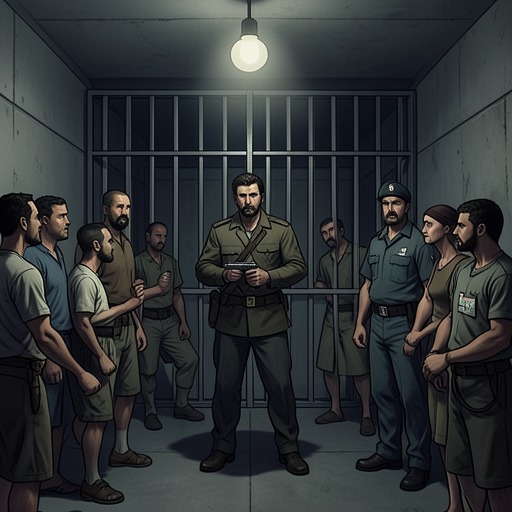
Lennart Oscarsson
Three SecondsLennart Oscarsson, chief warden of Aspsås Prison, stands between the institution’s official authority and the hidden decisions that determine what happens to Piet Hoffmann. After twenty-one years in prison service, he has finally attained the office he once wanted; yet pressure from above turns that long-awaited position into a test of obedience, responsibility, and what he is willing to acknowledge. His story is also marked by a quieter loss: when his professional dream arrives, he no longer knows what to do with it.
Identity and the office he wanted
Oscarsson has worked as a prison warden, principal officer, and acting chief over twenty-one years. Four months before the events involving Hoffmann, he was appointed chief warden of Aspsås Prison and moved his files into the larger shelves of the office he had wanted for most of his adult life. The promotion is concrete and hard-earned, but it does not bring the satisfaction he expected. Looking out at prisoners in the yard, he wonders what remains when a dream has been achieved. His question about whether to escape follows from that vacancy, not from any stated plan to leave the prison.
The private cost of his choices appears in the view from his office. Beyond the prison wall, Oscarsson looks toward a small town and a window that had once belonged to a family bedroom. He now lives alone. He believes that he chose wrongly and that some mistakes may become impossible to put right. The account does not explain the choice or identify the people involved; instead, this glimpse establishes that his isolation is not confined to work. His new authority sits alongside a private sense of regret.
The office itself reflects the limits of the life he has made. Its windows look toward the fence and prison yard, while its institutional furnishings offer little suggestion of a private world. Two bunches of flowers stand out against that austerity. One consists of twenty-five yellow tulips, still in bud, with a card thanking the prison for a successful partnership from the Aspilis Business Association. Oscarsson complains about the recent flood of flowers and attention surrounding Aspsås, but then regards the tulips with pride. The small contradiction makes visible his attachment to the institution even as he resents the pressures and public scrutiny surrounding it.
First dealings with Piet Hoffmann
When Piet Hoffmann arrives at Aspsås Prison, Oscarsson presents him to the staff as the new cleaner, due to begin the following day. He offers a hand with a soft but firm grip and identifies himself by name. The practical instructions are modest: empty the two wastebaskets each day and collect any unwashed glasses. Hoffmann is being introduced not as a visitor but as a prisoner folded into the prison’s working routine. Their first formal encounter therefore places Oscarsson in the role of the official who assigns him a place within the institution.
Oscarsson’s office also gives the arrival a particular setting. Its windows face the yard and fence; the room is orderly but not personal, and the tulips are its conspicuous exception. The exchange about cleaning does not disclose the full danger surrounding Hoffmann’s identity or operation. Instead, it makes the prison’s everyday machinery visible: a new inmate is named, given duties, and expected to fit into an established schedule. Oscarsson is one of the people who administer that routine, even as other decisions about Hoffmann are being made beyond his apparent control.
His authority is visible again when he meets Ewert Grens, who has come to question Hoffmann. By then Oscarsson has been instructed to prevent the meeting. A general director phones him at home, in the middle of his solitary evening routine, and firmly tells him that Grens must not see Hoffmann that day or the next. Oscarsson asks no questions. Only later, while washing the single plate, glass, knife, and fork from his supper, does he understand why the instruction has provoked anger: he recognizes it as a lie. The domestic details connect his obedience at work to the isolation of his private life, while the recognition marks a change from passive compliance to conscious doubt.
Obedience, pressure, and the prison crisis
Oscarsson’s conflict is not simply that he receives orders, but that he carries them out in ways that obstruct access to Hoffmann. When challenged later, he admits that he was ordered to keep Grens—and any other police officer—from Hoffmann. He says he tried to meet Grens’s eyes at reception while claiming that Hoffmann was in the hospital unit and would remain there for three or four more days. The explanation is specific: Oscarsson did not merely relay a scheduling decision; he gave Grens a false account to prevent contact.
He also reveals that he was ordered to allow a lawyer to visit Stefan Lygas, a prisoner in Hoffmann’s unit, on the evening before Grens arrived. Stefan had been among those who attacked Hoffmann and was later shot. Oscarsson notes that lawyers are often used to carry information into a prison. His account therefore connects the visit to the prison’s channels of communication without claiming to know every message exchanged. When Mariana Hermansson asks who gave the orders, Oscarsson’s response points beyond himself, but his own part in arranging the visit and misleading Grens remains part of the account.
The strain becomes stark during the hostage crisis. Oscarsson receives news that a warden has been taken by an armed prisoner identified as Hoffmann, and a vase of yellow tulips falls from his desk. He sits on the floor as the petals drift in the spilled water. The flowers that had represented partnership and pride become a fragment of a room interrupted by emergency. The narrative also notes that Oscarsson protested, as Martin Jacobson later did, though it does not specify the terms or result of that protest. He is not shown as a detached administrator: the crisis reaches him through both the institution’s emergency and the people caught within it.
Confession and responsibility
When Mariana Hermansson finds Oscarsson in his office, he is bent over his desk, breathing heavily and apparently unaware of her arrival. The scene presents him as overwhelmed, but does not settle whether his condition comes from tears or exhaustion. He tells her that other people are involved. His admission makes clear that the decisions affecting Hoffmann were not made by a single prison official acting alone.
Oscarsson later tells Ewert Grens that General Director Pål Larsen ordered him to act. Grens counters that Oscarsson, as the person appointed to lead the prison service, decides what happens within the prison. The exchange sharpens the distinction between receiving an order and exercising authority: Oscarsson identifies the superior who directed him, while Grens insists that his position still carries responsibility. Oscarsson’s testimony does not erase the choices he made, including blocking Grens and permitting Stefan’s lawyer to visit, but it places those choices within a larger chain of command.
Grens also recalls that Oscarsson had acknowledged making at least four decisions that forced Hoffmann to act as he did. The account does not itemize all four decisions in this exchange, so their particulars remain unstated. What it does establish is that Oscarsson’s involvement was broader than a single false explanation at reception. His confession gives the investigation a named superior and a route into the institutional decisions surrounding Hoffmann, while leaving the question of how responsibility should be divided between subordinate and director unresolved.
The unresolved encounter
Oscarsson and Hoffmann meet again after Hoffmann has assaulted Oscarsson in the voluntary isolation unit. When asked whether anyone is waiting for him, Oscarsson says he is not going home and that he and Hoffmann are meeting again the next day. He closes the file and turns to look at him. This detail matters because their relationship has not been reduced to the assault or to Oscarsson’s earlier obstruction: another meeting is planned, though the account gives no explanation of its purpose and does not describe it as reconciliation.
At the prison gate, Oscarsson is still behind Hoffmann. Their eyes meet. Hoffmann expects shouting or a rush of movement, but Oscarsson says nothing and does not move. Hoffmann then leaves in the appearance of a summer temporary worker, a figure without a readily identifiable name. The encounter does not establish what Oscarsson understands about the disguise, or why he remains silent. Its force lies in that uncertainty: the official who once helped enforce orders against Hoffmann is present at the moment of departure, yet the text supplies no declaration, intervention, or clear resolution between them.
Oscarsson’s arc thus turns on the gap between institutional rank and personal agency. He has the office he dreamed of, but that achievement coexists with private regret; he follows instructions, but recognizes a lie and later names the official who ordered him; he participates in decisions that constrain Hoffmann, yet his final encounter with him is marked by silence. The novel makes him neither simply an all-powerful prison chief nor merely a powerless subordinate. He is an administrator whose choices matter inside a closed system, and whose testimony exposes part of that system without settling the full measure of his own responsibility.