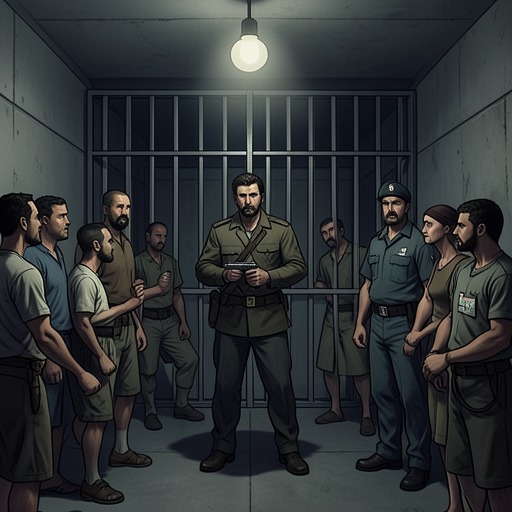
Martin Jacobson
Three SecondsMartin Jacobson is a senior prison officer at Aspsås prison whose long service and settled ties to the staff make him an ordinary human presence inside the institution’s escalating crisis. Taken hostage by Piet Hoffmann, Jacobson becomes both a person at risk and a crucial witness: Hoffmann’s decision to move him away from the coming explosion helps preserve his life, and Jacobson’s later account supplies investigators with evidence about Hoffmann’s actions.
Identity and Position
Jacobson is a principal officer at Aspsås prison. When he introduces himself to Hoffmann in the voluntary-isolation unit, he identifies himself as its principal officer and the person in charge there. He is not a distant administrator: he works inside the prison and moves through the spaces where the crisis unfolds, including the workshop area and its adjoining office.
A police account gives his age as sixty-four and says that he has worked at Aspsås since he was twenty-four. He is married, has grown-up children, and lives in the town. The same account describes him as liked and respected, with no indication that he poses a threat. These details place Jacobson firmly in the ordinary social world beyond the prison as well as in its daily routines: he has a family and a local life, while decades of service have made the institution his workplace.
The book’s closing acknowledgments explicitly label Martin Jacobson fictional. That note establishes his status as a constructed character, even as his prison duties and personal relationships are rendered through specific biographical details. His narrative importance comes not from authority over the wider crisis, but from being an individual whom its violence puts in immediate danger and whose testimony later helps explain it.
Work and Personal Ties
Jacobson’s closest established connection among the prison staff is with Lennart Oscarsson. Their relationship spans nearly twenty years of working together and almost as long as neighbors. Jacobson calls Oscarsson a friend, colleague, and boss, and counts him among the few people he asks over for a Sunday drink. The combination matters: their bond is both professional and personal, shaped by long familiarity inside and outside the prison.
When Jacobson tries to meet Oscarsson’s gaze during their conversation, the gesture goes unanswered. The exchange is brief, but it sets a personal relationship against the impersonal pressure of the prison crisis. Jacobson’s loyalty and affection are not presented as abstract virtues; they are grounded in years of shared work, nearby homes, and ordinary invitations. Oscarsson’s presence is therefore more than a line in Jacobson’s biography: he is one of the few people whose response Jacobson seeks at a moment when the familiar order is breaking down.
Jacobson’s professional authority also has limits. In the isolation unit, he is the principal officer responsible for the space, but Hoffmann can still make demands and control the encounter. Later, in the workshop, Jacobson is no longer acting as an officer directing events. He is a hostage, and the staff member who once exercised authority within the prison becomes dependent on the choices of a prisoner.
Taken Hostage
During the crisis, Hoffmann holds Jacobson at gunpoint. In the security-room footage, Jacobson appears bound while Hoffmann makes the weapon visible to the camera. A police briefing identifies him as a 64-year-old officer who has served at Aspsås since he was twenty-four, married, with adult children and a good reputation among those who know him. Those details emphasize the stakes without making him a combatant: Jacobson is a long-serving employee caught in events he does not control.
The chief warden’s response registers the human cost of the takeover. On hearing that Jacobson has been taken by an armed prisoner, he strikes the telephone against the desk, knocking a vase of yellow tulips to the floor. The flowers and their scattered petals briefly bring the emergency back to the scale of a workplace and its people. Jacobson is not simply another item in a security report; his colleagues know him, and his capture turns the crisis into a personal threat for the staff around him.
Hoffmann later moves Jacobson to a storeroom in the workshop, away from the place where the explosion will occur. Jacobson is frightened and tries to get free; he wants to go home to have supper, watch television, and drink Canadian whisky. Hoffmann tells him, in effect, that remaining where he is will protect him. Jacobson is still crying when the warning comes. The scene keeps two facts in tension: Hoffmann has made Jacobson a hostage, but he also takes steps to keep him from dying in the blast.
Witness and Aftermath
After the explosion, Jacobson can tell investigators that Hoffmann moved him to the back of the workshop, near the main door, and that they had little contact after that. Jacobson recalls that Hoffmann had promised he would not die just before the blast. His account gives investigators reason to consider that Hoffmann’s placement of him was protective rather than incidental.
Jacobson also reports that Hoffmann used the telephone in the office at the back of the workshop twice. From behind the glass partition, Jacobson saw him leave the hostages in view while making the calls, once near the beginning of the episode and again shortly before the explosion. He estimates that each call lasted about fifteen seconds. That detail adds a separate line of evidence to the hostage account: while maintaining control of the room, Hoffmann briefly communicated with someone outside it, and Jacobson was positioned to observe him.
The account of Jacobson’s clothing supplies another consequence of the encounter. In the aftermath, Hoffmann washes and changes into clothes that Jacobson had worn as a principal officer. They fit Hoffmann almost perfectly, making them useful as he changes his appearance. The garments had also served as a makeshift pillow, so the description connects Jacobson’s ordinary uniform to Hoffmann’s improvised escape and disguise. Jacobson’s presence thus continues to shape events after he is no longer physically beside Hoffmann.
Narrative Role
Jacobson functions as a witness whose information revises the picture of Hoffmann’s conduct. The crisis presents Hoffmann as an armed hostage-taker, but Jacobson’s recollections establish that Hoffmann twice left the immediate scene to make calls and deliberately moved Jacobson before the explosion. Neither fact erases the threat Jacobson endured; together they show why his testimony complicates a simple account of the event.
His story also brings the prison’s professional community into view. The decades of service, his friendship with Oscarsson, and the colleagues’ alarm at his capture make the institution more than a map of locked units and security posts. It is a workplace in which people have long histories with one another, and where an emergency can turn a respected officer into a vulnerable hostage. Jacobson’s survival and later testimony give that human dimension a concrete consequence: what he saw becomes part of the effort to understand what happened.