Nils Krantz
Three SecondsNils Krantz is the forensic scientist whose careful work turns the investigation of Jens Christian Toft’s murder from a scene of uncertain impressions into a chain of testable findings. Trusted by Ewert Grens and Sven Sundkvist, he contributes not through dramatic deductions but through patient examination: checking what can be established, preserving what might otherwise be overlooked, and returning to the evidence when the first result is inconclusive.
Forensic Work at Västmannagatan 79
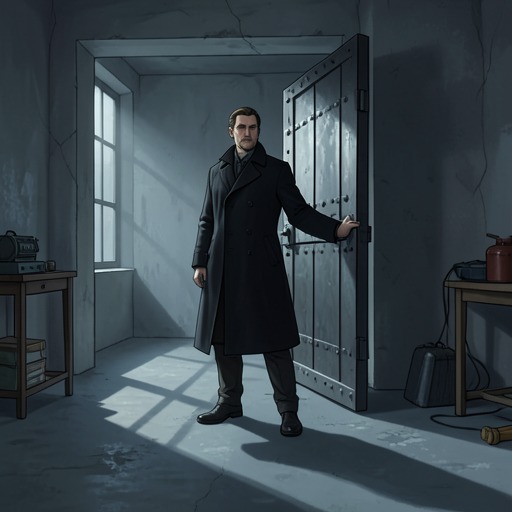
At the flat on Västmannagatan 79, Krantz works alongside two younger colleagues and a team of forensic technicians, documenting the room and its details. He draws Grens’s attention to the entrance wound and explains what the physical evidence indicates about how the shot was fired. His account gives the investigators a firmer basis for understanding the scene, while his measured procedure contrasts with Grens’s struggle to focus on the investigation rather than the death itself.
Krantz also tests the victim’s hand for gunshot residue. He lifts fingerprints with tape, examines the sample under a microscope, and reports that the test has found no residue. The result does not by itself settle the question of who fired the weapon, but it narrows what the scene can support. His willingness to check rather than assume is central to his role: the evidence is allowed to complicate the investigators’ expectations.
When Grens asks him to extend the search beyond the flat, Krantz examines stairwells between numbers seventy and ninety. In a paper-recycling container at Västmannagatan 73, he finds a bloodstained gray-and-white garment. Laboratory analysis links the blood and gunshot residue on it to the victim and to the same discharge found at the murder scene. Krantz presents the match as a concrete connection, while Grens objects that it does not yet identify the murderer. That distinction marks the limits as well as the value of forensic work: a reliable link can advance a case without resolving it.
Trace Evidence and the Limits of Inference
Krantz’s analysis of the recovered garment adds specificity to the earlier match. At a computer screen, he compares the DNA profile supplied by Copenhagen police for Jens Christian Toft with the profile generated from bloodstains on the garment by the National Laboratory of Forensic Science. The comparison uses stains at least two by two millimeters across; every STR marker aligns. The result confirms whose blood is present, but it does not identify who fired the shot. Grens remains focused on the murderer, and Krantz’s findings make the distinction plain: a forensic match can establish a connection without answering the central question.
The garment also carries a different kind of trace. While examining it on a workbench, Krantz points out flower fragments, particularly near the bottom of the right sleeve. He presents them as an additional finding rather than as a solved lead. Their presence broadens what investigators can ask of the evidence, but the available findings do not establish where the fragments came from or who brought them there.
Krantz also returns to the emergency call associated with the Västmannagatan investigation. After going back to the scene to test his hunch, he identifies a sound near the end of the brief call that matches the kitchen refrigerator compressor in both frequency and interval. The observation links a detail in the recording to a specific feature of the flat, making the call open to closer interpretation. It is a provisional theory, not a conclusion about the caller’s identity, and its value lies in showing Krantz’s habit of checking an acoustic detail against the physical scene rather than treating the recording as self-explanatory.
Reconstructing the Prison Explosion
At Aspsås prison, Krantz returns to forensic work in the aftermath of the workshop explosion. Four technicians examine the charred room and soot-darkened walls, while Krantz moves through the scene with concentrated purpose. Grens and Sundkvist know him as someone more at home with a microscope than a cocktail glass; here, that methodical temperament becomes a way to reconstruct an event no investigator witnessed directly.
Krantz begins with the bullet’s path. A hole in the workshop wall and the window across the room establish the line from the church tower, where Hoffmann had stood exposed during the crisis. The ammunition was designed to ignite and explode, and its initial velocity—830 meters per second—meant that the shot reached its target in three seconds. The measurements turn a brief, consequential interval into something investigators can examine as a sequence rather than a blur.
The scattered remains initially suggest an explosion, but Krantz distinguishes the effects of the projectile from those of the blast. The ammunition had torn apart bodies; it had not itself exploded. That distinction directs attention to the other forces in the room and prevents the investigators from treating every consequence as the product of a single weapon.
A diesel barrel near Hoffmann supplies another part of the reconstruction. Diesel mixed with gas produced the poisonous smoke, but barrels and cans of fuel were ordinary workshop equipment, used for machines, forklifts, and cleaning tools. Its position was not ordinary: the barrel had been moved close to Hoffmann. Krantz’s examination supports the conclusion that the placement was deliberate and that Hoffmann wanted the resulting fire and smoke to be certain.
Later, Krantz identifies two explosives in the scene: pentyl and nitroglycerine. Pentyl caused the blast wave that forced out the window and generated the heat that ignited the diesel; nitroglycerine had been applied directly to someone’s skin, though Krantz could not yet identify whose. His findings therefore clarify how the explosion unfolded while preserving an unresolved question about the person involved. The scene yields a reconstruction, not a complete account, and Krantz’s role is to make that boundary visible.
The Forensic Scientist as a Retrospective Witness
Krantz has never witnessed a crime as it happens or been present at the moment a place becomes a crime scene. His work instead brings him to its aftermath, where he gathers and interprets traces so that others can reconstruct the event. That distance defines both the reach and the limit of his role: he can establish a bullet’s path, connect physical traces, and distinguish the effects of different forces, but his account remains an inference built from what the scene preserves, not an eyewitness’s memory.