Piet Hoffmann
Three SecondsPiet Hoffmann is a police informant whose ability to inhabit a criminal identity becomes both his chief instrument and his greatest danger. After nine years on the Swedish police’s unofficial payroll, he enters Wojtek under the code name Paula and works toward exposing its planned expansion into Swedish prisons. At Aspsås Prison, he turns that assignment into a struggle for control of the prison drug market. When someone exposes him as an informant and knowledge of his code name points toward the small circle of officials who knew it, the operation’s protection becomes another threat. His eventual escape, disguised as a prison warden, leaves him alive but isolated from the ordinary attachments he has learned to suppress in order to survive.
Identity and Undercover Background
Hoffmann has spent years operating between police work and criminal organizations. The arrangement is not formal public service: he has worked as a secret civil servant on the Swedish police’s unofficial payroll for nine years. That history has taught him that he is valuable to the authorities, and that police officials have previously made offenses disappear in both his private and professional life. He expects Erik Wilson, his contact, to make a new problem vanish in the same way. Hoffmann’s confidence rests less on a belief in transparent justice than on his experience of how secret intelligence reports can influence senior officials.
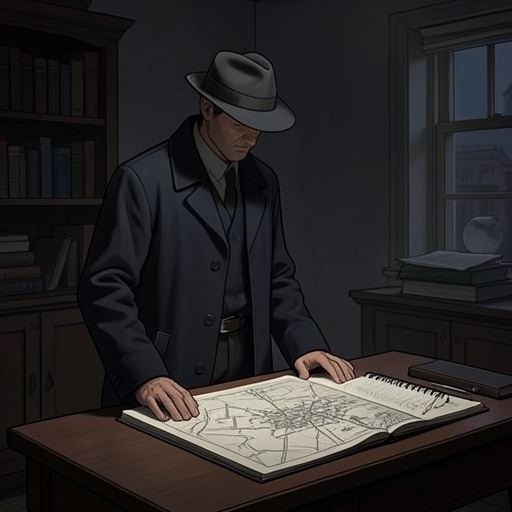
His assignment inside Wojtek demands a more sustained performance. Hoffmann describes himself as the organization’s number one in Sweden, while recognizing that the people around him have been trained by Polish intelligence services to detect anything suspicious. His cover name, Paula, is therefore more than an alias: it is the identity under which he must remain useful to the criminal organization while sending information to the police. At a government meeting on 10 May, he secretly records the date on a thin digital recorder, checks its green indicator and full battery, then conceals it inside a cigar case. The small device embodies the practical double life of the operation: evidence must be gathered without disturbing the appearance of ordinary business.
The plan is to let Wojtek continue its intended takeover of drug dealing in Swedish prisons long enough for Hoffmann to report on deliveries and sales. Those reports are meant to help the police identify when and how to strike, while his position also gives him information about the organization’s operations. He describes a narrow strategic balance: the network must become extensive enough to expose its center in Warsaw, but it must not expand beyond the point at which the police can still disrupt it. Hoffmann’s work consequently depends on prolonging the danger he is supposed to help end.
Entering Aspsås Prison
Hoffmann has studied Aspsås Prison before entering it. From the church tower he has mapped the buildings and examined the barred windows; during remand, with Wilson’s help, he has learned about the prisoners and staff in Block G. Yet this preparation cannot make his first arrival routine. The prison bus passes through two iron gates toward central security, and guards escort him into registration. Leg irons restrict his steps until they are removed. After ten days, he is placed in a unit that will be empty for several hours while its residents are at the workshop, library and classroom. A principal officer shows him the unit’s practical routines, including where to use the toilet and why lock-in is at seven thirty rather than seven thirty-five. He must learn a tightly controlled daily order at the same time as he begins to establish his place within it.
He does not wait passively for the other prisoners to return. A few minutes before they are due, he takes a seat in the television corner, where he can see each of the fifteen men arrive and ensure that they see him. He chooses a conspicuous position and behaves as if he already belongs: he takes another prisoner’s preferred chair, uses marked playing cards and begins solitaire at a table without asking permission. These are small acts, but their purpose is explicit. Hoffmann wants his presence to register as confidence rather than fear or evasion.
The prison’s informal rules matter as much as its formal routines. At supper, two older prisoners question him; Stefan and Karol Tomasz get up as if to intervene, but Hoffmann signals them to hold back. He allows the questions because they concern a shared expression of hatred that can establish the basis of respect. Meanwhile, Stefan and Karol Tomasz have already prepared his reception by discussing why he has been imprisoned, whom he has worked with and his standing with Eastern European criminal organizations. They obtain copies of official criminal and prison records, along with his recent judgment, through Stefan’s lawyer. The false criminal identity is supported not only by Hoffmann’s conduct but by documentary material that helps make it legible to the people around him.
Building a Prison Drug Network
Once inside, Hoffmann advances the operation through controlled distribution. He plans to introduce the first grams to the first customers, generating word that a new supplier has arrived in one of Sweden’s most secure prisons. The police need information about supply, delivery dates and distribution channels; Wojtek needs a working market. Hoffmann’s role requires him to serve both purposes without letting either side see the other. He intends to limit each customer’s first purchase to two grams, regardless of pressure or threats, so that the initial supply is spread carefully rather than exhausted at once.
The takeover begins with the removal of three principal dealers. Hoffmann uses forty-two grams hidden in four library books to incapacitate them, then prepares to make the first sales with amphetamine concealed in the buds of fifty yellow tulips. He also takes care over what the prison’s cleaning staff might see: the discarded packaging is placed beneath ordinary-looking trash, with envelopes and plastic cups visible above it. The concealment and the distribution are parts of the same method. He must make the new market visible to prisoners while keeping its physical traces inconspicuous to anyone who might inspect the waste.
His work is incremental and exposed to interruption. A brief realization that others know signals how precarious the operation has become, but the evidence does not identify who has discovered what at that moment. Hoffmann’s method remains to press forward: build enough of the prison network to furnish useful intelligence, while managing the risks generated by his success. In this closed setting, control of the drug supply gives him influence, but it also makes his manufactured criminal identity increasingly consequential.
Exposure, Violence and the Collapse of Protection
Hoffmann eventually understands that he has been identified as an informant. The revelation becomes more dangerous when he realizes that the person who exposed him also knew the code name Paula. He believes only four people knew that name: Wilson, who invented it; Chief Inspector Göransson, who approved it; and, after a meeting at Rosenbad, the national police commissioner and the state secretary. The code name therefore turns the exposure into evidence of a breach among the officials entrusted with protecting the operation. Hoffmann concludes that one of those people has burned him, and the protection he relied on has become a possible source of the danger.
The resulting crisis brings his criminal role into direct conflict with his purpose as an informant. Hoffmann had intended to exchange hostages and use the situation to threaten Wojtek rather than the prison authorities, but he misjudges the hatred directed toward him. When Stefan rushes toward him, Hoffmann reacts in fear and shoots him with a single round. The killing is not presented as a planned step in the undercover strategy; it is the sudden consequence of a survival response in a situation Hoffmann has failed to control. His ability to perform a criminal identity does not give him command over the violence attached to it.
During the prison standoff, Hoffmann also uses the environment and its objects to prepare an escape. A helicopter lands in the field between the prison wall and the churchyard while police officers run toward it and others move on the roof and outside the workshop door. Hoffmann checks that an unnamed prisoner’s hands and legs are tied, moves the prison warden into view of a camera and turns it toward the wall. In the workshop office he takes a razor from a drawer and scissors from a pencil case. He then checks the packing tape securing Martin Jacobson, the warden, and pulls down a curtain and takes up a rug. These practical actions belong to a plan unfolding amid an active siege: the camera, restraints, razor, scissors, curtain and rug are handled as parts of an improvised route out, not as incidental details.
Survival, Family and Narrative Significance
The escape requires a form of emotional withdrawal. Hoffmann recognizes that fear and anxiety would ordinarily be expected, but says that he feels nothing. He has adopted numbness as a survival state, pushing away thoughts and longings, including thoughts of Zofia, Hugo and Rasmus, because reminders of life threaten the mental blankness he depends on. This suppression is not evidence that those relationships have ceased to matter. Earlier, after returning from Warsaw, he had called home; Rasmus kept hold of the receiver and told him about a cartoon and a frightening green monster. The call offers a brief counterweight to the operation’s coded reports, prison calculations and concealment: ordinary family conversation remains present, but it cannot safely accompany him into the most dangerous moments.
Wilson is both Hoffmann’s experienced contact and a figure on whom he has learned to rely. Wilson’s call from Jacksonville forms part of Hoffmann’s expectation that the authorities can erase the consequences of his actions. That trust is tested when Hoffmann recognizes that Paula’s code name has escaped the circle that was supposed to protect it. The evidence establishes Hoffmann’s suspicion that an insider has betrayed him, rather than identifying which of the four people responsible was the source. The distinction leaves the betrayal unresolved even as it destroys his confidence in the protection system.
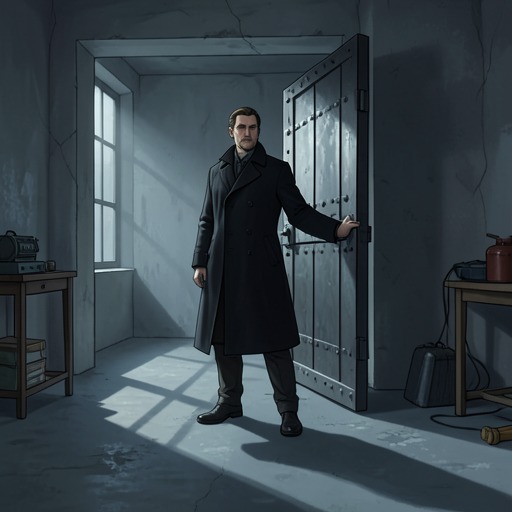
After the crisis, Hoffmann hides in the prison ventilation shaft, where he intends to remain for at least three days. He lies still with a pile of clothes beneath his head and resolves not to dream or feel. The shaft extends his survival strategy to its starkest form: waiting, bodily necessity and the refusal of thought replace the family life and public identity from which he has been cut off. Eventually he leaves through a door opened from inside a glass enclosure. The clean-shaven man with cropped hair who passes through the prison gate in a warden’s uniform has no name; summer temporary staff are seldom named. The disguise lets Hoffmann move out of the prison as someone apparently familiar but individually unremarkable. His survival is confirmed: Hoffmann is alive, despite the belief that he had died.
Hoffmann’s arc turns on the instability of the roles he performs. The police need him to act convincingly as a criminal; the prison’s informal order rewards the confidence and calculated aggression that make that performance work; and the same performance helps make him a target when his identity is exposed. His success at building a network does not bring secure control, but a crisis in which he must improvise alone. The final disguise preserves his life while extending the divide between the operative and the person whose family he has tried to keep in mind. Survival, here, is an achievement measured not by restored safety but by the ability to leave unnoticed.