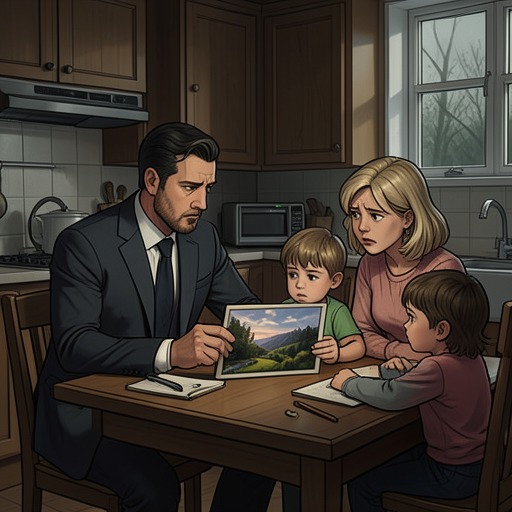
Piet Hoffmann's moral crisis over involving his family
Three SecondsPiet Hoffmann's moral crisis over involving his family begins when an undercover operation collides with ordinary family life: after leaving an empty flat connected to the shooting at Västmannagatan, he collects his feverish sons, Rasmus and Hugo, and takes them with him. He had promised himself never to put anyone he loved in danger, yet now Zofia and the boys are caught up in the lies sustaining his covert life. What unsettles him is not only the immediate risk but the recognition that he has violated the moral boundary on which his own sense of worth depended.
The promise and its breach
Hoffmann's rule had been absolute in his own understanding: his family would never be used to support a lie, and Zofia and the boys would never be made part of the deception. He regarded that boundary as a reason he could still like himself, a distinction between his choices and the conduct of people he despised. The crisis arrives when he can no longer treat the rule as a future safeguard. He has already crossed it.
The immediate circumstances sharpen the breach. Having left number five after the shooting and the breakthrough involving Wojtek, Hoffmann is pulled into an ordinary parental emergency: someone from the nursery tells him that the boys have fevers and need to be collected. He picks up the sleepy children, takes them home, gives them medicine, and puts them to bed. Later, as the situation requires him to leave, he carries them to the car and tells them he will be gone only briefly. Rasmus lies on the back seat with Hugo partly on top of him. Their presence turns a covert decision into a family risk he can see directly.
Hoffmann's shame is therefore attached to a particular act, not merely to the general burden of his undercover identity. He feels that the boys should not be there. The thought of their trust and dependence makes the compromise harder to excuse: they are feverish children who have been brought along without understanding why their father must leave them alone. His recognition that this should be the one and only time signals an attempt to contain the breach, but it does not undo what has happened.
Zofia's trust and the habit of lying
The lie also reaches Zofia, whose trust has long helped Hoffmann sustain his life. He remembers an earlier visit from two senior figures in his organization: Zofia welcomed them for coffee, unaware of who they were, while Hoffmann later explained that they were clients. She accepted his explanation. In the present, he again relies on her trust, and the ordinary intimacy between them makes the deception feel more—not less—serious.
His conduct exposes a contradiction in the way he understands himself. He knows that he can assemble a lie easily and has become good at doing so, but the skill no longer appears morally neutral. When he considers what would happen if Zofia stopped believing him and demanded to know what he had really been doing, he imagines himself collapsing. He has built his strength and purpose around her trust; its withdrawal would threaten the structure he depends on. That dependence does not make the lie harmless. Instead, it reveals how much of his private stability rests on a confidence he is exploiting.
The scenes of affection do not resolve the conflict. Hoffmann kisses Zofia, and their familiar gestures continue, but closeness sits beside concealment rather than replacing it. Her trust remains intact in the moments shown, while his awareness of the deception grows. He cannot simply tell her the truth, yet he also cannot take comfort in the ease with which he has hidden it. The strain lies precisely in this gap between the relationship he values and the false account he keeps offering it.
Self-contempt and the collapse of his moral distinction
Hoffmann's crisis deepens when he recognizes himself in people he had judged. He had despised those who lied to themselves, including prisoners he associated with Cell 4 and Cell 8, and had treated his own family rule as proof that he was unlike them. Now he sees that he has done what he condemned. His judgment turns inward: he cannot claim that his stated morals have protected him when his actions have contradicted them.
The emotional register is not simply fear of being found out. In the sterile garage where he waits in an abandoned car, he experiences the chill as coming from within and identifies self-contempt as its source. Zofia's imagined presence accompanies him there: he carries her frustration in his thoughts, while knowing she does not know that he is the kind of person who lies. The scene gives physical setting to an inward recognition, without making confession or discovery the condition for guilt. His private knowledge is enough to unsettle him.
This self-condemnation also changes the meaning of his claim that the family would be involved only this once. The promise sounds less like a restored boundary than an effort to contain a breach already made. Hoffmann has not found a way to reconcile his work with the rule he broke; he has instead become conscious that his self-image depended on believing the rule remained unbroken. His admission to himself that he has been lying to himself marks the crisis's clearest turn.
Family attachment under the pressure of undercover work
The boys' illness gives the episode its concrete domestic stakes. Hoffmann watches over their feverish faces, gives them medicine despite their protests, and later sees them sleeping beneath white duvets with unread comics in their hands. He remembers the emptiness of life before they called him Daddy, but that recollection no longer carries the old importance. Fatherhood has reorganized what matters to him: the private world he once needed to consider only himself now gives his decisions their sharpest consequences.
That attachment is a source of purpose and a vulnerability at once. Hoffmann's love for the children makes the danger of involving them intolerable, while his reliance on Zofia's trust helps preserve the secrecy that puts them near that danger. The family is not shown as knowing the full nature of his work; the episode instead emphasizes the asymmetry between his knowledge and their ordinary reliance on him. He can see the lie's cost even while those closest to him cannot assess it.
Private shame within a concealed system
The broader account of police informants places Hoffmann's private deception inside an institutional pattern. The Swedish Police Service has used criminals as covert human intelligence sources while denying and concealing that cooperation. The book describes criminal backgrounds and police records being altered to make informants credible, and official investigations proceeding without information held in secret intelligence reports. A review of 302 reports reveals cases in which efforts to uncover one crime gave rise to another, while knowledge already available within the organization did not prevent investigations from collapsing.
That system does not erase Hoffmann's responsibility for bringing his family into his lies; his shame depends on recognizing that choice as his own. But it clarifies the environment in which secrecy becomes routine and the informant's criminal identity is fashioned and maintained by those who use him. The account also describes exposed informants as outlaws: authorities deny their services and leave the infiltrated organization to respond to the exposure. Hoffmann's moral crisis thus joins intimate betrayal to a larger arrangement that depends on concealed wrongdoing and offers no dependable protection when concealment fails. Its decisive consequence is a loss of the moral distinction he had relied on—not because his attachment to his family has disappeared, but because he now knows that he has compromised it.