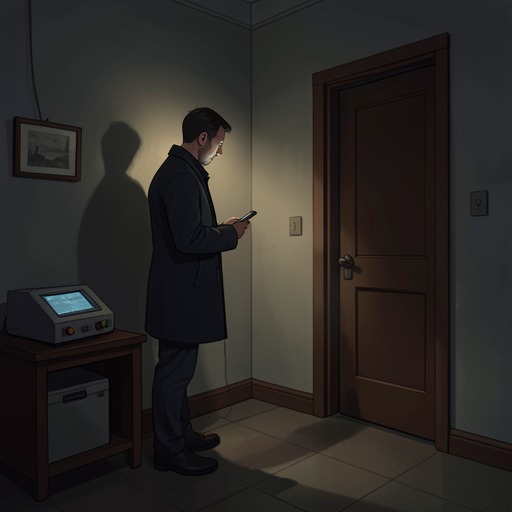
Rosenbad meeting recording CD
Three SecondsThe Rosenbad meeting recording CD is the physical key to Ewert Grens’s discovery that Piet Hoffmann’s undercover operation was discussed and shaped at a meeting in Rosenbad. Its importance lies not merely in preserving voices, but in making the official story audible: the recording connects Hoffmann, Erik Wilson, the national police commissioner, and Göransson to the construction of a criminal identity intended to justify a long prison sentence. When Grens hears the voices, the operation’s apparent legality collapses into something he understands as legitimized murder.
Physical form and playback
Grens retrieves the recording from a plastic bag whose contents have not yet been entered on a chain-of-custody list or delivered to forensics. The CD itself is conspicuously unmarked: neither side carries a label to identify what it contains. Its blankness offers no explanation before playback and no visible clue to the meeting it preserves. Grens inserts it into the short end of his computer tower, turning an apparently ordinary disk into evidence through the sound it releases.
The recording is introduced by the spoken identification, “Government Offices, Tuesday, tenth of May.” Its duration is seventy-eight minutes and thirty-four seconds. Grens has already listened to the material with Sven Sundkvist, but listens again, measuring what it reveals against what he knows. The return to the recording matters: recognition does not arrive as a single, complete disclosure. It accumulates as voices, phrases, and identities become distinguishable, until the meeting’s implications can no longer be separated from the people who took part.
The CD is also linked to another piece of equipment: a receiver sent to Grens in an envelope. He tests that receiver against the frequency of the transmitter found on the church-tower railing and confirms that they match. He then identifies the disk as the remaining item he needs to examine. The paired devices place the recording within a chain of intercepted sound, while the unlogged bag and the need to test the receiver underline that Grens is assembling the evidence outside a properly completed forensic process.
Voices on the recording
The audio first gives Grens a familiar voice. The voice that identifies the meeting is the same one he recognizes from the earlier alarm and threat: Hoffmann’s. The connection establishes that Hoffmann was present in the recorded scene under the name Paula. Grens understands the name as a code name, and the recording makes the hidden identity audible without making it visible on the disk itself.
The sound also preserves the circumstances of the microphone’s movement. At eleven minutes and forty-seven seconds, muffled voices begin. Grens hears scraping and the sound of fabric rubbing against the microphone as someone walks. The microphone is low, around leg height; its bearer moves nearer to the source of the conversation, stretches out a leg, then gets up and stands close to the speakers. The recording therefore supplies more than spoken content: movement and changing proximity help Grens interpret how the conversation was captured and who carried the device.
One unfamiliar speaker is a woman whose voice Grens estimates as belonging to someone around forty or fifty. Her question begins, “The document… I've read it. I assumed… I assumed that it concerned a … woman?” The question’s uncertainty contrasts with the more definite instructions that follow. Another voice says, “We have to make him more dangerous… He will have committed some serious crimes. He'll be given a long sentence.” Those words disclose that the criminal record and sentence were not simply consequences of an established case: the stated plan was to make Hoffmann appear more dangerous and secure a lengthy term.
Other voices attach the plan to senior figures. Grens identifies Wilson, a colleague who had earlier approached the investigation and offered ideas that pointed in the wrong direction. He also recognizes the national police commissioner in the remark, “Paula doesn’t have time for Västmannagatan.” Göransson’s voice follows with, “You've dealt with similar cases before.” The CD thus places the undercover operation alongside discussion of the Västmannagatan investigation and allows Grens to identify participants by voice, rather than by a label or written record on the disk.
Evidentiary reversal
The recording changes the status of what Grens has been investigating. The phrases he hears describe a deliberate effort to create the appearance of serious criminality and impose a long sentence. They make the fabricated criminal identity part of an official discussion, rather than merely a suspicion about how Hoffmann came to be in prison. The CD does not explain every part of the operation, but the voices it preserves give Grens grounds to connect its construction to Wilson, the commissioner, and Göransson.
The evidence also reverses the meaning of police procedure. The prison placement and the severe identity built around Hoffmann can no longer be read simply as the lawful machinery of an undercover assignment. Hearing the meeting, Grens concludes that a legal police operation has become legitimized murder. That is his response to the recording’s revelations, not a claim written on the disk: the object makes the discussion available, while Grens recognizes what the discussion means for the man exposed to its consequences.
Narrative significance
The CD’s plain surface and consequential contents form a sharp contrast. Before playback, it is a featureless object with no indication of the voices, date, or decisions concealed within it. Afterward, its duration, recorded movement, and identifiable speakers give Grens a route from a sound file to the meeting and from the meeting to the people implicated in Hoffmann’s fate. The evidence is especially forceful because it consists of their own recorded words, including the intention to make the target more dangerous and sentence him for serious crimes.
Its discovery also draws attention to the uneasy handling of proof. Grens examines material that has not entered the ordinary chain of custody, verifies the receiver’s frequency himself, and listens again to a recording already heard with Sven. The novel thereby makes the CD both an evidentiary breakthrough and a sign of the compromised conditions under which the truth emerges. The disk does not repair the institutions implicated by its contents; it gives Grens a means to hear their involvement, and turns an undercover operation’s hidden arrangements into an accusation that can no longer be dismissed as an abstract suspicion.