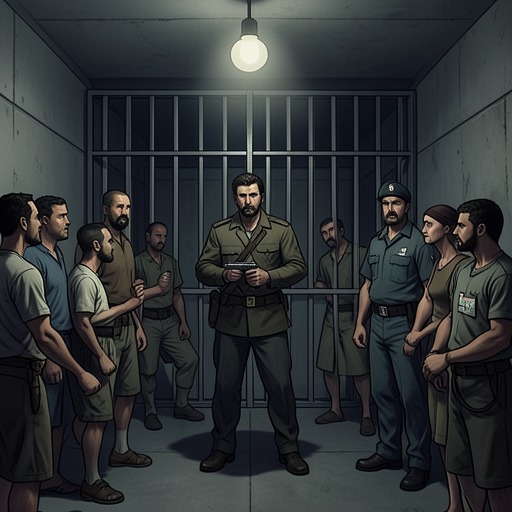
Sterner
Three SecondsSterner is a military marksman brought into the Aspsås prison hostage crisis as a police marksman, stationed on the tower of Aspsås Church and Churchyard. His role places military expertise inside a police operation: he is assigned a long-range shot while Ewert Grens challenges what that assignment is meant to accomplish. Sterner’s account of his training and his reading of Piet Hoffmann make him more than a weapon at the scene; he becomes a witness to the calculated risks Hoffmann takes and the perilous logic of the response.
Identity and Deployment
Sterner is introduced in a white-and-gray camouflage uniform as a man in his forties. The military marksman has arrived at the church tower during a hostage drama that Grens describes as out of control and potentially ending in a shot from the tower. His presence is part of the official response, but it does not erase the distinction between his military role and the police operation: for five hours and thirty-eight minutes, he is legally serving as a policeman.
On the narrow balcony, Sterner replaces one of two men already lying there. A colleague remains to act as his observer. Their placement establishes a coordinated shooting position rather than a lone marksman acting without support. From this exposed vantage, Sterner focuses through binoculars on the hostage taker, who is standing near a window. The arrangement puts the police response at a distance from the crisis while making Sterner’s line of sight—and the consequences of his assignment—central to the scene.
The Position and the Assignment
Sterner gives the distance as 1,503 metres, describing it as the job he has been given. The number makes the task precise, but Grens disputes the narrowness of that description. He reminds Sterner that the purpose is to prevent one person from killing two others, or, in his deliberately unsparing formulation, to stop one soft target from killing another. Their exchange exposes a tension between an assigned firing solution and the human stakes that give it meaning.
Sterner also explains that the rifle is not an ordinary sniper weapon but an M107 anti-materiel rifle: heavier and more powerful, designed for targets such as buses or boats and for exploding mines. The detail changes the scale of the scene. This is not simply a test of marksmanship with a standard rifle; the weapon has force associated with equipment and targets beyond an individual hostage-taker. Sterner’s technical explanation makes the distance and the weapon concrete, while Grens’s challenge insists that their use remains a decision about people.
Marksmanship and Judgment
Sterner describes the governing maxim of sniper training as one bullet, one hit. He says he shoots only when he knows he will hit the target. The statement presents marksmanship not as a willingness to fire but as a threshold of certainty: the shot is conditional on confidence in its outcome. In a crisis where the available position is distant and the consequences irreversible, that discipline is both his professional standard and a source of tension.
His account of Hoffmann’s behaviour turns the marksman’s attention from the target’s body to the target’s understanding. Sterner recalls feeling that Hoffmann knew exactly where he was and what he was doing. He reasons that a person trained at the relevant facility would know the tower was the only place from which the police could reach him, and therefore would understand that he could be killed. This remains Sterner’s assessment of Hoffmann’s awareness, not a statement that the two men communicated or that Sterner could know Hoffmann’s thoughts directly.
Reading Hoffmann’s Exposure
Sterner interprets Hoffmann’s choice of position as deliberate. In his view, Hoffmann selected the workshop and, in particular, the window with care; he exposed himself and provoked the police to fire, knowing that a good, well-trained marksman could kill him if necessary. That reading recasts apparent vulnerability as possible strategy. The man at the window may be visible not because he has failed to understand the tower’s danger, but because Sterner believes he understands it.
This judgment gives Sterner a distinct role in the crisis. Grens frames the assignment through the lives at stake, while Sterner supplies the technical and tactical reading of the scene: the range, the rifle, the standard for taking a shot, and the possibility that Hoffmann has anticipated the firing position. Together, their exchange holds two forms of responsibility in view—the police purpose of preventing deaths and the marksman’s obligation to fire only when he expects to hit. Sterner’s significance lies in that narrow but consequential point where professional certainty meets an opponent who, in his assessment, may be deliberately inviting the shot.