Swedish Prison and Probation Authority
Three SecondsThe Swedish Prison and Probation Authority is presented both as the administrator of Sweden’s prison system and as a powerful channel through which senior officials can bend that system to a covert operation. Its role in arranging Piet Hoffmann’s placement at Aspsås links high-level political direction to the daily rules of prison life, while the resistance of a senior warden shows that institutional authority is not exercised without conflict.
Authority and command
At a meeting about what should happen to Hoffmann, the state secretary introduces Pål Larsen as the director general and tells him that he is to help arrange the next stage. Larsen is asked to place Paula, the undercover identity used for Hoffmann, in Aspsås prison after an arrest for possessing three kilos of amphetamine. He points out that such a sentence would normally send a prisoner first to Kumla, but is told that this case will be handled differently.
The plan reaches beyond placement. Hoffmann is to arrive with a job already arranged as a cleaner in the administration block and workshop, although prison management would ordinarily grant cleaning work as a reward. When Larsen objects, the state secretary invokes her appointment of him and defines his decision-making power as what she and he have agreed he may decide. The exchange presents the Authority’s chain of command as both administrative machinery and leverage: an exceptional arrangement can be imposed by a political superior through the director general.
Larsen’s questions also expose the risks embedded in that exception. He challenges the plan to use dogs to find planted drugs, warning that the operation could put staff at risk and lead to an uninvolved prisoner being charged. The scene does not resolve those concerns; instead, the state secretary presses him to carry out the arrangement. The Authority is therefore implicated not simply as the custodian of a prisoner, but as the institution whose routines and personnel are being enlisted in a covert police operation.
Placement, records, and prison routine
The Authority’s practical power is expressed through control of where a prisoner is sent and what work he performs. Although Hoffmann has been taken into custody under a constructed criminal identity, the plan directs him toward Aspsås rather than the usual first stop at Kumla, and gives him a position that will bring him into the administration block and workshop. These details make the institutional arrangements part of the undercover design rather than a neutral backdrop.
Hoffmann’s entry into Aspsås brings him into a highly controlled environment. After the gates open, he passes through registration and security, is issued prison clothes, and is held in a sterile waiting room. The account emphasizes the prison’s material controls and the restricted conditions that follow: for ten days he spends twenty-three hours a day in a five-square-metre cell, without visitors or ordinary media. The institution regulates not only his location but also his time, access, and contact with others.
Routine within the unit is similarly specific. Hoffmann learns the rules for ordinary movement, including where to use the toilet and why lock-in is at seven thirty rather than seven thirty-five. Before his fellow prisoners return, he chooses a visible place in the television corner, making his arrival and refusal to hide legible to the group. The Authority supplies the formal setting and timetable; within those boundaries, a prisoner must also read and negotiate the informal expectations of the unit.
The prison’s documentary system contributes to that negotiation. Before Hoffmann arrives, Stefan Lygas and Karol Tomasz Penderecki obtain copies of police and prison records and his latest judgment through Stefan’s lawyer, allowing them to circulate a prepared account of his background among the prisoners. The records help make his criminal identity credible inside Aspsås. The evidence presents these documents as material used to support the cover, not as records falsified by the Authority itself.
Isolation and institutional control
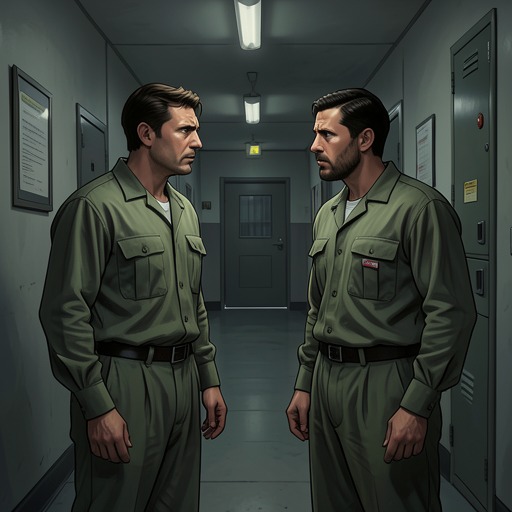
When Hoffmann faces exposure, the prison’s voluntary-isolation unit offers a route away from the danger of his ordinary unit. Ten members of the prison riot squad enter Block G in helmets and shields; six remain to deter further violence, while four escort him to Block C. The isolation unit resembles an ordinary prison unit, with a wardens’ room, television corner, showers, kitchen, and table tennis, but its defining difference is that its residents do not encounter prisoners from other units. It is a controlled change of location that alters whom Hoffmann can meet without releasing him from custody.
The account also shows how prison procedure can become a weapon when decisions are made above the level of routine administration. The director general tells Aspsås chief warden Lennart Oscarsson that a city police detective superintendent must not be allowed to question Hoffmann and that the two must not meet. Oscarsson initially follows the instruction without asking questions, but recognizes its dishonesty as he reflects on the call. The intervention turns the Authority’s command structure into an obstacle to an external police inquiry.
Resistance and significance
The conflict becomes personal when Oscarsson’s friend and colleague Martin Jacobson asks him to look at him and demands to know whether the matter is personal. Oscarsson tells him not to ask questions and invokes the order; Jacobson refuses to carry it out, saying that if Hoffmann is to be moved back, Oscarsson will have to do it himself because the move is wrong. Their exchange distinguishes formal command from ethical judgment within the prison hierarchy. The Authority can transmit an instruction, but the people expected to enact it retain, and contest, some responsibility for its consequences.
Across these episodes, the Swedish Prison and Probation Authority is neither depicted solely as a neutral service nor reduced to a single corrupt actor. It administers custody through placements, work assignments, schedules, records, and transfers; its senior leadership is also drawn into a secret arrangement that compromises ordinary safeguards and obstructs questioning. The contrast between centralized pressure and local refusal gives the institution its narrative force: the same machinery that can conceal Hoffmann inside the prison can also expose the moral choices required to keep that machinery running.