Swedish prisons’ tacit tolerance of drug trafficking
Three SecondsSwedish prisons’ tacit tolerance of drug trafficking is depicted as more than a failure to secure contraband: the book’s closing factual note presents it as a practice the prison system could stop but refrains from stopping. That compromise sustains an in-prison drug economy, with costs that follow some prisoners beyond their sentences.
A Closed System That Does Not Close
The afterword distinguishes the fictional Aspsås Prison from the institutional claims it presents as fact. It states that drugs can still be distributed in high-security prisons, despite the prison system’s capacity to stop the supply. The contrast is pointed: a prison is described as a closed system, yet routes for contraband persist within it. The text characterizes this persistence not simply as an inability to control the institution, but as a choice to refrain from fully exercising that control.
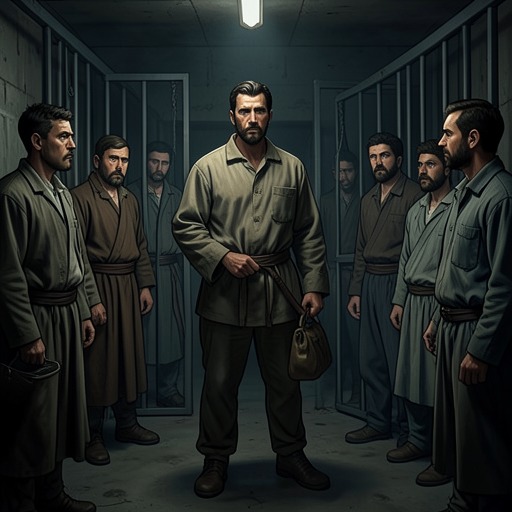
The narrative’s account of entry into Aspsås Prison supplies a contrasting image of formal control. On arrival, Piet Hoffmann is escorted through security, searched, issued prison clothes, and held under tightly limited conditions. Those procedures show the institution regulating movement, access, and daily life. Against that visible control, the afterword’s claim that drugs continue to circulate makes the limits of enforcement appear selective rather than absolute.
Supply and Concealment
The afterword identifies several channels through which amphetamines enter prisons: they can be concealed in bunches of yellow tulips sent to wardens, hidden in the margins of hardback library books, or placed in plastic bags and introduced through toilets. These examples give the policy a material dimension. Drug circulation depends not only on demand among prisoners, but on contraband being carried through objects and spaces that belong to the prison’s ordinary routines.
Within the plot, Hoffmann acts on that established market after entering the prison. He positions himself to be seen by the other prisoners and, with help from Stefan Lygas and Karol Tomasz Penderecki, works to displace competitors. A later scene records that he has taken down the prison’s three main dealers using forty-two grams of manufactured amphetamine at thirty percent strength. The episode depicts an active market whose internal hierarchy can be contested; it does not, by itself, explain the institution’s reasons for allowing supply to continue. Those reasons are stated separately in the afterword.
Institutional Calculation
The afterword connects continued drug availability to the pressures of prison management. It says drugs reduce anxiety, and describes an amphetamine user who has taken a dose withdrawing into a cell with pornography. A prison without drugs, it argues, would bring greater anxiety and chaos, placing new demands on staff. The text further suggests that responding to prisoners without relying on the stabilizing effects of drugs would require better staff skills and competence, at a cost society would not be prepared to pay.
This account frames tolerance as an institutional calculation rather than an endorsement of drug use. Short-term manageability is purchased at the price of maintaining the conditions that make prison supply possible. The book’s formulation is deliberately unsettling: the same institution understood to be capable of stopping the flow is presented as having reasons not to do so.
Consequences Beyond the Sentence
The afterword states that most prison inmates use drugs and that people serving prison sentences can continue using them inside. It links that continued use to what happens after release: a former inmate may return to crime to finance a habit and repay drug-related debts incurred in prison. The consequences therefore extend beyond the prison’s walls and the period of confinement. The tolerated market can reproduce need and obligation that remain in place after a sentence ends.
The policy’s significance lies in this chain of consequences. The prison is not merely a setting in which Hoffmann’s struggle for control unfolds; it is also a closed institution whose rules and omissions shape an illicit economy. By placing the dramatic contest over dealers beside the afterword’s account of institutional incentives and post-release debt, the book connects individual prison survival to a system that manages drug use without eliminating its supply or its wider costs.