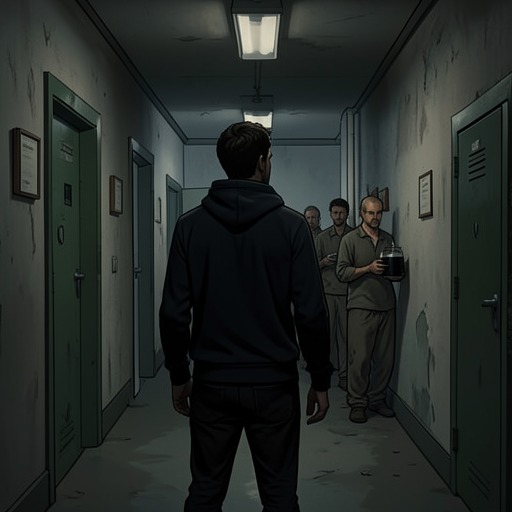
The void
Three SecondsThe void is the absence at the center of Ewert Grens’s office and, increasingly, a presence in its own right. It begins as the sharply bounded space left by a cassette recorder, cassettes, a photograph, and two loudspeakers. In Grens’s recurring dream, that small gap opens into a bottomless hole that draws him toward it; when he wakes, he is breathless on the floor. His efforts to cover the shelf can hide its outline, but cannot restore what the space held or return the time that had gathered around it.
The shelf and the dream
For four nights in succession, Grens dreams of the hole behind his desk. Its straight edges, visible in the dust, become a yawning black depth. The dream turns the shelf’s modest, measurable vacancy into something without a bottom: a place that seems to pull him in regardless of where he is or how hard he tries to escape. Its force is registered physically when he wakes breathless, sweating on the floor behind the corduroy sofa. The recurring image makes the gap more than a detail of office furnishings; it gives the absence a shape and an agency.
Awake at half past four, in the warmth and brightness of the courtyard at Kronoberg Police Headquarters, Grens returns to that same shelf. He wets a blue hand towel in the pantry and wipes the long marks left by the recorder he received for his twenty-fifth birthday, then the shorter outlines of the cassettes and photograph, and finally the squares where the two loudspeakers stood. Their clean-edged impressions are beautiful in their clarity: the vanished objects can be read precisely because they are gone. The shelf records both the arrangement of his former life and the fact that it is no longer there.
The erasure goes further than the objects. Dust had made the gap visible; after Grens wipes the shelf, “And now there wasn't even dust.” The sentence marks a second disappearance. The trace of absence has itself been removed, but cleaning does not make the missing things return. Rather, the stripped surface leaves Grens facing the difference between eliminating evidence of a vacancy and undoing the vacancy itself.
Filling what cannot be restored
Grens responds by moving the cactus from the windowsill and bringing files in from the floor, most of them preliminary investigations long since completed and awaiting filing. He packs the small spaces on the shelves until there is nowhere left for the eye—or the dream—to fall. The practical action becomes an attempted defense: if the shelf is full, perhaps there is no opening to become a pit. Yet the effort addresses the visible outline, not the underlying loss. Files and a plant can occupy space; they cannot reproduce the objects or the thirty-five years associated with them.
The objects’ arrangement matters because Grens measures the removed equipment through its marks, down to the relative lengths of the recorder and cassette outlines and the squares of the speakers. The shelf is therefore not an abstract symbol pasted onto the scene. Its geometry is specific, and its clarity contrasts with the harder-to-name absence attached to it. Grens had spent a large part of his day, over thirty-five years, oriented around a time that no longer existed. The hole condenses that temporal dislocation into a visible gap: a present-day office contains the imprint of a routine and a period that have ended.
When the shelf is seen again, the filling has not settled the matter. Grens lies on the corduroy sofa and looks at the files and a lonely cactus that conceal “a whole life.” The wording makes concealment distinct from recovery. The shelf can be made to look occupied, but the life it hides remains the absent center around which the room is understood. The image also reverses the morning’s careful effort: what was meant to prevent a fall now reads as a covering laid over what cannot be faced directly.
Absence beyond the office
The void’s reach becomes apparent in Grens’s hesitation near Haga and the large cemetery. Earlier, he has driven too fast out of the city; passing the cemetery, he slows, considers turning off, and continues. On the way back, he imagines driving slowly past people carrying flowers and watering cans. Later, a park attendant explains that the new graves lie at the far end, toward Haga, and offers to guide him. Grens thanks him but declines, saying he will go another day. The sequence brings the shelf’s private vacancy into proximity with burial and mourning without resolving his postponement into a completed visit.
The parallel is one of approach and retreat. At the office, Grens goes directly to the gap, wipes its edges, and tries to fill the space. At the cemetery, he reaches the grounds but stays in the car; even when offered help finding the new graves, he postpones going to them. The book does not make the two absences identical, but places them within the same unsettled pattern: an empty place can be carefully marked, approached, or covered, while the act of confronting what it signifies remains unfinished.
The altered room and its silence
The office’s changing appearance gives the void a social dimension. When Lars Ågestam enters, the room seems to have taken on new dimensions because what had been at its center has disappeared. He notices the files, the dead potted plant, and a patch of wall that seems to have been something else. His questions about the rearrangement expose what Grens’s filling operation cannot disguise: someone entering the room can still sense that its order has changed, even without knowing what the missing arrangement meant to Grens.
Sound supplies another measure of that change. Grens explains that he was heading toward the music he normally hears, associated with Siw Malmkvist, until he realized he had walked past it and that it was silent. The habitual sound, like the recorder and speakers, belongs to a pattern that had once seemed constant. Ågestam, by contrast, listens to music that has always been there and that he detests having to hear. Their different responses preserve the ambiguity of the scene: what is familiar or oppressive to one person may be registered by another as a room whose center has vanished.
The void thus recurs through connected forms rather than resolving into a single explanation: a dream-hole, an erased set of dust marks, a shelf packed with substitute objects, an unvisited stretch of new graves, and a silence that breaks a familiar routine. Grens’s refusal to discuss what he has done leaves the absence unnamed, while the physical details make it impossible to overlook. The gap can be covered, but the altered room—and the life concealed beneath its new arrangement—continues to disclose it.