What you're frightened of has already happened
Three Seconds“What you're frightened of has already happened” is a recurring expression that reframes fear as recognition of an event already past. It first appears amid a cemetery scene, then returns in a first-person variation beside two denials of killing, shifting the phrase from a general-sounding statement toward personal reckoning.
First Appearance
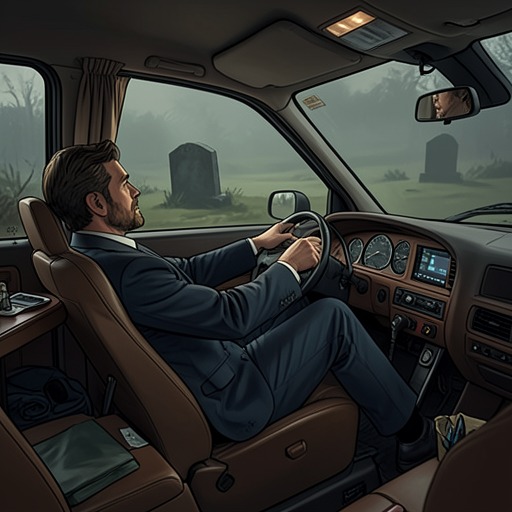
The expression occurs as the man looks at trees, graves, and a memorial garden, struggling to focus on the flickering in a woman’s eyes or the spasms in her legs. The sentence interrupts that effort to attend to the present: the fear is not merely about what might happen, but about something that has already taken place. He then looks around in a sudden rush and cuts across the graves in Section I5B, where the understated gravestones sharpen the passage’s attention to death and its aftermath.
Repetition and Variation
The phrase returns as “What I am frightened of has already happened.” The change from “you're” to “I am” shifts its grammatical position: what first sounds like a general address becomes an explicit statement of personal fear. Just before the recurrence, he does not cry, having already done so, and smiles; the statement follows the words “I didn't kill him” and “I didn't kill you.” The sequence connects fear with death and responsibility without explaining the full circumstances behind either denial.
Narrative Function
The repeated wording makes the expression work as a recognition rather than a prediction. Its tense insists that the feared event belongs to the past, even as the speaker remains caught in its consequences. The shift into the first person gives the refrain a more intimate force, while the graveyard setting and the adjacent denials keep its meaning tied to loss and unresolved responsibility.