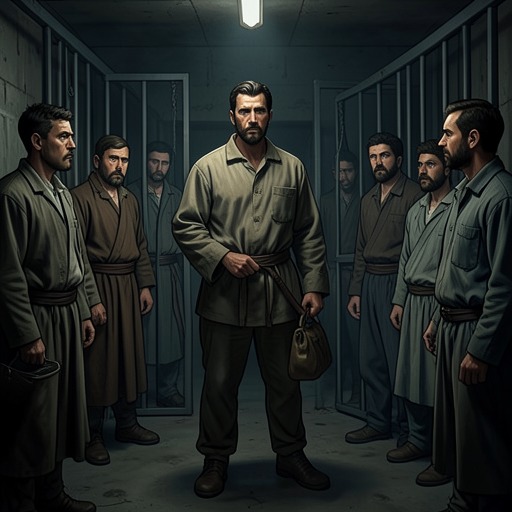
Wojtek enters the Swedish prison drug market
Three SecondsWojtek enters the Swedish prison drug market through a plan that treats incarceration not as a barrier to business but as a captive economy to be taken over. In Warsaw, senior figures approve the expansion and appoint Piet Hoffmann to lead its prison-side operation. The scheme is designed to establish Wojtek as the dealer inside Sweden’s prisons, then extend its control beyond the walls by turning drug debts into leverage over people released from custody. Hoffmann’s assignment places him at the center of a criminal takeover and, simultaneously, inside the undercover work intended to expose it.
A closed market becomes a target
The decision follows Wojtek’s success in neighbouring Nordic countries. At a meeting in Warsaw, the Roof gives the deputy CEO a confirming nod, and the deputy CEO announces that the organization intends to repeat that expansion in Sweden. The market is described as closed: the prisons are not simply another territory, but a bounded system in which access, supply, and influence can be controlled. Hoffmann understands that the meeting has brought him to the point toward which he has been working for years.
The financial case rests on the difference between prices inside and outside prison. Amphetamine and heroin are each said to cost roughly three times as much behind bars as on the street. The deputy CEO calculates that four thousand imprisoned heavy users could generate between eight and nine million kronor in a day’s business. That figure is a projection, conditional on customers paying, rather than a record of money already earned. Its importance lies in the scale it gives the proposed takeover: the prison population is framed as a market large enough to justify a substantial initial investment and a prolonged campaign.
Wojtek is prepared to wait for returns. Its deputy CEO describes the expansion as an unprecedented operation requiring major funding before revenue begins, while the organization’s financial backing gives it the capacity to invest for the long term. The Swedish prisons are therefore approached as a connected commercial opportunity, not as isolated institutions. The plan also assumes that successful control inside can be converted into influence over criminal activity outside.
Two fronts and a staged arrest
The operation divides responsibility between an outside leader and Hoffmann inside. The deputy CEO says that he will direct the external side, while Hoffmann will operate from one of three maximum-security prisons: Kumla, Hall, or Aspsås. Wojtek already has members in those institutions—four at Aspsås and three each at Hall and Kumla—who are placed in different sections but can communicate. Hoffmann is instructed to be arrested within a week for an offence serious enough to secure a sentence in one of the target prisons. He sets a limit of two months for his own involvement, while the deputy CEO promises him the time he needs.
Hoffmann outlines the arrest as a means of reaching the required institution quickly. He plans to be caught with three kilos of amphetamine, plead guilty, and present himself as acting alone. His expectation is that the immediate charges and an accepted sentence will avoid a wait for the judgment to take effect and place him behind bars within about two weeks. He draws on his earlier imprisonment at Österåker, remembering the routines and humiliation of custody, but treats that experience as preparation for a new assignment rather than as a reason to refuse it.
The prison takeover is planned in two stages. First, Hoffmann is to remove the existing competition. Then Wojtek will supply the market through its own channels, initially using the remaining seventy-eight kilos approved for the operation to undercut established prices. The intended low price is fifty kronor per gram of amphetamine, compared with three hundred kronor inside prison. Once Wojtek has displaced its rivals and secured control, the plan is to raise prices sharply. Hoffmann asks for three days without contact so he can deal with competitors and take in enough product. Beginning on the fourth day, he wants one kilo of amphetamine delivered each week through Wojtek’s channels, with no stockpiling or rival supply allowed to persist.
Hoffmann enters the prison system
Hoffmann has not previously been inside Aspsås Prison. Before his arrival, however, he has mapped its buildings from the church tower and studied the window bars; with Erik Wilson’s help, he has also learned about prisoners and staff in Block G. On entering the prison, he is escorted through registration and security, issued prison clothing, and placed in a waiting room. His advance preparation gives him knowledge of the institution, but not immunity from its routines or control.
Ten days pass with Hoffmann spending twenty-three hours a day in a five-square-metre cell, without visitors, newspapers, television, or radio. The period of isolation is part of the institution’s power over him: time and contact are restricted before he joins the unit where the operation must be carried out. When he is shown around, he learns the practical rules of his new home, including where to go and when the unit locks in. Prison life is both the setting for Wojtek’s business and a system of enforced schedules, restricted movement, and managed access that Hoffmann must learn to navigate.
Before the other prisoners return, he takes a conspicuous seat in the television corner. He has studied photographs and backgrounds of the fifteen men in his unit, and chooses a position from which he can see them arrive while ensuring that they see him. He sits in another prisoner’s preferred chair and begins playing with marked cards without asking permission. The gestures establish a deliberately confident presence before anyone has tested his status. He is looking in particular for Stefan Lygas and Karol Tomasz Penderecki, two of Wojtek’s four long-sentenced members at Aspsås. They are intended to help him displace the existing dealers; if his identity as Paula is exposed, they may also become his executioners.
The other Wojtek members have prepared the ground by discussing Hoffmann’s arrival and arranging access to copies of his criminal records, intelligence records, prison records, and latest judgment through Stefan’s lawyer. At supper, older prisoners challenge him to show his papers. Stefan and Karol Tomasz initially move to intervene, but Hoffmann waves them back and allows the questioning to proceed. He answers the challenge by objecting to how closely the men sit, turning the encounter into an early contest over respect and position rather than allowing his allies to settle it for him.
Taking control—and the danger of exposure
Hoffmann’s first advance is described in concrete terms: he has felled the three main dealers in Aspsås Prison using forty-two grams of manufactured amphetamine at thirty-percent strength. The reports needed for the next stage have reached Warsaw, where the deputy CEO and others recognize that the plan can proceed. The detail marks a transition from projected strategy to an operation already changing the prison’s drug hierarchy. Hoffmann’s place in the unit, the information gathered by Wojtek’s members, and the initial defeat of its rivals together provide a foothold for the larger campaign.
That foothold remains precarious. When Hoffmann fears that his identity may be exposed, he uses the prison system’s voluntary-isolation procedure as protection. A riot squad escorts him from Block G to the isolation unit in Block C, where he can move within a separate unit without encountering prisoners from the other sections. Isolation offers temporary distance from immediate threats, but it also demonstrates how little freedom an imprisoned operative has: escape from danger depends on being moved deeper into the institution, not out of it.
The threat is not only hypothetical. Hoffmann comes to understand that one of the four people meant to protect him has betrayed him. In the isolation unit, a voice calls for Paula, while staff do not understand the significance of the name. The moment turns the operation’s own network into a source of danger: the criminal identity that gave Hoffmann access can also make him a target, and the support arranged to sustain his position cannot be trusted without reservation.
The concealed cost of the expansion
The plot’s larger institutional context complicates any simple division between a criminal takeover and a police response. The operation is tied to Hoffmann’s work as a covert human intelligence source, whose information is intended to uncover serious crime. Yet the book’s later review of secret intelligence reports shows that informant work could also generate or conceal other crimes. Ewert Grens finds 302 reports from the preceding year describing cases in which the pursuit of one crime had given rise to another, while information already held within the police had not reached ordinary investigations.
That division between secret reporting and official casework has consequences. Grens tells prosecutor Lars Ågestam that he was involved in twenty-three cases that failed after being closed without the information contained in the secret reports. The files expose a system in which the hidden account of an informant’s activity could differ sharply from the version available to investigators and prosecutors. The final account of police practice makes the conflict explicit: criminal informants are used and their cooperation denied or concealed, while other crimes may be marginalized and proceedings conducted without the correct information.
Wojtek’s entry into the prison market is therefore significant beyond the projected profits or Hoffmann’s initial success against rival dealers. The plan turns prison dependence into a commercial resource and envisions extending that power beyond release by leaving indebted prisoners with a choice between working for Wojtek and facing violence. At the same time, the undercover operation intended to expose such expansion exists within a police system that can tolerate, conceal, or fail to disclose crimes in pursuit of intelligence. The closed market is not sealed off from the state: the struggle over who controls it also reveals how criminal power and compromised official practice can become entangled.