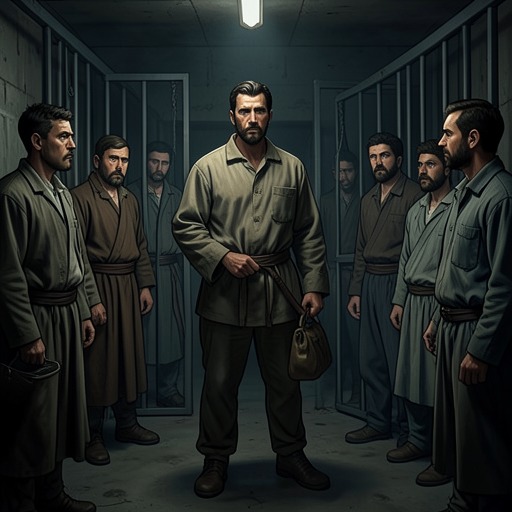
Zbigniew Boruc
Three SecondsZbigniew Boruc is the deputy CEO of Wojtek International and a senior figure in the organization Piet Hoffmann has infiltrated. A former military officer with a background in the secret police, Boruc represents the company’s connection to an older security establishment beneath its businessman’s appearance. In his encounters with Hoffmann, he helps turn the undercover operation’s criminal stakes into a direct test of whether Hoffmann can maintain his standing inside Wojtek.
Identity and Background
Boruc enters the story as one of two senior Wojtek figures summoned to meet Hoffmann in Warsaw; the other is Grzegorz Krzynówek, the organization’s Roof. Hoffmann has known Wojtek’s contact, Henryk Bak, through monthly visits to the company’s head office over the preceding three years, but has met Boruc only once before. The difference matters: Bak is a familiar intermediary who has helped Hoffmann rise through the organization, while Boruc belongs to its uppermost circle and remains comparatively unknown to him.
The novel associates Boruc with Wojtek’s military and intelligence origins. He is described as a former secret-police officer and an army major, carrying himself with the straight back and measured manner of an intelligence officer. The company presents itself as a business, but its structure and history connect it to organizations established by military and police figures after the political upheavals in Eastern Europe. Boruc’s position as deputy CEO therefore places him within a system where formal commercial authority and an older security culture coexist.
The Warsaw Meeting
Hoffmann arrives at Warsaw Chopin Airport with a small overnight bag, calls Henryk to confirm that his plane has landed, and learns that Boruc and Krzynówek will also attend the meeting. The unexpected presence of both senior men unsettles him: he cannot tell why the organization has assembled them, and feels apprehension as the taxi carries him through Warsaw toward Mokotów. The meeting is not simply another visit to the head office. Its participants and setting signal that Hoffmann’s position is being examined at a higher level.
In the meeting room, Boruc and Krzynówek wait at the far end of a long table. Hoffmann accepts their deliberately firm handshakes and sits in the chair already set out for him, with a bottle of water before him. He keeps his gaze steady, understanding that retreating from their scrutiny would itself mark a failure. Boruc studies him before asking about the delivery. Hoffmann answers yes. The exchange is brief, but it places him under the assessment of Wojtek’s leadership: the delivery is treated as a matter requiring confirmation from the person they are evaluating.
Hoffmann’s answer does not remove the danger of the encounter, but he later recognizes that meeting the Roof and leaving alive means he has advanced further into the organization. The implication is limited but decisive for his undercover work: he has gained access to a level of Wojtek where the operation he risks his life to pursue may approach a breakthrough. Boruc is part of that threshold, not as a confidant but as one of the senior men whose attention Hoffmann must withstand.
Conduct and Further Contact
After Krzynówek leaves, Boruc remains with Hoffmann. His manner changes: he relaxes, opens a bottle of Zubrówka, mixes the vodka with apple juice, and pours drinks into expensive hand-blown tumblers. Hoffmann recognizes the drinking as a gesture associated with intimacy and confidentiality between a boss and a subordinate. He responds politely to the custom, including the small piece of grass in the bottle, while Boruc handles the fine glasses with a degree of uncertainty. The scene places ceremony beside awkwardness: Boruc can command a senior meeting, yet the trappings of his business persona do not seem entirely natural to him.
Boruc appears again in Stockholm thirty-six hours after the Warsaw encounter, meeting Hoffmann and Henryk at a hotel. The visit is described as the head office’s way of showing that it is serious. This second meeting extends the first beyond a single test in Poland: Wojtek’s senior leadership is making its attention visible in Hoffmann’s new surroundings. The evidence does not specify what Boruc says or decides during the hotel encounter, but his presence alongside Henryk confirms that he remains a representative of the organization’s highest level.
Narrative Significance
Boruc’s role is defined by a contrast between surface and origin. Wojtek’s leaders call themselves businessmen, and Boruc participates in the formal gestures of corporate authority; behind that presentation stands an organization shaped by military and police personnel and joined to criminal interests. His former intelligence background makes that contrast especially clear without making him interchangeable with Krzynówek, who occupies the distinct position of Roof.
The novel’s closing account describes a broader police practice of using criminals as covert intelligence sources while concealing that cooperation, and of manipulating criminal records to create credible undercover identities. It does not identify Boruc as a participant in those police practices. His significance instead lies on the other side of Hoffmann’s infiltration: he is one of the senior Wojtek figures whose scrutiny and confidence the operation must negotiate. The meetings in Warsaw and Stockholm show how undercover access is measured through controlled contact with leadership, where even a brief question about a delivery can carry the weight of organizational trust.