
Speech, Silence, and Misunderstanding
Thus Spoke ZarathustraThis flow follows the book’s shifting trust in language as a bridge between people and its repeated recognition that words can conceal, distort, or exhaust meaning.
increasing Bearing strength in each event
 decreasing
Bearing strength in each eventdecreasingA Prophet Speaks to the Crowd
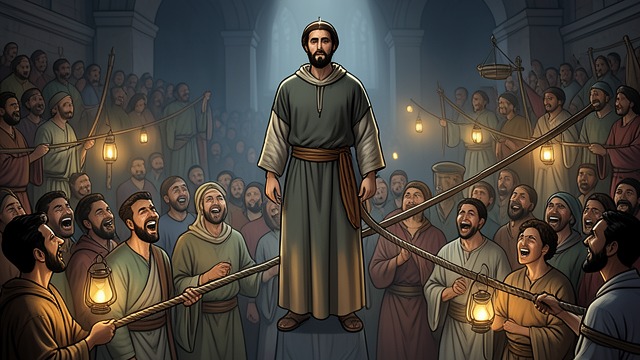
A Prophet Speaks to the Crowd
Words meet spectacle
Zarathustra tries to speak about the Superman to an audience waiting for a tightrope performance. The crowd hears enough to respond but not enough to understand his purpose.
Communication fails publicly
Their laughter reveals that speech does not guarantee shared meaning. Zarathustra must reconsider not only what he says but whom he addresses.
Writing in Blood

Writing in Blood
Experience behind words
Zarathustra praises writing that carries the pressure of lived experience and rejects the idle reader. Aphorisms should be difficult heights for readers willing to climb.
Style as selection
Language is not designed to make every idea equally accessible. The form of speech tests whether a listener has the strength and attention to receive it.
Music as a Bridge

Music as a Bridge
Words and sounds connect worlds
Zarathustra tells his animals that language and music are beautiful forms of appearance. They let separated inner worlds communicate, even though the connection remains incomplete.
Forgetting becomes relief
Music allows people to forget the distance between souls for a moment. This makes art neither a final truth nor a worthless illusion, but a meaningful bridge.
The Poet’s Unreliable Truth
The Poet’s Unreliable Truth
The speaker indicts himself
Zarathustra admits that poets lie too much, then acknowledges that he too is a poet. Their imaginative power can invent gods and distant worlds while disguising uncertainty.
Suspicion turns inward
The critique prevents Zarathustra from claiming a simple position outside the problem. His own images must be read as attempts to approach experience, not transparent proofs.
The Riddle of Midnight
The Riddle of Midnight
A teaching withheld
Zarathustra asks the Higher Men to attend to a song that they may not yet understand. Midnight gives voice to what daytime speech cannot easily contain.
Song carries the unsaid
The repeated refrain about joy and eternity lets the teaching move through rhythm and emotional force. The book’s final language remains both revelation and riddle.
At the marketplace in Part One
Early among the discourses in Part One
Part Three, after Zarathustra’s illness
Part Two, during Of Poets
Part Four, during the Intoxicated Song
