
Zarathustra and His Eagle and Serpent
Thus Spoke ZarathustraThis flow traces the animals’ role as witnesses, companions, interpreters, and limits on Zarathustra’s solitary self-understanding.
increasing Bearing strength in each event
 decreasing
Bearing strength in each eventdecreasingThe Animals Share the Mountain
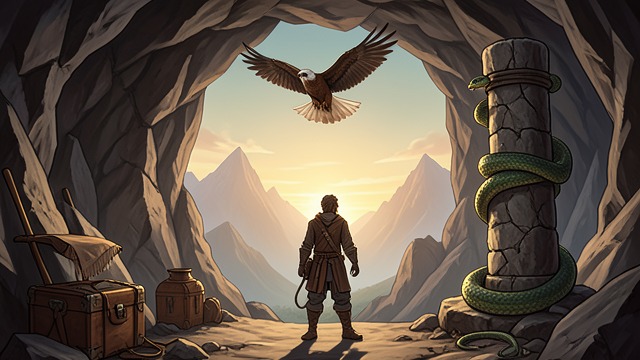
The Animals Share the Mountain
Companionship in isolation
Zarathustra’s Eagle and Serpent share his life in the mountain cave. The eagle signifies pride and height, while the serpent suggests wisdom and closeness to the earth.
An audience before humanity
They wait with Zarathustra for the morning sun and receive his surplus. Their presence makes solitude relational rather than empty.
The Saint’s Warning Remembered

The Saint’s Warning Remembered
A contrast with human devotion
The saint lives among animals and praises God, unaware that Zarathustra believes God is dead. Their encounter frames the animals as alternatives to a human world still ruled by old faith.
Animals as guides
Zarathustra later asks his own animals to lead him through dangerous human paths. Their companionship offers orientation where people have failed to understand him.
The Convalescent’s Audience
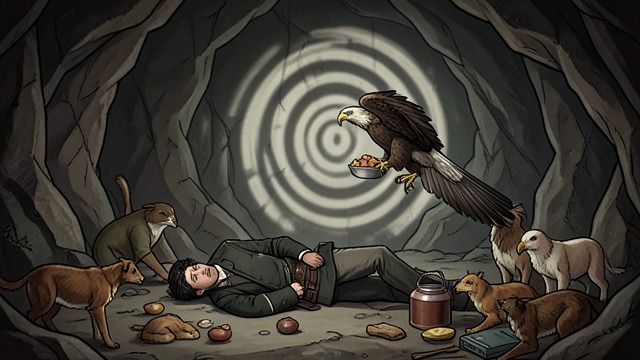
The Convalescent’s Audience
Care without speech
The eagle brings food while the animals remain beside Zarathustra during his collapse. Their presence provides a patient form of care when he cannot speak or act.
Interpretation offered
When he wakes, the animals recite the circular pattern of existence and identify him as its teacher. Their certainty comforts him but also risks reducing his ordeal to a formula.
The Animals’ Hurdy-Gurdy
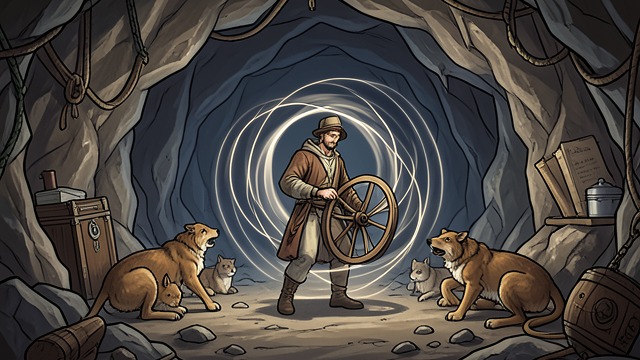
The Animals’ Hurdy-Gurdy
A teaching made simple
The animals turn recurrence into a song of everything departing and returning. Zarathustra calls them buffoons because they have made a painful insight sound easy.
Love mixed with resistance
He values their company but objects to their treatment of his suffering as entertainment. Their relationship allows affection and criticism to coexist.
The Sign of Recognition
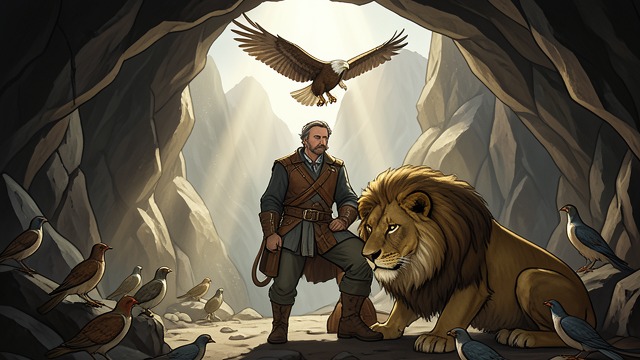
The Sign of Recognition
The eagle’s cry answered
The eagle cries above Zarathustra as birds gather around him and a lion presses its head to his knee. The animals mark an arrival he has long awaited.
A witness to departure
Zarathustra weeps and names his children as near. The animals share the moment but do not prevent him from leaving the cave for his work.
Before the opening descent
After Zarathustra leaves the forest saint
After seven days of illness in Part Three
As Zarathustra recovers from the recurrence crisis
At the book’s final dawn
