
The Tightrope Walker’s Passage
Thus Spoke ZarathustraThis flow reframes the tightrope walker’s performance and fatal fall as a miniature drama of human existence between animal life and the Superman.
increasing Bearing strength in each event
 decreasing
Bearing strength in each eventdecreasingThe Crowd Gathers
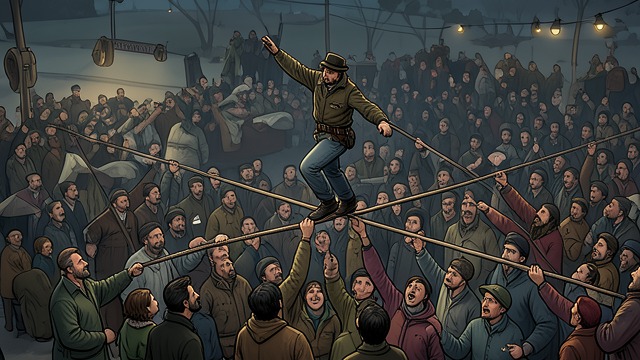
The Crowd Gathers
Spectacle draws an audience
The people assemble to watch a tightrope walker, making performance the marketplace’s expected form of meaning. Zarathustra enters a setting already organized around entertainment.
A speech misses its mark
His announcement of the Superman competes with the crowd’s excitement for the show. Their impatience exposes the divide between a transformative teaching and popular curiosity.
The Crossing Begins
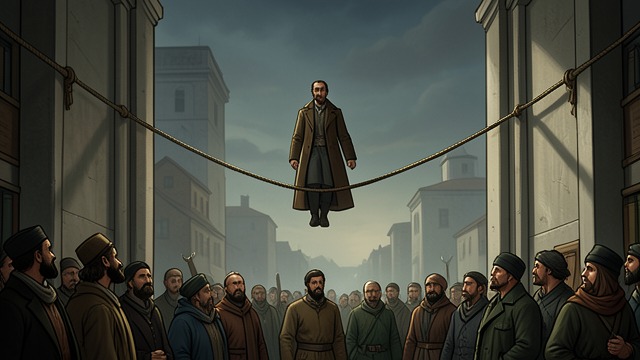
The Crossing Begins
A literal image of danger
The tightrope walker steps onto a rope stretched above the square. His precarious passage gives physical form to Zarathustra’s image of humanity as a bridge over an abyss.
The audience looks on
The crowd watches the performance rather than absorbing the speech. The tightrope becomes a public spectacle of danger, not yet a shared understanding of human possibility.
The Buffoon Pursues
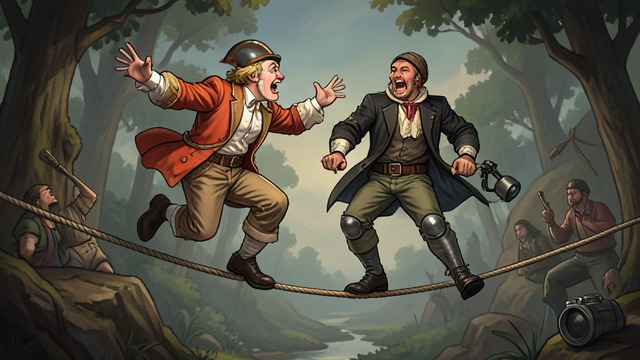
The Buffoon Pursues
A second performer appears
A brightly dressed buffoon follows the walker, taunting him and urging him to hurry. The chase converts a controlled act of balance into a contest shaped by ridicule and fear.
The crossing is destabilized
The walker confronts a danger he did not choose. The scene shows how easily a precarious human passage can be interrupted by forces that treat risk as amusement.
The Fatal Fall
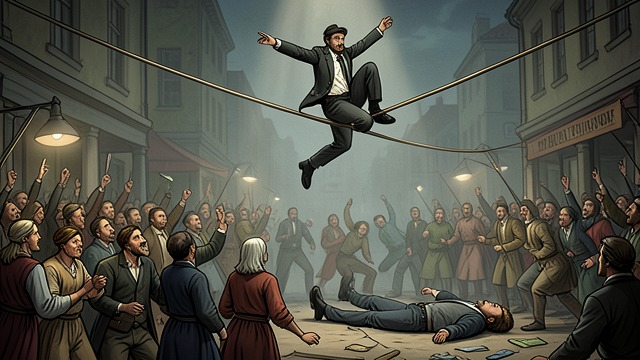
The Fatal Fall
The rope gives way
The tightrope walker loses his balance and plunges toward the square. The crowd scatters, and the public show becomes an actual death.
Zarathustra stays beside him
Unlike the fleeing spectators, Zarathustra kneels by the injured man and offers a final, unsentimental comfort. His response treats the walker’s dangerous vocation as something worthy of respect.
The Unburied Lesson
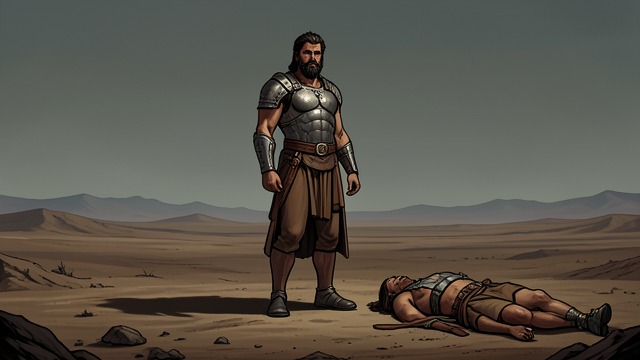
The Unburied Lesson
A corpse instead of converts
Zarathustra reflects that he has caught no human companion, only a corpse. The failure deepens his sense that human existence can appear uncanny and without meaning.
A turn in the mission
The episode prompts him to seek living companions rather than address the crowd. The fall becomes a threshold in the book’s movement from public preaching to selective teaching.
Early in Part One, at the town marketplace
Moments after Zarathustra’s opening address
At the tightrope’s midpoint
Immediately after the buffoon’s leap
That evening, after the crowd disperses
