Creation of New Values
Thus Spoke ZarathustraCreation of New Values is the act of breaking with inherited moral authority and bringing new values into being. Its decisive significance lies in the conflict it exposes: those who call themselves good and just cannot simply welcome a creator’s independent virtue, because creation challenges the standards by which they judge. Breaking the Law-tables opens a future, but not a safe one; the established assurances fall away, and the creator must accept uncertainty while remaining faithful to the work and will that are distinctly their own.
Definition and Stakes
The passage defines creation negatively as well as positively. It requires more than choosing differently within an accepted moral code: the creator devises a virtue of their own and breaks the Law-tables that preserve old values. The good and just do not understand this departure, because, as the passage frames it, their good conscience imprisons their spirit. Their moral certainty is not neutral ground from which they can assess the new; it is itself bound to the inherited standards the creator contests.
That conflict gives new value-creation its danger. The good are said to have no choice but to become like Pharisees: guardians of a righteousness that condemns the person who makes a virtue independently. Their hostility is directed most strongly at the creator, whom they name a law-breaker. The opposition is therefore not merely between two competing opinions about good conduct. It is between preserving an existing moral order and allowing someone to establish values that order cannot authorize in advance.
The Creator and the Old Values
The passage connects this hostility to a claim about what the good can and cannot do. They cannot create; instead, they become the beginning of an ending. In that formulation, their danger is not simply that they reject one innovator. By condemning the writer of new values, they sacrifice the human future to the preservation of their own moral world. The creator’s conflict with the good thus takes on a larger consequence: what is at stake is whether the future remains open to values not yet recognized by the present.
The text makes the creator’s exposure especially stark by describing the good as unable to understand him and as turning against him. The point is not that every inherited standard is individually examined and refuted. Rather, the passage dramatizes a structural resistance: a moral order founded on established goodness cannot easily make room for a person whose virtue originates elsewhere. Calling the creator a transgressor helps that order defend itself, while obscuring the possibility that its own values may obstruct what has not yet been created.
The Risk of Breaking the Tablets
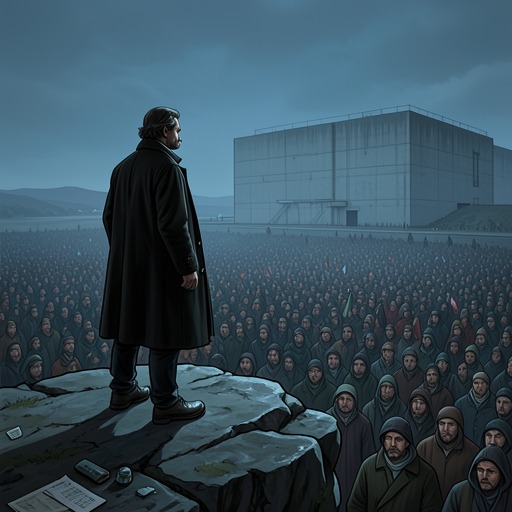
When Zarathustra calls for the shattering of the good’s Law-tables, he presents the act as an embarkation: mankind is sent onto the high seas. The image establishes both movement and exposure. Breaking inherited standards does not immediately supply a new shore or a replacement set of certainties. Instead, it brings terror, sickness, disgust, and disorientation. The passage treats these responses as consequences of the departure, not proof that the old assurances were sound.
The contrast is between the high seas and the false shores and securities taught by the good. People have been born and kept within what the speech calls the lies of goodness; their understanding has been distorted down to its foundations. Once those assurances are challenged, the resulting unease reveals how much security depended on the inherited account of value. Creation therefore begins in a vulnerable interval: the old standards have lost their unquestioned authority, while the new values have not yet become a settled shelter. The passage neither disguises this instability nor offers a quick resolution to it.
The Higher Men and the Work of Creation
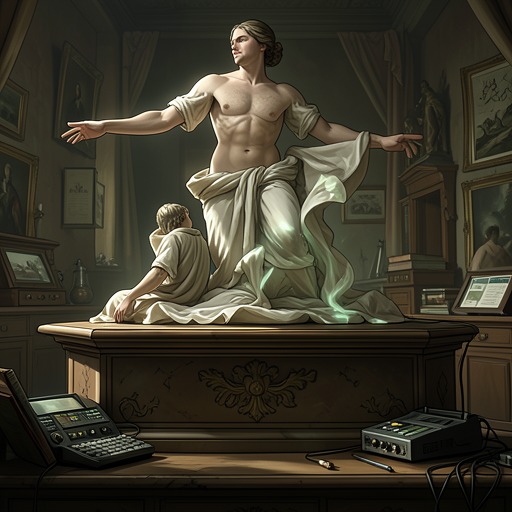
The address to creators among the Higher Men gives the idea a more personal and practical shape. Each creator, the passage says, is occupied with their own child: the work that has not yet appeared and must be protected and nourished. The image explains why creation cannot be reduced to service performed for another person. A creator may act for a neighbour in ordinary terms, but that motive does not describe the source or purpose of the creative work.
The passage accordingly urges these creators to unlearn the language of doing something for someone else, for the sake of someone else, or because another person requires it. Such motives are associated with petty reciprocity, the expectation that one good turn answers another. The creator’s task follows a different measure. The work and will are identified as the creator’s neighbour: the object of sustained care is the still-unseen result toward which the creator’s love and virtue are directed.
This account presents self-concern not as casual indulgence but as the discipline that protects creation. The creator’s prudence consists in tending the work before it can be seen or judged. Read beside the earlier attack on the good and just, the advice clarifies why independent value-creation remains vulnerable: the creator must resist both inherited judgments and the demand to justify the work through conventional reciprocity. The passage leaves that work exposed to uncertainty, but makes its fidelity to its own emerging purpose central to the possibility of a human future beyond the old Law-tables.