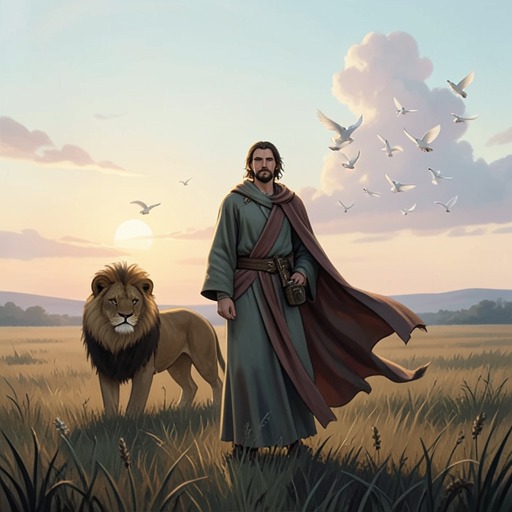
Death of God
Thus Spoke ZarathustraThe Death of God names a historical and spiritual rupture: the collapse of belief in the supreme authority that had organized human meaning, morality, and orientation. The event is presented not as a divine departure witnessed from outside, but as a consequence for which humanity bears responsibility. Its force lies in the interval it opens: old guarantees have failed, yet the new values and form of humanity that might answer their loss have not arrived.
The Public Announcement and Its Meaning
In the marketplace parable, a madman enters among people who do not believe in God, carrying a lantern in broad daylight and asking where God is. Their laughter treats his search as absurd. He answers by reversing the accusation: God has not merely vanished; humanity has killed him. The announcement turns disbelief from a private opinion into a world-historical deed with consequences that its participants have not understood.
The madman describes the loss through images of severed orientation. With the old center gone, the earth is no longer held in place by its former relation to a sun; familiar directions and measures cease to feel secure. The questions he raises about movement, above and below, and the approach of darkness register the scale of the change rather than propose a new cosmology. The lantern, needed at an hour when it should not be, makes the contradiction concrete: the inherited light has failed, but no replacement has yet been established.
The event is therefore more than the weakening of religious observance. God had been the highest and holiest authority available to the culture, and the madman insists that the act of destroying that authority exceeds the understanding of those responsible for it. His language of murder assigns responsibility collectively, to the unbelievers and to the wider humanity whose historical actions have made the old faith untenable. The participants in the change have not yet shown themselves equal to its consequences. The possibility that people must become godlike to appear worthy of the deed is posed as a demand and a problem, not as an accomplished result.
The Unfinished Aftermath
The marketplace audience does not initially grasp the announcement. Its laughter and the madman’s grave response establish a distance between the fact of unbelief and comprehension of what unbelief entails. People may have stopped believing without recognizing that the frameworks once supported by belief have lost their foundation as well. The scene makes that delay central: the event has occurred, but awareness of its full meaning arrives unevenly.
Zarathustra encounters a parallel form of that delay in the forest. An old saint, devoted to God and living apart from the towns, has not heard that God is dead. Zarathustra recognizes the gap only after their meeting, reflecting that the old man has remained untouched by news known elsewhere. The encounter places the announcement against a life still organized by devotion: the death of God may be decisive for the emerging world and yet unknown to someone who continues to serve the old one.
Later, The Abdicated Pope gives the loss a more intimate and complicated history. He says that he served God until the last hour, but that retirement has left him without a master rather than free or cheerful; he lives chiefly in memories of religious service. Zarathustra asks whether God died from pity for humanity, unable to endure the sight of human suffering. The Abdicated Pope does not confirm the account with an answer. Zarathustra offers a possible image of God growing old, weary, and overwhelmed by pity, then cautions that the account could have happened otherwise: gods, he says, die in many ways. The conversation preserves uncertainty about the manner of the death even as it treats the loss itself as final.
From Religious Loss to the Earth
The announcement changes what counts as the gravest offense. Zarathustra teaches that when God was alive, blasphemy against God ranked as the supreme transgression; after God’s death, contempt for the earth takes that place. His challenge is directed against hopes that devalue earthly life in favor of a superterrestrial destination. The inherited opposition between soul and body, in which the body was treated as something to diminish or escape, is presented as part of the old order that the announcement calls into question.
This teaching does not simply replace religious faith with confidence in a new cosmic system. The surrounding account warns against treating the universe as a living organism or a machine arranged to fulfill a purpose. The loss of God therefore supplies no automatic substitute that explains the world or guarantees its direction. What follows is exposed to chance and uncertainty; meaning must be made rather than received intact from a transcendent authority. The Death of God thus intensifies the need for earthly value-creation while denying that the need has already been met.
The Higher Men and the Future
The consequences become explicit when Zarathustra addresses The Higher Men. In The Market-place, he warns, the crowd answers claims of distinction with the insistence that everyone is equal. Its appeal to equality before God depends on an authority that, in Zarathustra’s account, has already died. He therefore urges The Higher Men to leave the marketplace rather than mistake popular assent for a new source of value.
For these figures, God’s death has a double charge. The old God had been their greatest danger, and only after that authority has fallen can they, in Zarathustra’s formulation, be resurrected and assume a higher standing. Yet their emergence is not the same as humanity’s completion. Zarathustra distinguishes the question of preserving humanity from the more difficult question of overcoming it. The death of the old authority removes an obstacle, but the future remains a task.
At the Great Noon, this task is voiced as a collective desire that the Superman shall live now that all gods are dead. The formula links the event to an aspiration beyond existing humanity, not to a promise that the Superman has already appeared. The Death of God creates the historical opening for that aspiration and makes its fulfillment humanity’s responsibility. Its decisive significance lies in this unresolved passage: the old source of meaning is gone, the earth must no longer be despised in its name, and new values remain to be created.